
Miami-Dade and Broward counties operate under the most stringent glazing requirements in the United States. If you're a GC bringing a glazing sub into the Miami market without HVHZ-specific experience, you're taking on significant risk.
Why Miami Is the Hardest Glazing Market in the US
Hurricane Andrew made landfall in South Florida on August 24, 1992, with sustained winds exceeding 165 mph. The storm's aftermath revealed that a significant portion of the building damage resulted not from the wind itself, but from wind-borne debris penetrating building envelopes through failed glazing. Once the building envelope was breached, internal pressure spike loads caused catastrophic structural failures.
The response was the establishment of the High-Velocity Hurricane Zone (HVHZ) designation for Miami-Dade and Broward counties. The HVHZ building code requirements - now incorporated into the Florida Building Code - are substantially more stringent than the rest of the state, particularly for exterior glazing:
- All exterior glazing must be impact-rated - storm shutters are not an acceptable substitute for most commercial applications
- Impact ratings must be documented with Miami-Dade Notices of Acceptance (NOA), not just Florida Product Approvals
- NOA testing requires both large-missile impact testing (ASTM E1886/E1996) and cyclic pressure testing at higher design pressure levels than the rest of the state
- The installation must follow the NOA exactly - any deviation from tested configurations voids the acceptance
- Miami-Dade's Product Control inspection process is more rigorous than standard Florida inspections
HVHZ-Specific Requirements for Commercial Projects
For commercial buildings in HVHZ, the glazing requirements go beyond what's required elsewhere in Florida:
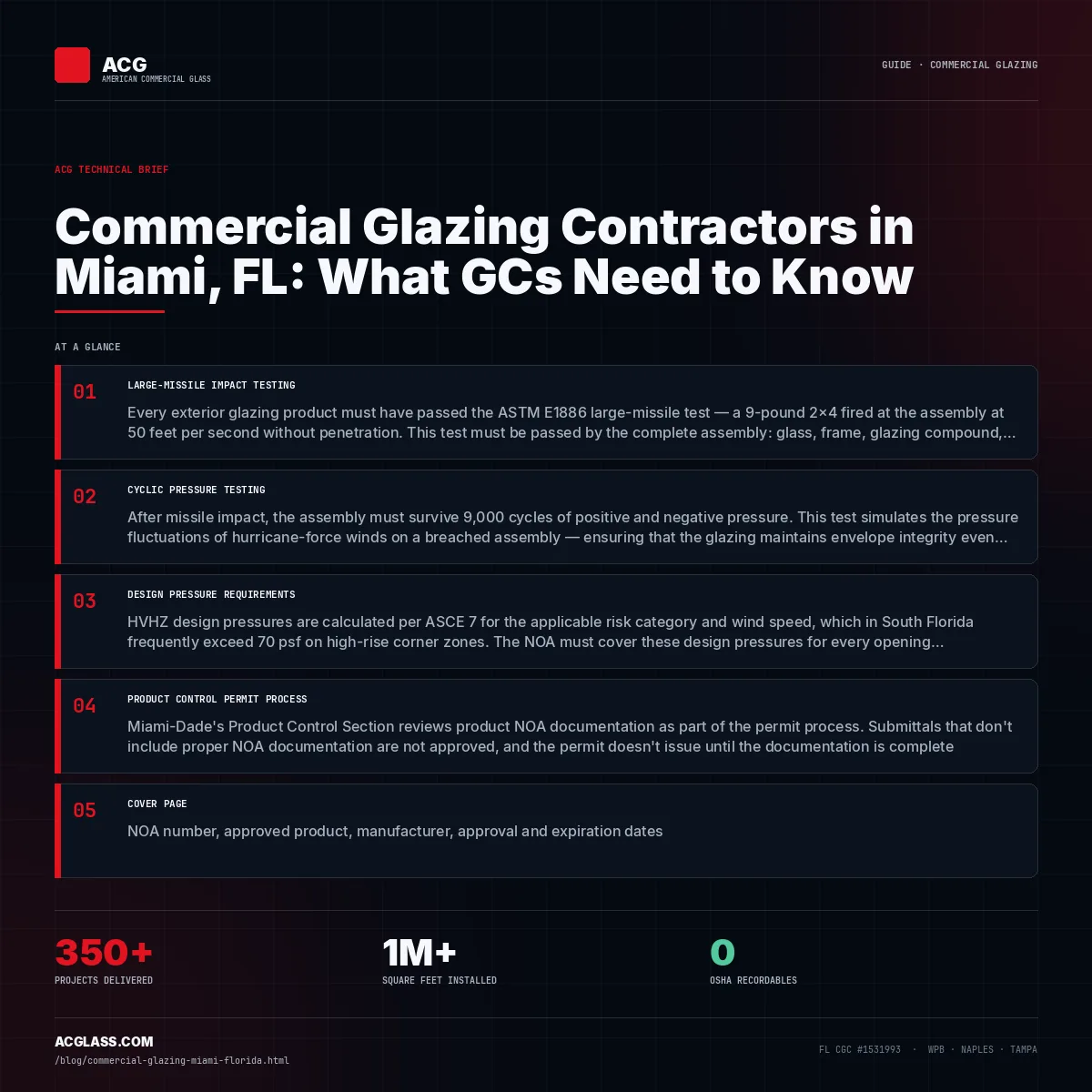
Large-missile impact testing: Every exterior glazing product must have passed the ASTM E1886 large-missile test - a 9-pound 2x4 fired at the assembly at 50 feet per second without penetration. This test must be passed by the complete assembly: glass, frame, glazing compound, and anchors as tested together.
Cyclic pressure testing: After missile impact, the assembly must survive 9,000 cycles of positive and negative pressure. This test simulates the pressure fluctuations of hurricane-force winds on a breached assembly - ensuring that the glazing maintains envelope integrity even after it has been struck by debris.
Design pressure requirements: HVHZ design pressures are calculated per ASCE 7 for the applicable risk category and wind speed, which in South Florida frequently exceed 70 psf on high-rise corner zones. The NOA must cover these design pressures for every opening configuration on the project.
Product Control permit process: Miami-Dade's Product Control Section reviews product NOA documentation as part of the permit process. Submittals that don't include proper NOA documentation are not approved, and the permit doesn't issue until the documentation is complete.
What NOA Documentation Looks Like
A Miami-Dade Notice of Acceptance is a multi-page technical document. A complete NOA for a commercial storefront or curtainwall product will include:
- Cover page: NOA number, approved product, manufacturer, approval and expiration dates
- Scope of use: The specific product configurations covered - frame sizes, glass types, maximum panel dimensions, design pressure ratings by configuration
- Installation instructions: Anchor spacing, anchor type, required sealants, required clearances - the installation must match these exactly
- Glass schedule: Approved glass types and thicknesses for each panel size
- Test reports: References to the testing laboratory and test report numbers that support the acceptance
When your glazing sub submits for a Miami HVHZ project, the submittal package should include the full NOA document - not just the NOA number - for every exterior glazing product in the scope. A submittal that lists "NOA on file" without the document is incomplete and will be rejected by Product Control.
Vetting a Glazing Sub for HVHZ Work
Not every Florida glazing contractor has genuine HVHZ experience. The vetting questions that matter:
- How many HVHZ projects have you completed? Ask for specific project names and references in Miami-Dade or Broward. General Florida experience is not equivalent.
- Who is your NOA contact at your product manufacturers? A sub with real HVHZ experience has established relationships with product reps and knows the NOA documentation for every product they specify.
- Have you ever had a Product Control rejection? And how was it resolved? This surfaces genuine experience with the inspection process.
- Can you name the applicable NOA for the product you're planning to specify on this project? A qualified sub can answer this immediately. Hesitation is a red flag.
ACG's Track Record in Miami-Dade
ACG has completed multiple HVHZ commercial glazing projects in Miami-Dade County, including the Medley Business Park industrial complex in Medley and the Westlake development in Hialeah. Our submittals on HVHZ projects include full NOA documentation for every exterior glazing product, organized by opening location with design pressure confirmation for each.
Our project management system tracks NOA expiration dates and flags any approaching expiration during the submittal and fabrication phases, preventing the situation where a product's NOA expires between submittal approval and installation. On HVHZ projects, this is a real risk - NOAs expire, and products sometimes go through testing cycles that temporarily interrupt coverage.
For Miami and South Florida commercial glazing projects, see our dedicated Miami commercial glazing page and our detailed Miami-Dade glazing guide. For HVHZ certification details, visit our HVHZ contractor page. To get ACG on your bid list for a South Florida project, contact our team.
FAQ
What glazing is required in Miami HVHZ?
All exterior glazing on commercial buildings in the HVHZ must be impact-rated with a Miami-Dade Notice of Acceptance (NOA). The NOA must document that the complete assembly - glass and frame together - passed both the large-missile impact test (ASTM E1886/E1996) and the cyclic pressure test. Standard Florida Product Approval FL# numbers are not sufficient for HVHZ work.
How do I find an HVHZ-certified glazing contractor in Miami?
Verify the sub holds an active DBPR Glass & Glazing Specialty Contractor license and has completed actual HVHZ projects - ask for specific references in Miami-Dade or Broward. The sub should be immediately fluent in NOA documentation and Miami-Dade's Product Control process. Call references to confirm their HVHZ submittal and inspection track record before award.