
Orlando is one of the most complex commercial construction markets in Florida - not because it's the most code-intensive (South Florida's HVHZ holds that distinction), but because of the sheer variety and volume of construction types happening simultaneously. Healthcare campuses in Lake Nona, theme park facility expansions on the west side, midrise multifamily and mixed-use along the I-4 corridor, the ongoing expansion at Orlando International Airport, and a dense network of office and retail development across Orange, Seminole, Osceola, and Polk counties. GCs operating in this market need commercial glazing subcontractors who can execute across all of it.
Orlando's Construction Market Context
Understanding what drives commercial construction in Greater Orlando helps explain what GCs need from a glazing sub here.
Healthcare construction is one of the most active sectors in Central Florida. The Lake Nona medical city concept has generated substantial institutional construction - hospital towers, medical office buildings, research facilities, and specialty care centers - all of which require complex commercial glazing scopes: curtainwall on institutional towers, impact-rated storefronts on ground-floor medical facilities, automatic entrance systems at hospital lobbies, and fire-rated glass assemblies throughout. Healthcare glazing scopes are detailed, specification-driven, and require a glazing sub who can manage the full Division 08 scope under a single contract.
Theme park and entertainment facilities on Orlando's west side - the Universal, Disney, and SeaWorld corridors - generate ongoing construction of hotels, retail, restaurant, and entertainment facilities. These projects are often design-build or design-assist, with fast-track schedules and complex facade designs. ACG's scheduling and rapid scope turnaround are particularly well-suited for the fast-track nature of hospitality and entertainment construction.
Airport expansion at Orlando International Airport is a sustained, multi-phase construction program generating significant commercial glazing work: terminal facades, concourse storefronts, and the specialty glazing required in the TSA and secured zones. Airport glazing requires understanding the specific fire and security rating requirements for various zones within the terminal.
I-4 multifamily and mixed-use along the corridor from downtown Orlando through Altamonte Springs, Casselberry, and into Seminole County has been among the most active multifamily markets in Florida. Mid-rise residential and mixed-use buildings in this corridor commonly specify window wall systems, which ACG installs across multiple manufacturers.
Office and retail development in suburban Orange County, Lake County, and Polk County continues at a strong pace driven by population growth and corporate relocations to Central Florida. This work is typically aluminum storefront and glass entrance systems - ACG's bread-and-butter scope.
Orange County Building Code for Glazing
Commercial buildings in Orange County must comply with the Florida Building Code, which governs wind load design for all exterior glazing under Section 1609. Orange County adopts the Florida Building Code by reference and administers commercial plan review and inspection through the Orange County Building Division.
The key code considerations for commercial glazing in Orange County:
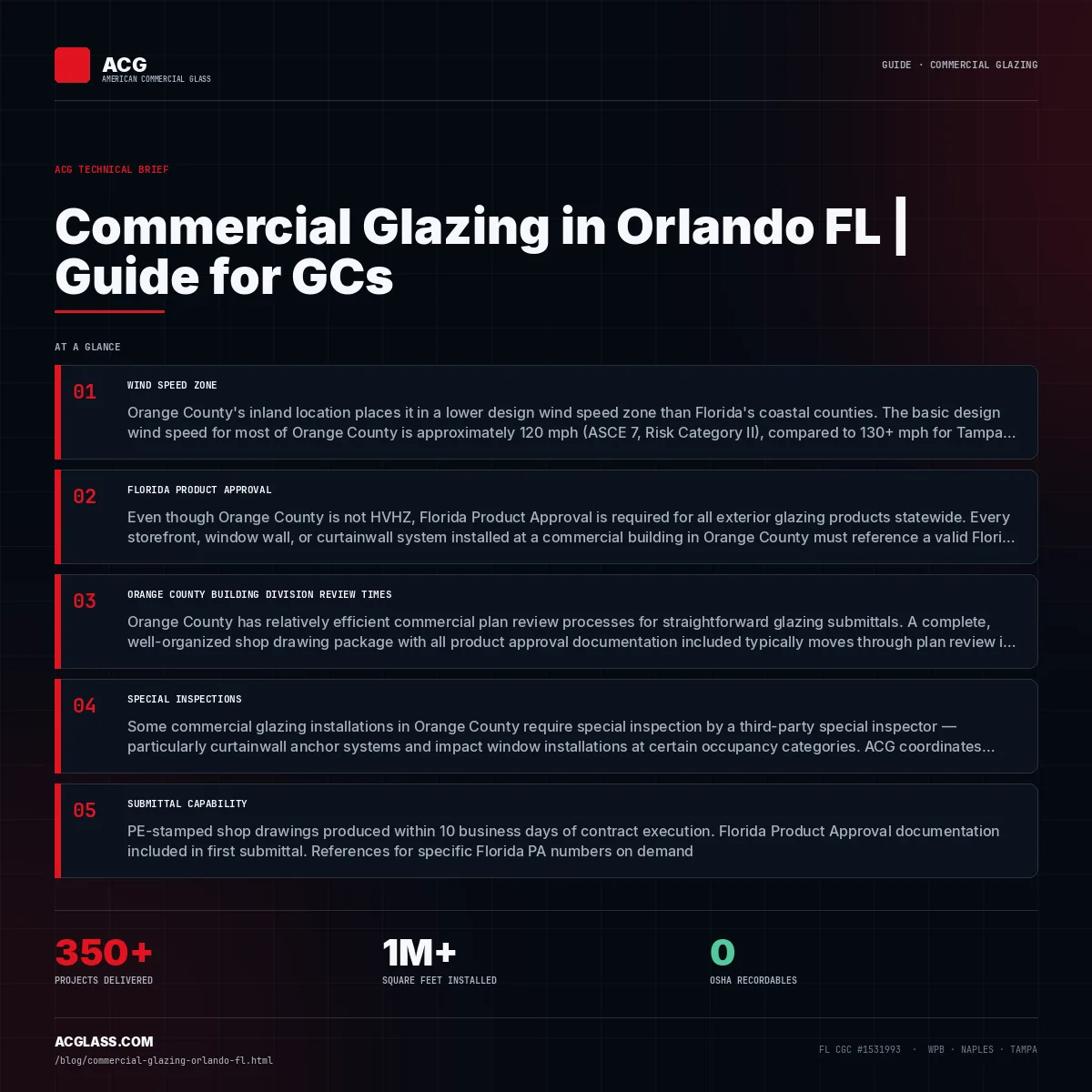
Wind speed zone: Orange County's inland location places it in a lower design wind speed zone than Florida's coastal counties. The basic design wind speed for most of Orange County is approximately 120 mph (ASCE 7, Risk Category II), compared to 130+ mph for Tampa Bay coastal areas and 170-185+ mph for HVHZ in Miami-Dade and Broward. This means that impact-resistant glazing is not universally required throughout Orange County, but certain coastal proximity areas and wind-borne debris region designations may trigger impact requirements depending on the specific site.
Florida Product Approval: Even though Orange County is not HVHZ, Florida Product Approval is required for all exterior glazing products statewide. Every storefront, window wall, or curtainwall system installed at a commercial building in Orange County must reference a valid Florida PA number in the permit application and shop drawing package.
Orange County Building Division review times: Orange County has relatively efficient commercial plan review processes for straightforward glazing submittals. A complete, well-organized shop drawing package with all product approval documentation included typically moves through plan review in 2-4 weeks. Incomplete submittals, missing product approvals, or shop drawings that don't reference the actual Florida PA numbers will be rejected and returned for resubmittal - adding weeks to the schedule.
Special inspections: Some commercial glazing installations in Orange County require special inspection by a third-party special inspector - particularly curtainwall anchor systems and impact window installations at certain occupancy categories. ACG coordinates special inspection requirements at the start of every project so there are no surprises at the inspection stage.
Wind Exposure in Central Florida
Central Florida's inland location is an advantage from a code compliance standpoint. The design wind pressures at a 5-story office building in Orlando are lower than at a comparable building in Fort Myers, and significantly lower than in Miami. This generally means that the glazing systems required in Orlando are less expensive than equivalent systems on Florida's coasts - the products needed to meet 120 mph design wind speeds are less costly than impact-resistant systems rated for 155-185 mph coastal zones.
However, lower wind speeds don't eliminate wind load design requirements. Every exterior glazing system at a commercial building in Orange County still requires a Florida Product Approval, still requires PE-stamped shop drawings with wind pressure calculations, and still requires a glazing sub that understands the Florida Building Code compliance process.
GCs who use residential glass companies or non-Florida glazing subs on Orlando commercial projects often discover that the cost savings at bid time are absorbed by delays in the submittal approval process - because a residential installer doesn't produce PE-stamped commercial shop drawings, and a non-Florida sub doesn't understand the Florida PA requirement.
What Orlando-Area GCs Need From a Glazing Sub
Based on the construction types active in Greater Orlando and the code environment, here's what an Orlando GC should specifically verify before awarding glazing scope:
Submittal capability: PE-stamped shop drawings produced within 10 business days of contract execution. Florida Product Approval documentation included in first submittal. References for specific Florida PA numbers on demand.
Full Division 08 scope: The ability to cover storefront, curtainwall, window wall, automatic entrances, and fire-rated glass under a single subcontract. Healthcare projects in particular need a single glazing sub who can coordinate the intersection of these systems - especially at fire-rated wall assemblies where the glazing sub and the fire stopping scope interact.
Schedule integration: or otherwise sophisticated scheduling that integrates material lead times with the GC's master schedule. Orlando's fast-track hospitality and theme park construction moves quickly - a glazing sub with a manual scheduling process is a risk on those projects.
Central Florida coverage: ACG serves Greater Orlando from its Tampa office, which covers Hillsborough County east through Orange, Osceola, Seminole, and Polk counties. ACG crews are based in the Florida market - not flying in from out of state - and are familiar with Orange County Building Division's review and inspection processes.
ACG's Central Florida Coverage
ACG serves the Greater Orlando market from its Tampa office, with field crews deployable across Central Florida. The types of projects ACG handles in the Orlando area span the full range of what this market produces: healthcare facilities requiring coordinated Division 08 scopes, hospitality and mixed-use projects with multi-system glazing facades, mid-rise multifamily with window wall, and suburban commercial retail and office with aluminum storefront.
For GCs building in Orange, Osceola, Seminole, Polk, Volusia, or Lake counties, ACG provides the same scope, speed, and service that South Florida and Tampa GCs have been counting on for 5+ years. 48-hour scope turnaround. Complete submittals. Single-sub Division 08 accountability. scheduling integrated with your master schedule.
If you're building in the Orlando area and need a glazing sub who can execute, send us your plans.