
Glazing is one of those scopes where the lowest bid frequently costs the most money. A sub who can't produce the right license, doesn't understand Florida product approvals, or submits an incomplete scope will create problems - failed inspections, schedule delays, and change orders - that far outweigh any savings on their base price. Here's how to vet them properly before you sign the subcontract.
Florida Licensing Requirements for Glazing Contractors
Florida requires glazing contractors to hold a valid license issued by the Department of Business and Professional Regulation (DBPR). The specific license type for commercial glazing work is the Glass and Glazing Specialty Contractor license, classified under the Specialty Structures category.
There are two tiers relevant to commercial work:
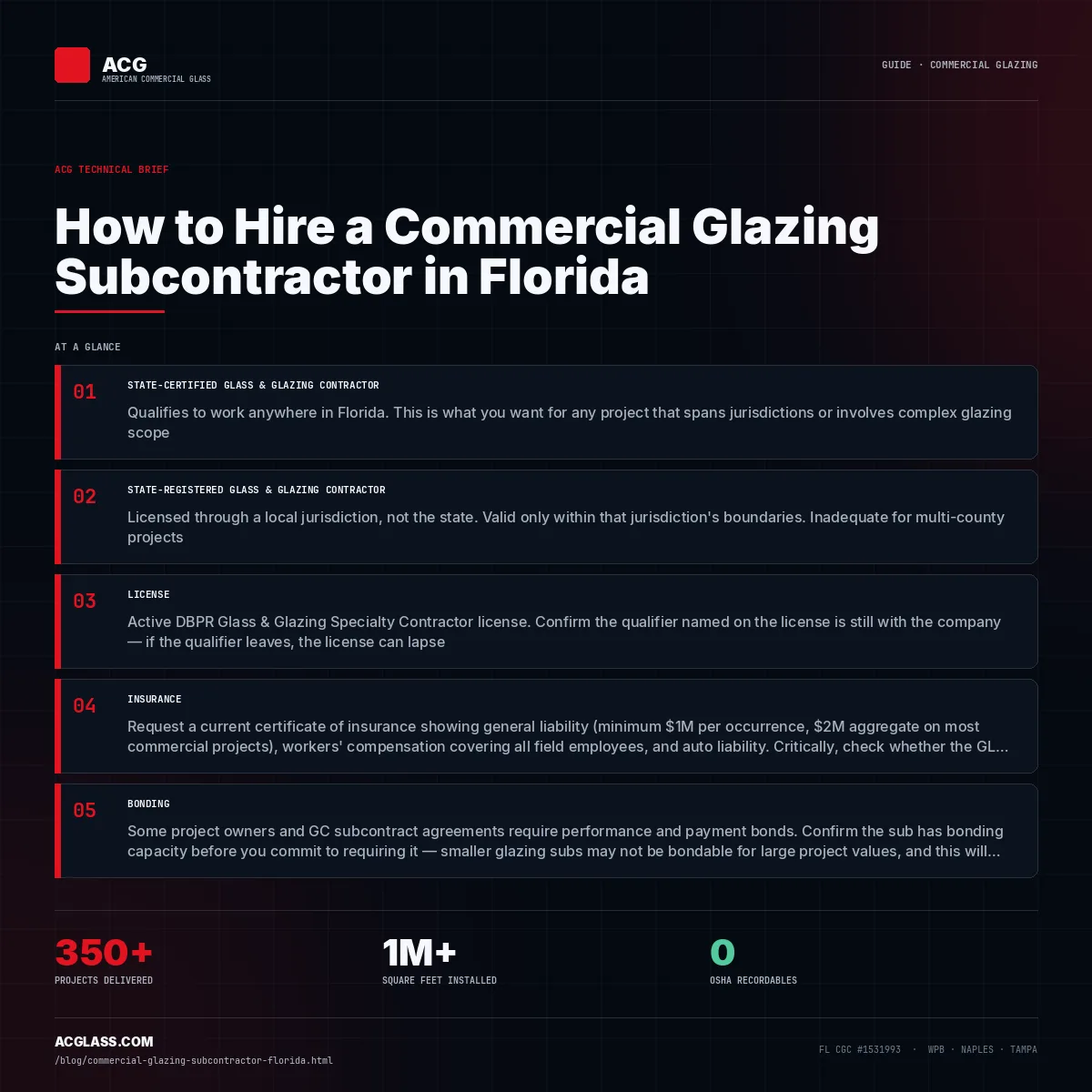
- State-Certified Glass & Glazing Contractor: Qualifies to work anywhere in Florida. This is what you want for any project that spans jurisdictions or involves complex glazing scope.
- State-Registered Glass & Glazing Contractor: Licensed through a local jurisdiction, not the state. Valid only within that jurisdiction's boundaries. Inadequate for multi-county projects.
To verify a sub's license, use the DBPR licensee search at myfloridalicense.com. Enter the contractor's name or license number and confirm the license is active, not expired, and has no outstanding disciplinary actions. This takes two minutes and should be non-negotiable before you request a bid.
What to Verify Before Hiring
License: Active DBPR Glass & Glazing Specialty Contractor license. Confirm the qualifier named on the license is still with the company - if the qualifier leaves, the license can lapse.
Insurance: Request a current certificate of insurance showing general liability (minimum $1M per occurrence, $2M aggregate on most commercial projects), workers' compensation covering all field employees, and auto liability. Critically, check whether the GL policy excludes glass breakage - some standard policies do, which is a significant gap for a glazing contractor. Have your certificate name your company as additional insured.
Bonding: Some project owners and GC subcontract agreements require performance and payment bonds. Confirm the sub has bonding capacity before you commit to requiring it - smaller glazing subs may not be bondable for large project values, and this will surface at a bad time if you don't check up front.
Product approval knowledge: Ask the sub directly: which products are you planning to use, and do they have current Florida Product Approvals? A sub who can't answer this clearly is a sub who's going to cause inspection problems.
How to Read a Glazing Bid
A well-structured glazing bid should clearly state what's included and what's not. Here's what a complete scope looks like and where gaps commonly appear:
What should be explicitly included:
- System manufacturer and product line (e.g., "ESWindows ES-9500" - not just "storefront system")
- Glass type, thickness, and interlayer specification (e.g., "1" insulated laminated unit, 1/4" + 0.090 PVB + 1/4", tempered")
- Florida Product Approval numbers for all specified products
- Shop drawing preparation and submittal
- Hardware - door closers, panic devices, locks, thresholds (hardware is frequently excluded or vague)
- Caulking and perimeter sealant (sometimes excluded)
- Permit fees, if the sub is pulling the permit
- Final cleaning
Common exclusions to watch for: Structural steel for curtainwall anchors, concrete infill at storefronts, electrical for automatic doors, and storefront blocking or framing are frequently excluded from glazing scopes and need to be picked up elsewhere. If the bid is silent on these items, assume they're excluded and confirm in writing.
Florida Product Approvals: What to Check
Every glazing product installed in Florida under a building permit must have either a Florida Product Approval (FL# number) or a Miami-Dade Notice of Acceptance (NOA) for work within Miami-Dade County. The installer must use the product exactly as tested - any modification to the frame size, glass type, or anchor spacing can void the approval.
You can verify product approvals at the Florida Building Commission's approval search tool at floridabuilding.org. Any glazing sub operating in Florida should be able to pull up their FL# numbers immediately. If they're vague about which products they're planning to use, that's a red flag - it may mean they're planning to substitute lower-priced products at installation.
Red Flags to Watch For
- Vague material specifications: Bids that say "storefront system" without naming the manufacturer and product line are unenforceable. You can't verify product approvals, and you can't hold them to a spec at installation.
- No shop drawing commitment: Any commercial glazing scope requires shop drawings. If the bid doesn't mention them, ask who's responsible.
- Unusually fast fabrication estimates: Custom glazing products typically require 6-14 weeks of fabrication. A sub promising delivery in 3 weeks may be planning to substitute a stocked product that doesn't match the specification.
- Unfamiliar with HVHZ requirements: If your project is in Broward or Miami-Dade, the High-Velocity Hurricane Zone requirements are non-negotiable. A sub who isn't immediately fluent in HVHZ is not qualified for that work.
- No references on comparable projects: Commercial glazing requires different expertise than residential. Ask for three references on commercial projects of similar scope and value - and call them.
Working with ACG
ACG - American Commercial Glass - is a Florida-licensed commercial glazing subcontractor delivering projects across the state. Our DBPR Glass & Glazing license is current, our submittals always include FL# documentation for every specified product, and our bids are fully scoped with no ambiguity on exclusions.
We operate from West Palm Beach headquarters, giving us coverage across the full Florida market. If you want to add us to your bid list or need a scope review on a project in design, contact our team or send plans directly - we return scopes within 48 hours.
See our full commercial glazing services or our project portfolio for examples of completed work.
FAQ
Is a glazing contractor license required in Florida?
Yes. Commercial glazing work in Florida requires a DBPR Glass & Glazing Specialty Contractor license. The license qualifier must be actively associated with the contracting company. Verify any sub's license status at myfloridalicense.com before requesting a bid.
What insurance should a glazing subcontractor carry?
At minimum: general liability ($1M per occurrence, $2M aggregate), workers' compensation for all field employees, and auto liability. Verify the GL policy does not exclude glass breakage - some policies do. Require your company be named as additional insured on the certificate before site mobilization.