
Curtainwall and storefront are often treated as interchangeable terms for "the glass on the outside of the building." They are not. Understanding the structural, performance, and cost differences between the two systems is essential for any GC evaluating glazing scope - and it's especially important in Florida, where hurricane code requirements add a layer of product approval complexity that doesn't exist in most other states.
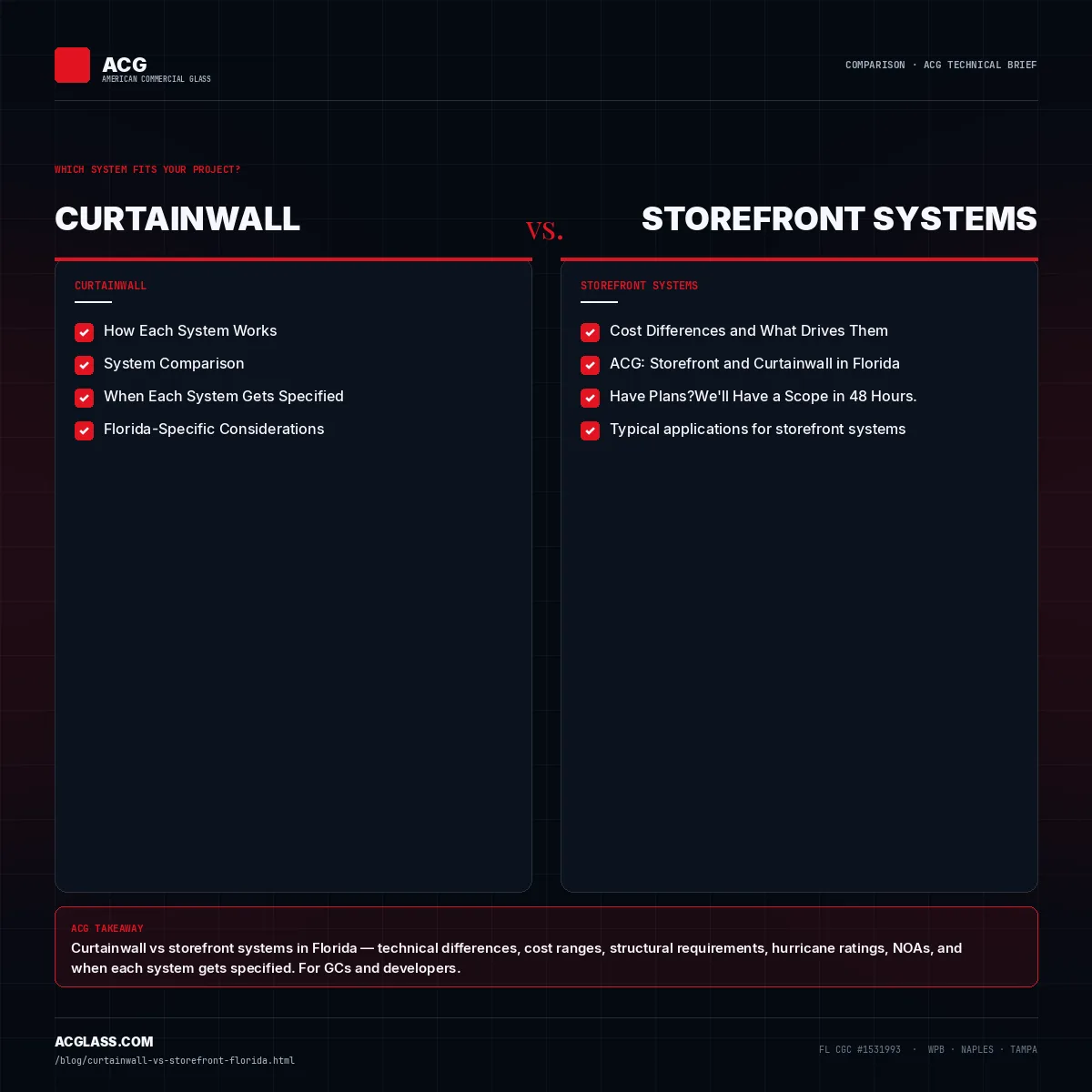
How Each System Works
Storefront is a non-load-bearing aluminum framing system installed between the floor slab and the structure above. Typical applications are ground-floor commercial entrances, retail storefronts, and low-rise building perimeters where the frame spans a single floor. Storefront systems transfer wind loads to the surrounding construction - the head anchor, sill anchor, and jamb conditions carry the load back to the structure. Span heights are typically limited to 12 feet in a standard single-span configuration, though some heavy-duty systems can reach 16 feet with engineering.
Curtainwall is a structural exterior wall system that spans floor-to-floor. Unlike storefront, curtainwall carries its own dead load - the weight of the aluminum and glass - via anchor connections at each floor slab. It is engineered to resist wind pressures at elevation, accommodate thermal movement across large spans, and drain water through a defined internal drainage pathway. Curtainwall is the specified system for multi-story commercial buildings, high-rises, and any application where the glazing system spans more than one floor level.
System Comparison
| Factor | Storefront | Curtainwall |
|---|---|---|
| Typical Application | Ground-floor, single-story, low-rise | Multi-story, high-rise, floor-to-floor spans |
| Max Span Height | Typically 12-16 ft | Floor-to-floor (10-20+ ft spans) |
| Structural Role | Non-load-bearing; transfers loads to structure | Self-supporting dead load; anchors to slab per floor |
| Installed Cost (Florida) | By scope | By scope |
| Florida PA Required | Yes | Yes |
| Miami-Dade NOA (HVHZ) | Required in Miami-Dade & Broward | Required in Miami-Dade & Broward |
| Submittal Complexity | Moderate | High - PE-stamped calcs per floor anchor |
| Lead Time (typical) | 6-10 weeks | 12-20 weeks |
When Each System Gets Specified
Storefront is specified when the glazing application is at grade level, spans a single floor, and doesn't require the structural performance of a curtainwall system. Typical applications include retail storefronts, restaurant frontages, office building ground-floor lobbies, medical office building entries, and light commercial construction. Storefront can also be used on upper-floor applications in low-rise buildings where the span height is within limits and the wind pressure requirements are met by the system's testing data.
Curtainwall is specified when the building design requires continuous glazed facades spanning multiple floors, when the building height creates wind pressures that exceed storefront system capacities, or when the design intent requires a "glass box" aesthetic that storefront framing cannot achieve. Office towers, mixed-use high-rises, and institutional buildings (hospitals, universities) commonly use curtainwall on upper floors with storefront at the ground level.
Florida-Specific Considerations
Florida Product Approval. Every exterior glazing product installed in Florida requires a Florida Product Approval number issued by the DBPR. The PA confirms the product has been tested to the Florida Building Code's wind load and impact requirements for the design wind speed zone where the building is located. Without a valid PA, the glazing won't pass inspection.
High Velocity Hurricane Zones (HVHZ). Miami-Dade and Broward counties are designated as HVHZ under the Florida Building Code. In HVHZ, every exterior glazing product requires a Miami-Dade Notice of Acceptance (NOA) - a separate approval issued by Miami-Dade County's Product Control Section after testing to TAS 201, 202, and 203 protocols. The TAS testing standard is more stringent than the standard ASTM test protocols used for Florida PA approvals in non-HVHZ counties. Not every curtainwall or storefront system with a Florida PA has a corresponding Miami-Dade NOA. Verify before specifying.
Large Missile Impact Testing. In HVHZ, exterior glazing must pass Large Missile Impact testing (TAS 201), which simulates a 9-pound 2x4 traveling at 50 ft/sec. Most standard storefront systems with laminated glass meet this requirement. Standard tempered glass alone does not. For curtainwall in HVHZ, every glass lite in the system must meet the impact requirement - which affects glazing specification, unit weight, and frame sizing.
Pressure Calculations. Florida's high-wind environment means design wind pressures are higher than most other states. A glazing sub with Florida experience will size framing members and anchor conditions to the actual design pressures for the building, not to the minimum catalog specifications. Undersized framing relative to the calculated design pressures will fail the building official's review.
Cost Differences and What Drives Them
Curtainwall requires PE-stamped anchor calculations per floor, precision-fabricated extrusions, and a field installation process that involves crane work, anchor setting, and alignment at height. Storefront is installed from the ground up, typically without the structural engineering content or crane requirements of a curtainwall scope.
ACG: Storefront and Curtainwall in Florida
American Commercial Glass delivers commercial glazing projects across Florida, including both curtainwall and storefront scopes from ground-floor retail to multi-story mixed-use. We operate from three offices - West Palm Beach, Naples, and Tampa - and cover the full HVHZ documentation requirement for South Florida projects. Send us your plans for a 48-hour scope and pricing response.
Frequently Asked Questions
What is the main structural difference between curtainwall and storefront?
Storefront is a non-load-bearing aluminum framing system that spans between the floor slab and the structure above - typically sill to head heights under 12 feet. It transfers wind loads to the surrounding structure at the head and sill conditions. Curtainwall is a structural glazing system that spans floor-to-floor, carrying its own dead load (the weight of the glass and aluminum) back to the building structure via anchor connections at each floor slab. Curtainwall is designed for multi-story applications where the system must resist wind pressures at height and handle thermal movement across large spans.
Do curtainwall and storefront systems require NOAs in Florida?
All exterior glazing products installed in Florida require a Florida Product Approval (Florida PA) issued by the DBPR. In the High Velocity Hurricane Zone (HVHZ), which covers Miami-Dade and Broward counties, a Miami-Dade Notice of Acceptance (NOA) is also required. NOAs require testing to TAS 201, 202, and 203 protocols. Not all products with a Florida PA have a Miami-Dade NOA - verify this before specifying any system for an HVHZ project.