
Getting a commercial glazing bid sounds simple - just send the drawings and wait. But doing it right means sending the right documents, knowing what to expect back, and understanding how to compare multiple bids without getting misled by the lowest number.
Step 1: Gather Your Documents
The more complete your document package, the more accurate and useful your bid will be. Here's what to send:
Architectural Drawings (Required)
- Floor plans showing building layout and glazing locations
- Exterior elevations showing the glass systems as viewed from outside
- Glazing schedule or window schedule - a table that lists each opening, its dimensions, and its requirements (glass type, frame finish, hardware, etc.)
- Door schedule - if the storefront includes commercial glass doors
- Detail sheets showing how the glazing connects to the structure (head, sill, jamb details)
Specification Sections (Helpful)
The Division 08 specification section tells the glazing sub exactly what products are specified - system manufacturer, glass type, frame finish, performance requirements. Without it, the glazing sub has to guess on the spec or make their own product selection. With it, all bids are based on the same requirements.
Project Schedule (Important for Timing)
When does glazing need to be complete? When is the storefront rough opening ready? The glazing sub needs this to confirm they can meet your timeline and to flag any schedule risks.
Step 2: Send It to the Right Contractors
Not every glazing contractor in Florida is right for every project. Match the contractor to the scope:
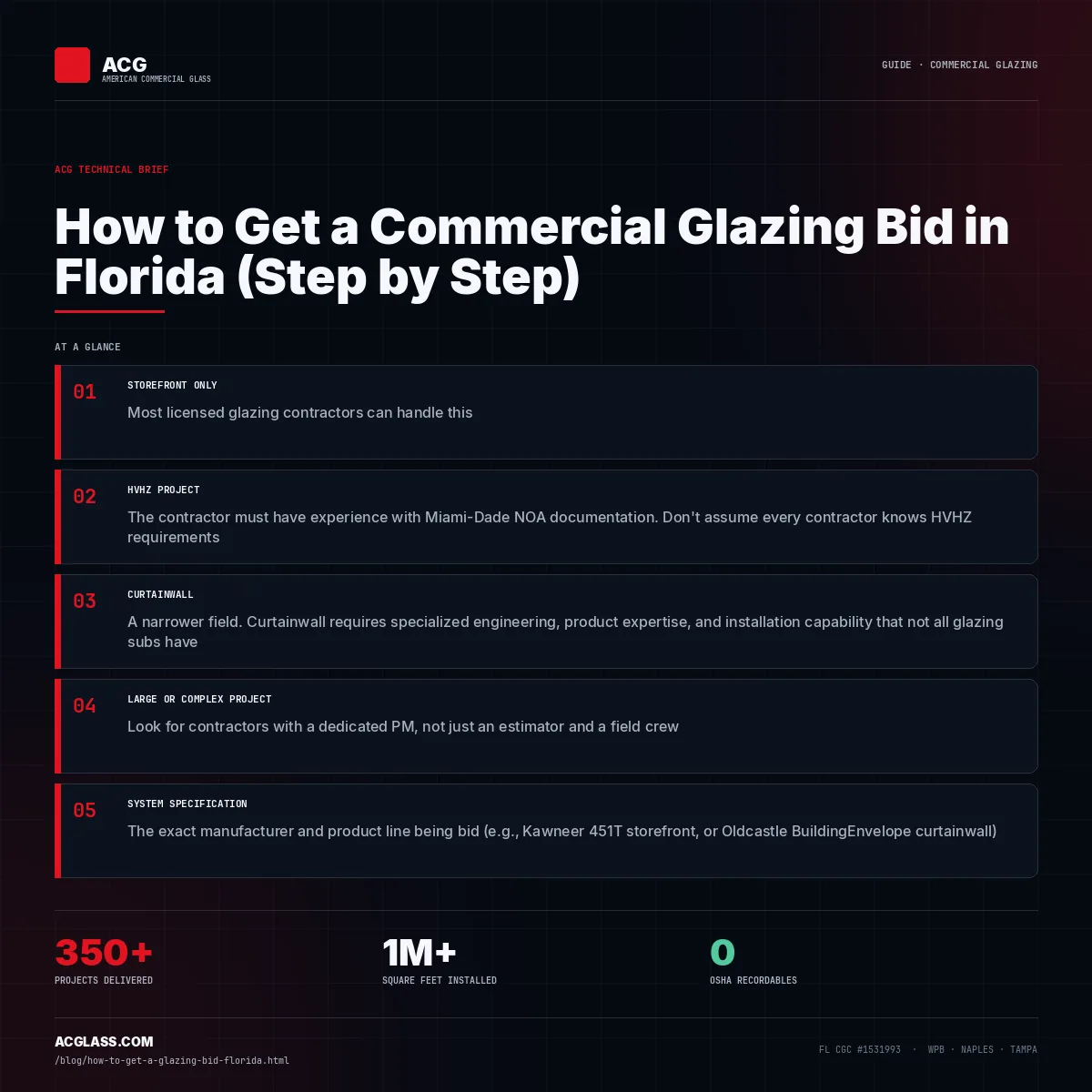
- Storefront only: Most licensed glazing contractors can handle this.
- HVHZ project: The contractor must have experience with Miami-Dade NOA documentation. Don't assume every contractor knows HVHZ requirements.
- Curtainwall: A narrower field. Curtainwall requires specialized engineering, product expertise, and installation capability that not all glazing subs have.
- Large or complex project: Look for contractors with a dedicated PM, not just an estimator and a field crew.
ACG handles storefront installation in Florida and full curtainwall scopes. We serve all Florida wind zones including HVHZ. You can get a bid from us regardless of project size or complexity.
Step 3: What a Good Bid Looks Like
A complete glazing bid should include all of the following:
- System specification: The exact manufacturer and product line being bid (e.g., ESWindows ES-9500)
- Glass specification: Glass makeup - thickness, type (tempered, laminated), coating (Low-E type), and performance ratings (SHGC, U-factor)
- Quantities: Square footage of glass, linear feet of framing, number of doors, number of automatic operators
- Hardware: Closers, handles, locks, panic hardware - listed specifically, not just "allowance"
- Scope inclusions and exclusions: What's included (caulking? flashing? permits?) and what's explicitly excluded
- Lead times: Fabrication lead time for the specified products
- Total price: Broken out by system type if there are multiple systems
Be cautious of bids with large "allowances" for hardware or doors. These are placeholder numbers that will become change orders after contract.
Step 4: How to Compare Glazing Bids
The lowest number is not always the best bid. Compare these things:
Compare the Scope, Not Just the Price
The real comparison is closer than it looks - and Bid B might end up higher after change orders.
Compare the Glass Spec
Are both bids specifying the same glass type? A bid using a lower-performance Low-E coating will be lower-priced but may not meet energy code. Confirm each bid specifies glass that meets the project's SHGC and U-factor requirements.
Compare the System
Is one bid specifying a premium thermally broken system while the other uses a non-thermally-broken frame? The non-thermally-broken system will cost less but perform worse in Florida's heat.
Compare the Timeline
Both bids might be priced similarly but one contractor has a 10-week lead time and one has a 6-week lead time. On a tight schedule, the faster timeline has real value.
ACG's 48-Hour Turnaround
We return a complete bid - system specification, glass spec, quantities, hardware list, scope inclusions/exclusions, and total price - within 48 hours of receiving a complete plan set. No chasing. No back-and-forth to get a basic number.
Ready to get a bid? Send us your plans. We'll have a scope back to you fast.
See our commercial glazing services to understand the full range of what we bid and install. And see our project portfolio for completed work examples.
Frequently Asked Questions
What do I need to send to get a glazing bid?
At minimum, you need architectural drawings that show the glazing scope - floor plans, elevations, and a glazing schedule or window schedule. The Division 08 specification section tells the glazing sub what products and performance requirements are specified. A project schedule helps the sub confirm whether they can meet your timeline. The more complete your document set, the more accurate the bid.
How long does it take to get a commercial glazing bid?
A well-organized glazing contractor should return a complete bid within 48-72 hours for a straightforward project. Complex projects may take 3-5 business days. ACG's standard turnaround is 48 hours from receipt of a complete plan set.
How do I compare glazing bids from different contractors?
Compare bids on scope, not just price. Look at what's included: does the bid include doors and hardware? Caulking and perimeter sealants? Automatic entrance operators? A bid that excludes these items will have change orders that bring the total above a higher-priced bid that included them. Also compare the specified system - is the glass type and performance rating equivalent between bids?