
GCs and project managers often use "impact glass" and "laminated glass" interchangeably. They're not the same thing. Getting this wrong on a commercial project in Florida leads to failed inspections, expensive glass replacements, and schedule damage. Here's what the distinction actually means and when it matters.
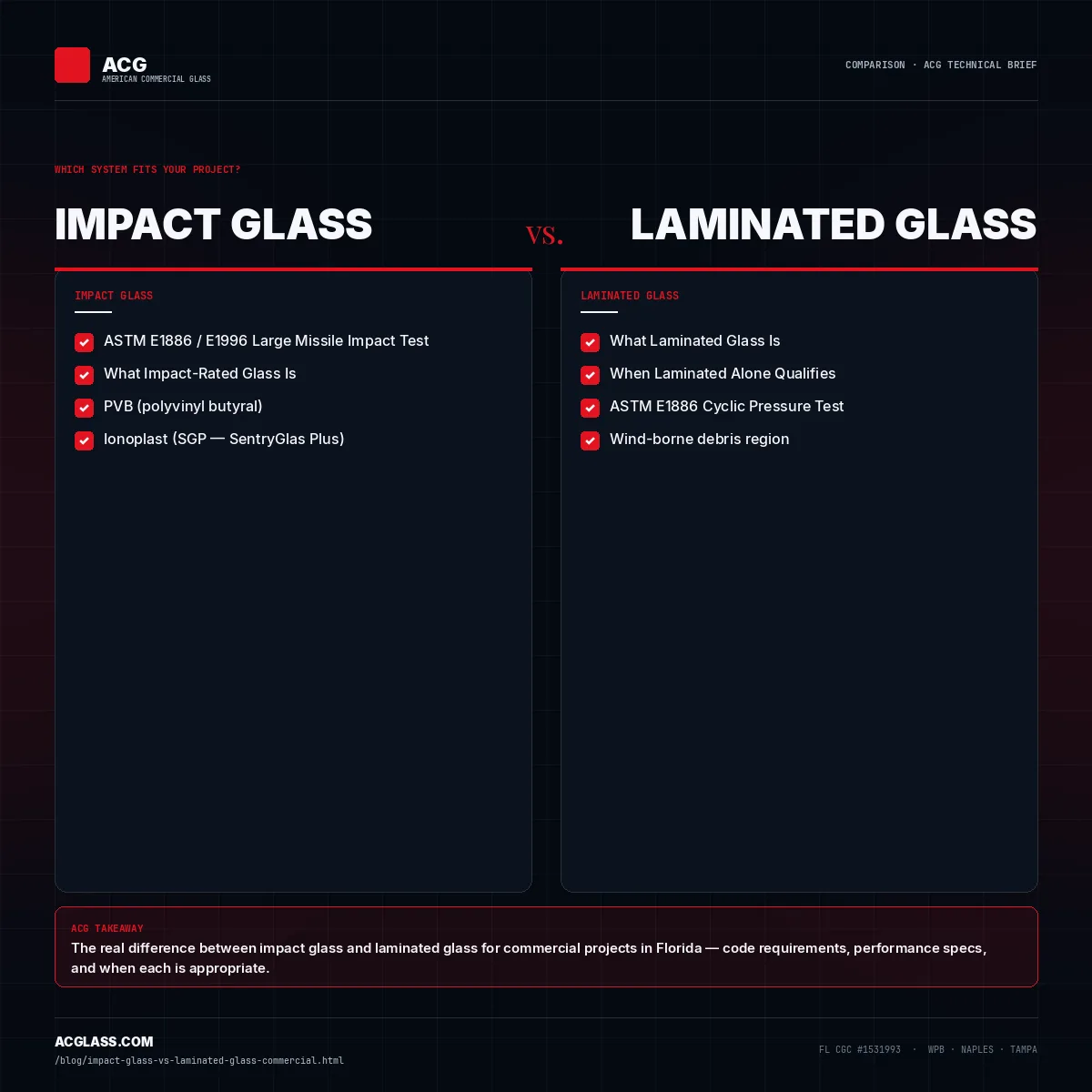
What Laminated Glass Is
Laminated glass is a construction type. It consists of two or more glass lites permanently bonded together with an interlayer material. The interlayer is the key variable. The two most common interlayer types in commercial applications are:
- PVB (polyvinyl butyral): The standard interlayer for most commercial laminated applications. PVB is flexible, transparent, and bonds well to glass. Typical thicknesses are 0.030", 0.060", and 0.090". PVB provides excellent post-breakage retention - broken glass adheres to the interlayer rather than shattering into the opening.
- Ionoplast (SGP - SentryGlas Plus): A stiffer, stronger interlayer that performs significantly better under hurricane conditions. Ionoplast interlayers are typically five times stiffer than PVB and offer substantially higher post-breakage structural capacity. In demanding HVHZ applications, ionoplast interlayers are the standard for large-format glazing.
Laminated glass is used for safety glazing, overhead glazing, sloped glazing, and anywhere glass retention after breakage is required. But laminated glass alone is not automatically impact-rated for hurricane protection purposes.
What Impact-Rated Glass Is
Impact glass - more precisely, impact-resistant glazing - is a system designation, not a glass type. An impact-rated system has been tested as a complete assembly: glass, frame, anchors, and glazing compound, tested together per the applicable ASTM standards.
The two key tests for Florida impact rating are:
- ASTM E1886 / E1996 Large Missile Impact Test: A 9-pound 2x4 fired at 50 feet per second must not penetrate the glazing assembly. This simulates wind-borne debris during a hurricane.
- ASTM E1886 Cyclic Pressure Test: After surviving the missile impact, the assembly must withstand 9,000 cycles of positive and negative pressure without failure. This simulates the pressure fluctuations of hurricane-force winds through an already-damaged assembly.
An impact-rated system must pass both tests. And critically - the rating applies to the tested assembly. A glass unit that passed testing in a 4" ESWindows frame cannot be installed in a different frame and claim the same rating. The Florida Product Approval documents specify exactly what was tested and what configurations are permitted.
Florida Building Code Section 1609: What's Required
Florida Building Code Section 1609 governs wind-borne debris protection for exterior glazing. The requirements depend on three factors: the building's location, its design wind speed, and whether it's in the High-Velocity Hurricane Zone (HVHZ).
Wind-borne debris region: Florida Building Code defines wind-borne debris regions as areas where the basic design wind speed exceeds 130 mph (for Risk Category II buildings), or within one mile of the mean high water line in areas with design wind speeds above 110 mph. Most of coastal Florida and virtually all of South Florida falls within this definition.
In wind-borne debris regions, exterior glazed openings in enclosed buildings must either be protected by an approved impact-resistant system OR by an approved storm shutter. For most commercial buildings, shutters are impractical, which means impact-rated glazing is the de facto requirement.
HVHZ (Miami-Dade and Broward counties): The HVHZ has more stringent requirements administered by the Florida Building Commission and Miami-Dade County. Products used in HVHZ must have a Miami-Dade Notice of Acceptance (NOA), which requires passing both the large-missile and cyclic pressure tests. In HVHZ, there is no shutter alternative for most commercial applications - impact-rated glazing is required.
When Laminated Alone Qualifies
There are limited conditions under which laminated glass without full impact system testing is code-compliant for Florida commercial projects:
- Interior glazing applications where wind-borne debris protection isn't required
- Safety glazing applications (CPSC 16 CFR Part 1201 or ANSI Z97.1) where breakage characteristics are the concern, not wind pressure
- Overhead and sloped glazing where post-breakage retention is required but wind-borne debris rating is not
In practice, if you're building a commercial exterior opening anywhere in coastal Florida, you need an impact-rated system - not just laminated glass.
Common Specification Errors GCs Encounter
The most frequent error is a specification that calls for "laminated glass" on exterior openings in wind-borne debris regions without specifying impact testing standards or a Florida Product Approval number. This typically comes from an architect who copied a spec from a non-Florida project without updating it for Florida requirements.
The second common error is specifying an impact-rated glass unit but without specifying the frame system that was tested with it. The glass may have a Florida Product Approval, but if it's installed in a frame not included in that approval, the assembly doesn't comply. This is caught at inspection - and fixing it means removing and reinstalling glass.
A third error is specifying 0.030" PVB interlayer on large-format openings in HVHZ. Miami-Dade NOA requirements for commercial glazing in exposed locations typically require 0.090" PVB or ionoplast interlayers for large panel sizes. The tested assembly documentation will specify the minimum interlayer thickness for each glass size in the approval.
What ACG Specifies and Why
ACG's standard approach for commercial exterior glazing in Florida wind-borne debris regions is to specify glass units with valid Florida Product Approvals that include both the glass construction and the frame system - so the approval covers the complete tested assembly as installed.
For HVHZ projects, we use Miami-Dade NOA-approved assemblies throughout and document NOA numbers in our submittals. Our shop drawings identify the FL# or NOA number for every glazing unit in the scope, which gives inspectors a clear reference and eliminates product approval questions at inspection.
If you're seeing specification errors on a project in design or bid, bring ACG in early. We can review the glazing specification and flag compliance issues before they become field problems. See our impact glazing services and full service offering for more detail.
FAQ
Is laminated glass the same as impact glass?
No. Laminated glass is a construction type - two glass lites bonded with an interlayer. Impact glass is a system designation: a complete glazing assembly (glass plus frame) tested to ASTM E1886/E1996 and rated for wind-borne debris resistance. All impact glass is laminated, but not all laminated glass is impact-rated.
When is impact glass required in Florida commercial buildings?
Florida Building Code Section 1609 requires wind-borne debris protection for exterior glazing in wind-borne debris regions - most of coastal Florida and all of South Florida. In HVHZ (Miami-Dade and Broward counties), impact-rated glazing with Miami-Dade NOA is required for all commercial exterior openings. In other wind-borne debris regions, either impact-rated glazing or approved storm shutters are required, but shutters are rarely practical for commercial applications.