
When GCs think about commercial storefront, they often think about the glass. But a storefront system is more than glass lites dropped into an opening - it's an engineered assembly of aluminum framing, thermally broken sill members, head extrusions, vertical mullions, horizontal rails, perimeter anchoring, glazing tape, setting blocks, weep systems, weatherseal, and hardware. Every one of those components needs to be right, installed in the right sequence, with the right product approvals, to pass inspection and perform over the life of the building.
If you're building commercial in Tampa - retail, medical office, mixed-use, institutional - here's what you need to know about the storefront installation process in Hillsborough County.
Florida Building Code Requirements for Commercial Storefronts in Tampa
Florida's building code imposes requirements on commercial glazing that don't exist in most other states. For GCs new to the Florida market, or working in Tampa for the first time, these are the key code requirements that affect your storefront scope.
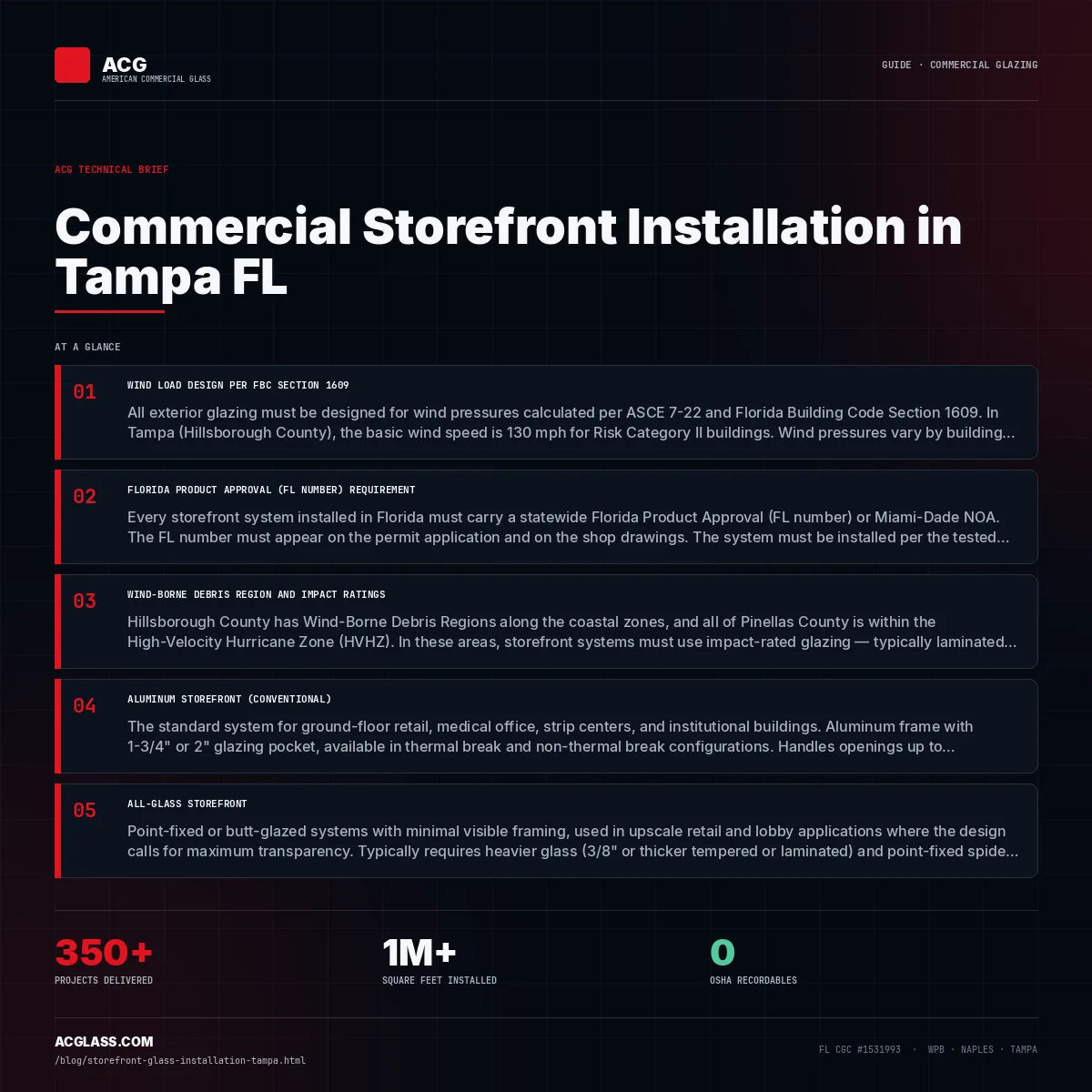
Wind load design per FBC Section 1609: All exterior glazing must be designed for wind pressures calculated per ASCE 7-22 and Florida Building Code Section 1609. In Tampa (Hillsborough County), the basic wind speed is 130 mph for Risk Category II buildings. Wind pressures vary by building height, exposure category, and location on the building face - a storefront opening at the corner of a building faces higher pressures than one in the field. Your glazing sub is responsible for verifying that the specified system is approved for the design pressures at each opening, not just that it carries a Florida Product Approval.
Florida Product Approval (FL Number) requirement: Every storefront system installed in Florida must carry a statewide Florida Product Approval (FL number) or Miami-Dade NOA. The FL number must appear on the permit application and on the shop drawings. The system must be installed per the tested installation conditions - anchor spacing, edge distance, fastener type - all of which are defined in the Product Approval installation instructions. Deviating from those conditions voids the approval and creates an inspection failure.
Wind-Borne Debris Region and impact ratings: Hillsborough and Pinellas counties are not in the High-Velocity Hurricane Zone (HVHZ). That designation is Miami-Dade and Broward only. Coastal Hillsborough and Pinellas are wind-borne debris regions, so storefront systems there use impact-rated glazing, typically laminated safety glass with an interlayer that retains the lite in the frame after impact. Confirm with your glazing sub that the system proposed for your project carries Florida Product Approval for the applicable wind zone, and that it's documented in the submittal package.
Types of Commercial Storefront Systems Used in Tampa Projects
Not all storefronts are the same. The system type that's right for your project depends on the opening height, design intent, occupancy, and budget. Here are the main system types ACG installs on Tampa Bay commercial projects.
Aluminum storefront (conventional): The standard system for ground-floor retail, medical office, strip centers, and institutional buildings. Aluminum frame with 1-3/4" or 2" glazing pocket, available in thermal break and non-thermal break configurations. Handles openings up to approximately 12-14 feet in height without intermediate structural support. Manufacturers including ESWindows and ESWindows offer systems with Florida Product Approvals for Tampa Bay wind zones.
All-glass storefront: Point-fixed or butt-glazed systems with minimal visible framing, used in upscale retail and lobby applications where the design calls for maximum transparency. Typically requires heavier glass (3/8" or thicker tempered or laminated) and point-fixed spider fittings or continuous patch fittings at sill and head. More complex installation and higher cost than conventional storefront.
Heavy glass entrance systems: Patch-fitting entrance systems using 1/2" tempered or laminated glass panels, patch hardware, and pivot or overhead closer assemblies. Common in bank lobbies, corporate entrances, and high-end retail. Requires precise field measurement and hardware alignment. Anchor conditions at the structural floor must be prepared accurately before glazing.
Automatic entrances: Sliding, swinging, or folding entrance systems with electromechanical operators. Requires coordination with electrical for rough-in conduit and power provision, and ADA compliance review for door width, threshold height, and opening force. Automatic entrances are a specialty scope within commercial glazing - confirm your glazing sub is certified for the specific operator brands they're installing.
The Installation Process: From Shop Drawings to Final Inspection
Understanding the sequencing of a commercial storefront installation helps GCs build realistic schedules and know when to escalate if a milestone is slipping.
Submittals and approval (3-6 weeks): After contract execution, the glazing contractor prepares shop drawings showing head, sill, and jamb conditions for each opening, door hardware schedules, product approval references, and anchor details. Submittals go to the architect and engineer of record for approval. Plan review at the building department happens in parallel or after architect approval depending on the project delivery method. Plan reviews in Hillsborough County can run 2-4 weeks for commercial projects.
Material procurement (8-14 weeks): Aluminum extrusions, glass lites, hardware, and perimeter sealant are ordered after approved shop drawings are in hand. Lead times fluctuate - budget 10-12 weeks as a planning assumption. Glass delivery is typically the critical path item, particularly for large or non-standard lites.
Rough-in and anchor preparation: Before aluminum framing can be set, anchor locations must be established and prepared. For slab-to-slab conditions, this means verifying structural rough openings are within tolerance, setting embedded anchors or drilling and setting post-installed anchors, and installing any required sub-sill flashing. This phase requires close coordination with the masonry or concrete sub.
Frame installation and glazing: Aluminum frames are installed in sequence from the structural anchor points outward. After frame alignment and shim conditions are set, glass lites are installed using setting blocks, glazing tape, and pressure bar. Weep systems and perimeter sealant are applied after glazing. Hardware is installed and adjusted last.
Inspection and punch list: Final inspection by the AHJ requires the glazing contractor or GC to request a rough-in inspection (for embedded conditions) and a final inspection after glazing is complete. In Hillsborough County, inspections are requested through the county's online permitting portal. Common punch list items include sealant voids, hardware adjustment, and weep hole clearance.
Why Storefront Timelines Go Wrong - and How ACG Prevents It
The most common reason storefront projects run late in Tampa Bay has nothing to do with the installation itself - it's material procurement. A glazing sub that doesn't order extrusions and glass immediately after contract execution, before shop drawing approval, is already behind. Material lead times are 8-14 weeks regardless of when they're ordered. Waiting for approved shop drawings before ordering - rather than ordering long-lead items immediately and finalizing details during the approval process - adds 4-6 weeks to the schedule without adding any value.
The second most common delay is inspection sequencing. Glazing inspections in Hillsborough County require a specific inspection type code and must be requested at the right project phase. A glazing sub unfamiliar with the county's inspection system can spend days getting an inspection that an experienced local contractor would schedule same-day.
ACG uses scheduling tools to track every procurement milestone, submittal status, and inspection request across active projects. When a material lead time extends or a submittal review cycle takes longer than expected, the schedule impact is flagged proactively - not discovered after the crew shows up with no material. For GCs, this means fewer schedule surprises and a glazing sub who can give you an honest update on your milestone when you call.
ACG's Tampa Storefront Work
ACG's Tampa crews have installed commercial storefront systems across Hillsborough, Pasco, and Pinellas Counties on projects ranging from single-tenant retail buildings to multi-building medical campuses. Our Dale Mabry Retail Tampa project is representative of the type of commercial storefront scope we execute: full exterior storefront framing, heavy glass entrance systems, and perimeter sealant on a multi-tenant retail strip along one of Tampa's highest-traffic commercial corridors.
We know the quirks of Tampa Bay's permitting environment, we have established relationships with the local building departments, and we have crews in the market - not crews driving from South Florida. If you're looking for a reliable storefront sub for your next Tampa Bay commercial project, send us the plans.