
The terms "storefront" and "window" get used interchangeably on commercial projects - in drawings, in specs, in conversations with owners. They're not the same system, and treating them as equivalent creates real problems: wrong product approvals, structural issues, waterproofing failures, and scope disputes. Here's a clear breakdown of what each system actually is and when each is appropriate.
If the drawings call for a storefront and you need the scope priced rather than explained, start at commercial storefront systems and installation.
Commercial Windows: Unit-Based Insertion Systems
A commercial window is a self-contained unit: aluminum (or composite) frame, glazing, hardware, and weatherstripping - all factory-assembled - that is inserted into a pre-framed rough opening in the building wall. The wall itself provides the structure; the window unit fills the opening.
The key characteristics of commercial window systems:
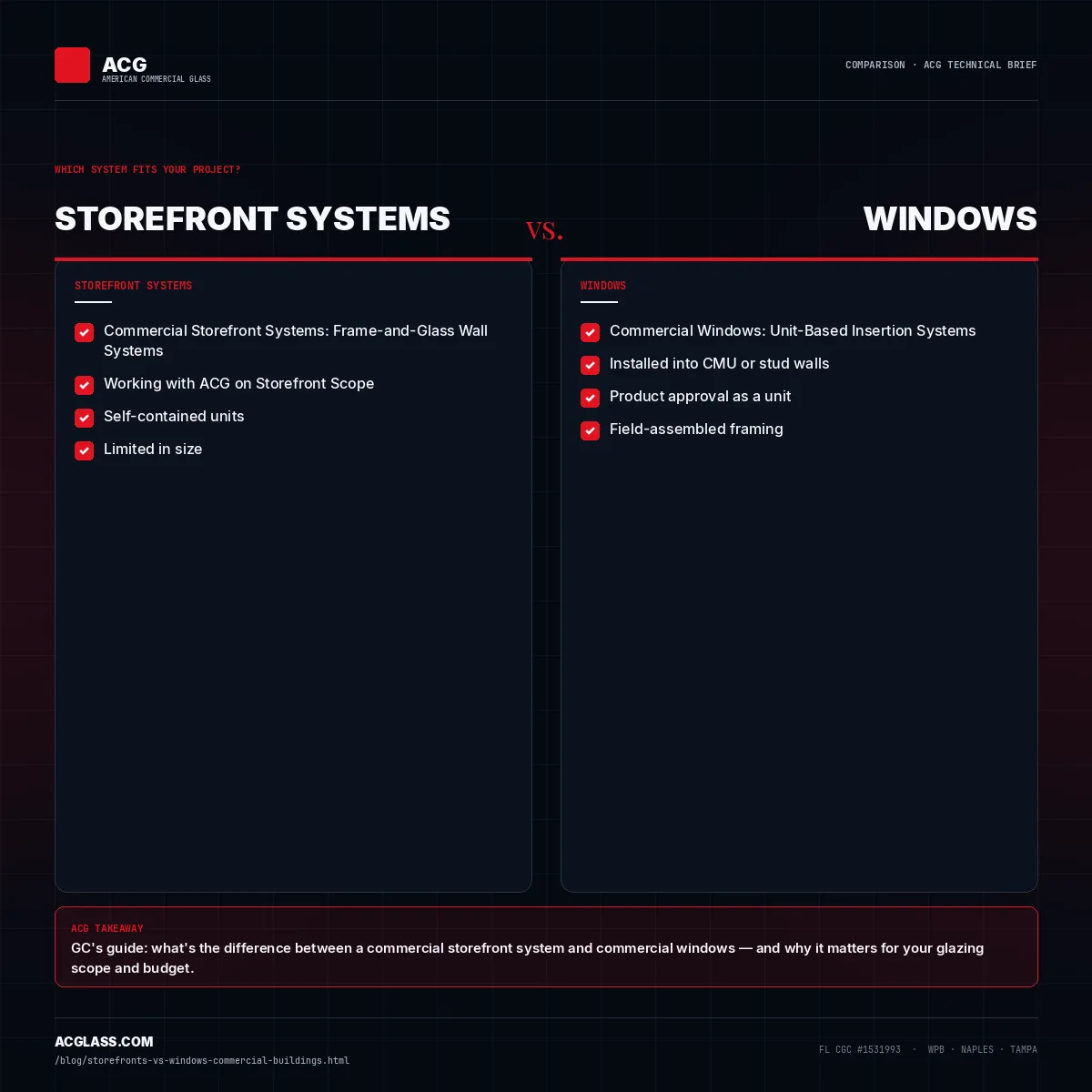
- Self-contained units: Each window is a complete factory-assembled product with its own frame, which installs into a rough opening prepared by others - typically the masonry or framing crew, not the glazing sub.
- Limited in size: Commercial window units have maximum size limitations based on their frame structure and glass size ratings. Most commercial window units range from 2 to 6 feet wide and 2 to 6 feet tall as individual units.
- Installed into CMU or stud walls: The rough opening is prepared in a CMU block wall, concrete frame, or stud-framed wall before the window arrives. The window unit is anchored to the rough opening frame.
- Product approval as a unit: Florida product approvals for windows cover the complete unit as tested - a specific frame size, glass specification, and anchor pattern.
Commercial windows are appropriate for office buildings with punched openings, multifamily residential (where window wall isn't specified), healthcare facilities with individual room windows, and any application where discrete opening sizes are used throughout the building envelope.
Commercial Storefront Systems: Frame-and-Glass Wall Systems
A commercial storefront is a different animal entirely. It's a field-assembled framing system - typically 4", 4-1/2", or 6" aluminum extrusions - that fills a large opening in the building exterior and is glazed in the field. The storefront is not a unit product; it's a system of components that a glazing crew assembles on-site.
Key characteristics:
- Field-assembled framing: Vertical members (mullions), horizontal members (transoms), head extrusions, and sill extrusions are cut and assembled in the field. Glass panels are installed within the framing after the frame is set.
- Spans large openings: A storefront system can fill openings 20, 30, or 40 feet wide and 12-14 feet tall in a single continuous run. Multiple bays are connected through the framing system with continuous mullions.
- Load path to structure: The storefront transfers wind loads to the building structure at the head (top anchor to the structure above) and sill (connection to the floor slab or concrete below). This is why storefront is limited in height - it needs structure above and below to transfer loads.
- Incorporates doors and fixed lites: Commercial doors, sidelites, transoms, and fixed glass panels are all integrated within the storefront framing system as components of a single continuous assembly.
Storefront systems are the standard glazing solution for retail storefronts, commercial building lobbies, bank branches, restaurants, and any commercial ground-floor application with large glazed openings.
Structural Difference: The Load Path
The fundamental structural difference is how each system transfers wind load to the building:
A commercial window transfers its wind load through the window frame to the rough opening framing - typically embedded anchors in CMU or through-bolts into a structural frame. The wall carries the load. The window is essentially a product filling a hole in the wall.
A storefront system transfers its wind load through the head condition to structure above (typically a concrete or steel beam, or a CMU bond beam) and through the sill to structure below (floor slab or grade). The storefront frame itself acts as a spanning structural element between the floor and the overhead structure. This is why storefront is height-limited - around 12-14 feet for standard 4" systems - and requires adequate structural framing at both the head and sill conditions.
When a storefront system is specified but the head condition doesn't have adequate structure to accept the wind load transfer, you have a structural problem that manifests as storefront deflection, glass breakage, and water infiltration. ACG reviews head conditions during the bid phase and flags inadequate structural support before it becomes a field problem.
Cost Differences
On a per-square-foot-of-glazed-area basis, storefront and commercial windows are often in a similar range for materials - both typically use commercial-grade aluminum extrusions and similar glass specifications. The installation cost is where the differences appear:
- Storefront installation is generally more efficient on large continuous runs because the glazing crew can set framing and install glass in a systematic, repetitive process. A 40-foot continuous storefront run installs faster per square foot than four individual 10-foot windows.
- Commercial window installation has more discrete labor per unit - each window requires individual anchor installation, flashing, sealant, and inspection. For buildings with many individual windows in separate openings, the per-unit installation labor accumulates quickly.
- Rough opening preparation is a cost that's sometimes missed: commercial windows require framed rough openings (often by the masonry or framing sub) that storefront doesn't require. If this is part of the GC's direct cost, it affects the comparison.
Florida Code Implications
In Florida's wind-borne debris regions, both storefront systems and commercial windows require Florida Product Approvals that cover the applicable design pressures. But there's a critical difference in how product approvals work for each:
Commercial window product approvals cover a specific unit size and configuration. If the specified window size isn't within the tested configuration, the product approval doesn't apply - you need a different product or a site-specific engineering calculation.
Storefront product approvals cover framing members and glass configurations with a matrix of permitted sizes and design pressures. The approval document specifies what glass sizes, glass types, and design pressures are permitted within the framing system. A single storefront product approval typically covers a much broader range of configurations than a window approval, which simplifies compliance across a large project with varied opening sizes.
Common Substitution Errors
The substitution errors that cause problems in the field:
- Installing commercial windows in place of specified storefront: This typically happens when a glazing sub tries to simplify procurement. The result is a product that doesn't match the architect's design intent, doesn't have the same structural performance, and may not be approvable under the permit.
- Specifying storefront where commercial windows should be used: Storefront requires a continuous open bay - if the wall has intermediate CMU piers between openings, the framing layout may not work without custom engineering.
- Ignoring head condition requirements: Storefront requires structure to receive the head anchor. On some buildings, the architect's drawing shows storefront at a location where the structure above is inadequate - this needs to be caught and resolved at bid, not in the field.
Working with ACG on Storefront Scope
ACG's commercial storefront scope covers the complete storefront system - framing, glass, doors, hardware, perimeter sealant, and shop drawings - with full Florida Product Approval documentation included in every submittal. We review the structural conditions at head and sill during the bid phase and flag any concerns before you're committed to a price.
To learn more about our storefront work, see our commercial storefront systems page and our project portfolio. Ready to get a scope? Send us your plans - we'll have pricing back in 48 hours.
FAQ
What is a commercial storefront system?
A commercial storefront system is a field-assembled aluminum framing system that fills a large exterior opening with glass, operable doors, and fixed lites integrated into a continuous frame. Unlike individual windows inserted into pre-framed openings, a storefront is a complete structural framing system assembled on-site, spanning from sill to head and transferring wind loads to the building structure at both points.
Are commercial storefronts the same as windows?
No. Commercial storefronts and commercial windows are structurally different systems with different product approvals, installation methods, and applications. Storefronts are field-assembled framing systems for large openings; windows are factory-assembled units inserted into pre-framed rough openings. Substituting one for the other without design review creates structural and waterproofing problems and may void the product approval coverage.