
Most GCs are familiar with Division 08 as the bucket that contains glazing work. Fewer are familiar with what's actually in the spec sections - the performance requirements, the product approval language, and the issues that most commonly create RFIs or disputes during construction.
This walkthrough is for reading the spec. When the sections below need to be bought as one package, ACG holds them as a Florida Division 08 subcontractor.
Division 08 at a Glance
CSI MasterFormat organizes all construction specification content into numbered divisions. Division 08 - Openings - covers every element that creates a hole in a building envelope or interior partition: doors, windows, curtainwall, storefronts, hardware, and glazing. For a commercial glazing subcontractor, the relevant sections cluster around the following MasterFormat numbers:
- 08 1000: Doors and Frames - Hollow metal doors and frames, wood doors, special function doors. Typically the responsibility of a separate door contractor, but interfaces directly with glazing at storefront entry systems.
- 08 4000: Entrances, Storefronts, and Curtainwalls - The core glazing spec sections. Section 08 4100 covers storefronts; 08 4400 covers curtainwall systems; 08 4500 covers translucent assemblies; 08 4600 covers window walls.
- 08 5000: Windows - Fixed and operable window specifications. Aluminum windows (08 5100), composite windows, storm windows. In Florida commercial, usually specifies aluminum-framed impact or non-impact units.
- 08 8000: Glazing - Glass specifications independent of the framing system. Section 08 8100 covers flat glass; 08 8300 covers mirrors; 08 8600 covers specialty glazing. The glazing section specifies what goes in the frames that Sections 08 4000 and 08 5000 define.
Section 08 4000: Reading the Storefront Spec
Section 08 4100 (Aluminum-Framed Entrances and Storefronts) is typically structured with Part 1 (General), Part 2 (Products), and Part 3 (Execution). The key content for a glazing sub reviewing this section:
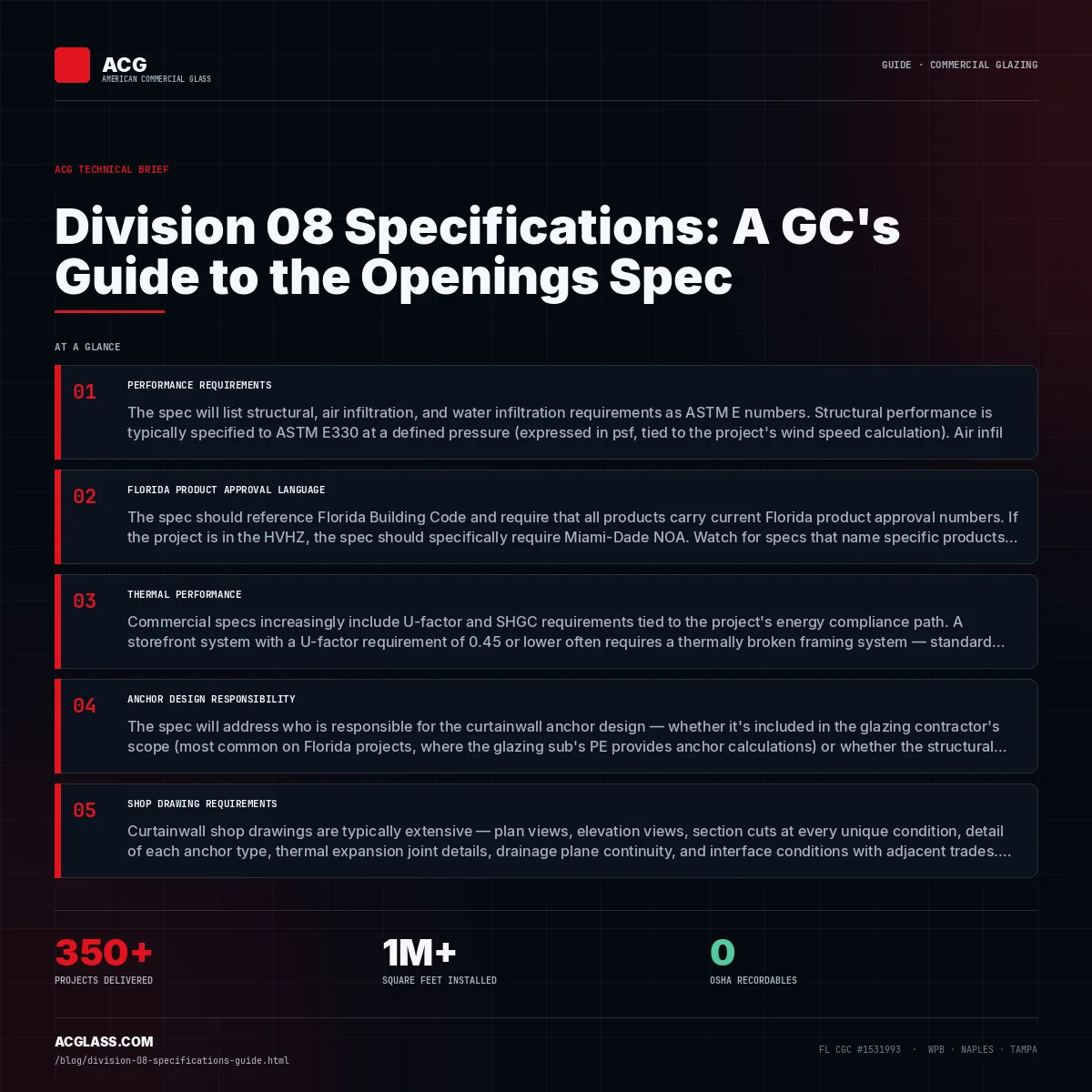
Performance requirements: The spec will list structural, air infiltration, and water infiltration requirements as ASTM E numbers. Structural performance is typically specified to ASTM E330 at a defined pressure (expressed in psf, tied to the project's wind speed calculation). Air infiltration is tested to ASTM E283. Water infiltration is tested to ASTM E331. The specified performance values must be met by the actual system installed - not just claimed in the product literature. Tested performance data from the manufacturer's certification testing is required.
Florida product approval language: The spec should reference Florida Building Code and require that all products carry current Florida product approval numbers. If the project is in the HVHZ, the spec should specifically require Miami-Dade NOA. Watch for specs that name specific products (ESWindows ES-8000 storefront, for example) as the basis of design - these create a substitution approval requirement if ACG proposes an equal product.
Thermal performance: Commercial specs increasingly include U-factor and SHGC requirements tied to the project's energy compliance path. A storefront system with a U-factor requirement of 0.45 or lower often requires a thermally broken framing system - standard non-thermally-broken aluminum storefront won't comply. This is a common spec issue that gets missed during bid review.
Section 08 4400: Reading the Curtainwall Spec
Curtainwall specifications are significantly more detailed than storefront specs because the engineering requirements are more complex. Key elements to understand:
Anchor design responsibility: The spec will address who is responsible for the curtainwall anchor design - whether it's included in the glazing contractor's scope (most common on Florida projects, where the glazing sub's PE provides anchor calculations) or whether the structural engineer of record takes responsibility for the anchor design with the curtainwall sub coordinating. This affects the submittal package significantly: if the glazing sub owns the anchor design, PE-stamped calculations are required as part of the submittals.
Shop drawing requirements: Curtainwall shop drawings are typically extensive - plan views, elevation views, section cuts at every unique condition, detail of each anchor type, thermal expansion joint details, drainage plane continuity, and interface conditions with adjacent trades. The spec will specify what scales, views, and details are required. Incomplete shop drawings are the single most common cause of curtainwall submittal revision cycles.
Mock-up requirements: Many curtainwall specs require a field-installed mock-up - a section of the actual curtainwall system installed at the job site and subjected to field water testing (AAMA 501.2) before full installation proceeds. Mock-up requirements add to the glazing sub's schedule and cost, and need to be identified during bidding. A missed mock-up requirement that surfaces after contract award is a cost dispute waiting to happen.
Section 08 8100: The Glazing Spec
The glazing section (08 8100) specifies the glass product itself - what goes in the aluminum frames. This section is often written generically and then edited for project-specific requirements. Key requirements to verify:
Glass type and coating: Specifications will call out specific glass product requirements - clear float glass (ASTM C1036), heat-strengthened (ASTM C1048 Condition A), tempered (ASTM C1048 Condition C), or laminated. Energy performance glass with low-e coatings will be specified with required VLT, SHGC, and U-factor values. Some specs name specific glass products (Guardian SunGuard, Vitro Solarban) as the basis of design - equivalents require substitution approval.
Insulating glass unit requirements: Commercial projects typically use insulating glass units (IGU) - double or triple-pane assemblies. The spec will define the IGU configuration: glass types on each lite, spacer type (aluminum, warm-edge, or stainless steel TGP-type), gas fill (air or argon), and overall thickness. ASTM E2190 covers the IGU standard. In Florida, insulating glass must be designed to handle thermal stress from the state's extreme solar conditions - a thermal stress analysis is often required as part of the submittal.
Impact requirements: If the project is in a wind-borne debris region, the glazing section will specify impact resistance requirements referencing Florida product approval or NOA. The spec should identify which Florida product approval numbers are acceptable or provide performance criteria that listed products must meet. Verify that the actual glass products proposed carry current, applicable product approvals - expired approvals or approvals for different configurations don't satisfy the requirement.
Product Substitution Requests: What They Look Like
Substitution review is one of the reasons to award the sections to a single Division 08 glazing subcontractor rather than splitting them.
When the specified product isn't available, isn't cost-effective, or has lead times incompatible with the schedule, a glazing sub submits a substitution request asking the architect to approve an alternate product. Under AIA contract documents, substitution requests must demonstrate that the proposed product is truly equal to the specified product in all performance characteristics.
A proper substitution request for a glazing system includes: a side-by-side comparison of specified vs. proposed product for every listed performance requirement, test reports for the proposed product on applicable ASTM standards, Florida product approval documentation, and a narrative explaining why the substitution is being requested. Generic substitution requests that just name an alternate product without technical substantiation get rejected - and they should.
ACG's submittal compliance track record reflects a disciplined approach to reading specs correctly during bidding and ensuring the proposed products meet every specification requirement - not just the ones that are easy to comply with. Substitution requests come in two categories: products that are genuinely equivalent and need a process to get approved, and products that aren't equivalent and shouldn't be substituted. Knowing the difference before the submittal goes in is the job.