
Curtainwall is the most technically demanding scope in commercial glazing. It's also the scope where selecting the wrong subcontractor creates the most significant schedule, cost, and quality problems. Here's how to evaluate curtainwall subs for Florida commercial projects.
What Makes Curtainwall Different from Storefront
The fundamental structural difference between storefront and curtainwall drives everything else. Storefront transfers wind loads to the building structure at the top and bottom of the system - the system's height is limited, typically to 12-14 feet without intermediate support, and the structural logic is straightforward. Curtainwall is a floor-to-floor spanning system that transfers loads back to the building structure through anchor points at each slab edge. It can span multiple stories, accommodate building movement, and carry much higher wind loads than storefront.
This structural difference means curtainwall requires:
- Engineering of record: Every curtainwall project on a Florida commercial building requires PE-stamped anchor calculations. The glazing sub's professional engineer of record is responsible for designing the connections between the curtainwall system and the building structure - confirming that the anchors can transfer the calculated wind loads to the floor slab without overstressing either the connection or the slab edge.
- ASCE 7 wind load analysis: The design wind loads for the curtainwall are calculated per ASCE 7 (adopted by Florida Building Code) using the specific building height, exposure category, site wind speed, and facade location on the building. Corner conditions experience higher wind pressures than field-of-wall locations. These pressures must be calculated correctly - using design values from product certification testing that was done at pressures equal to or exceeding the project-specific calculated loads.
- Movement accommodation: Curtainwall must accommodate interstory drift (horizontal building movement under lateral loads), floor deflection under live loads, and thermal expansion/contraction of the aluminum framing. The anchor details and joint details must accommodate all three movement sources simultaneously.
- Continuous waterproofing interface: At each floor slab anchor, the curtainwall's drainage plane must be detailed to prevent water infiltration at the slab edge condition. This is one of the most common failure points on curtainwall - poor detailing or installation at the floor-to-slab interface allows water past the drainage plane in a way that doesn't show up until long after construction is complete.
Florida-Specific Requirements
Florida's wind environment makes curtainwall selection and engineering more demanding than in most other states. Two requirements are specific to Florida projects:
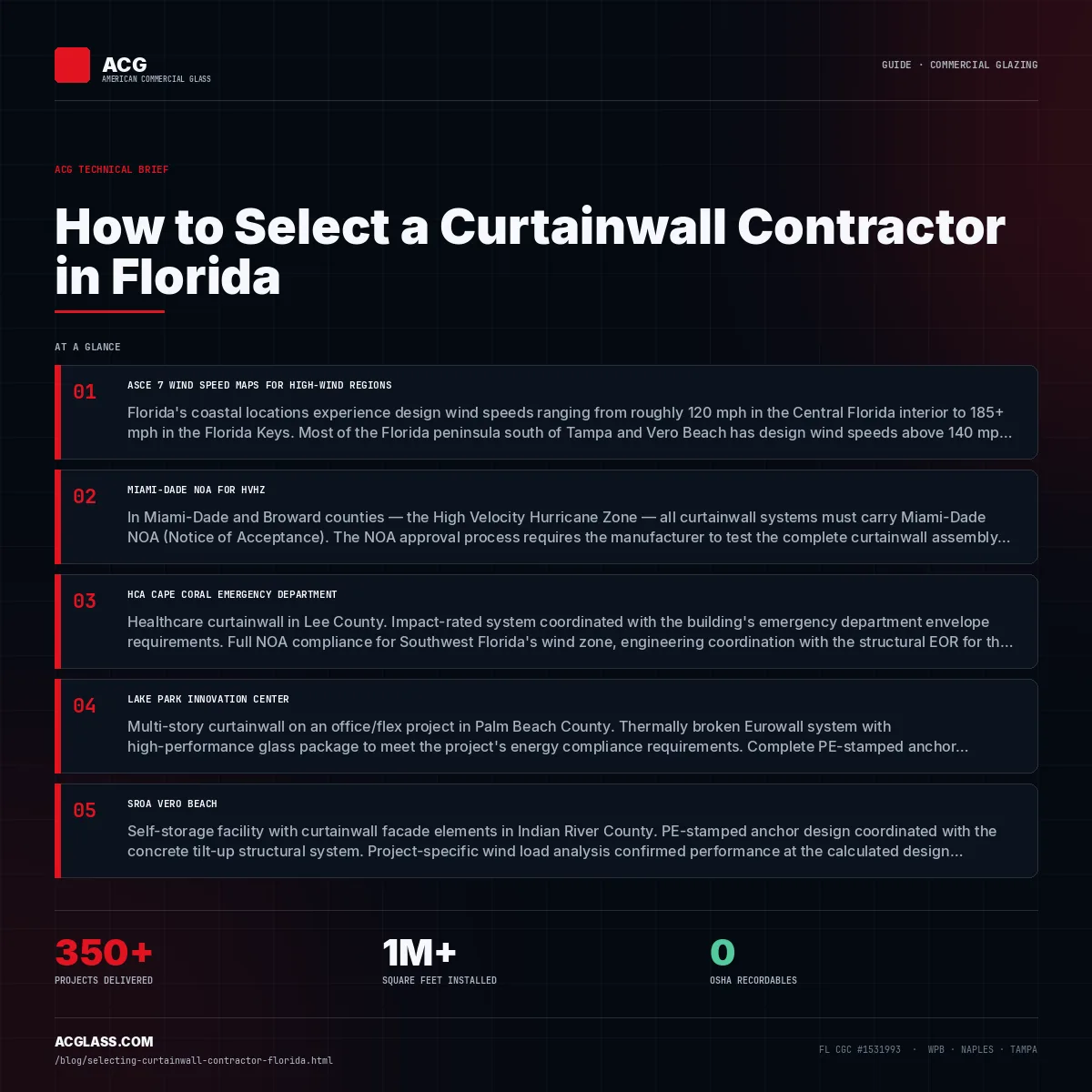
ASCE 7 wind speed maps for high-wind regions: Florida's coastal locations experience design wind speeds ranging from roughly 120 mph in the Central Florida interior to 185+ mph in the Florida Keys. Most of the Florida peninsula south of Tampa and Vero Beach has design wind speeds above 140 mph for standard Risk Category II buildings. School and hospital buildings (Risk Category III) use a higher factor. These wind speeds translate to design pressures significantly higher than what most curtainwall systems are tested to in catalog conditions - the glazing sub must confirm the system's tested performance envelopes the actual calculated design pressures.
Miami-Dade NOA for HVHZ: In Miami-Dade and Broward counties - the High Velocity Hurricane Zone - all curtainwall systems must carry Miami-Dade NOA (Notice of Acceptance). The NOA approval process requires the manufacturer to test the complete curtainwall assembly (aluminum extrusion system, glass configuration, anchor design, and installation method) to Miami-Dade's standard, which is more stringent than standard Florida product approval. Not all curtainwall systems carry NOA approval, and getting a new NOA takes months - the glazing sub must be using a system with existing NOA approval for HVHZ projects.
What to Look For in a Curtainwall Subcontractor
When evaluating curtainwall subs for a Florida project, these are the questions that separate qualified from unqualified:
1. Do they have a PE on staff or under retainer for curtainwall engineering? PE-stamped calculations for anchor design are required on Florida commercial projects. If the glazing sub doesn't have a clear answer for who's doing the engineering and how it's coordinated with the shop drawing process, that's a red flag. The PE's involvement should be integrated with the shop drawing production - not a stamp added after the drawings are complete.
2. Can they show curtainwall projects with similar wind speeds and HVHZ requirements? A curtainwall sub with Florida experience outside the HVHZ may not understand the NOA compliance process. Ask for specific project references in the county where your project is located. Ask who the GC was and call them.
3. What's their submittal track record on curtainwall packages? Curtainwall submittals routinely go through multiple review cycles. A qualified sub's first submittal is complete enough that revision cycles address genuine design questions rather than incomplete documentation. Ask how many revision cycles their curtainwall submittals typically require and what their most recent Florida curtainwall submittal timeline looked like.
4. What's their curtainwall installation supervision model? Multi-story curtainwall installation requires experienced field supervision. Ask who specifically will be supervising the curtainwall installation, what their experience level is, and how many simultaneous curtainwall projects they'll be managing. An inexperienced foreman on a complex curtainwall scope creates quality and safety problems.
ACG's Curtainwall Portfolio
ACG has completed curtainwall scopes on a range of Florida commercial projects that demonstrate the technical capabilities described above:
HCA Cape Coral Emergency Department: Healthcare curtainwall in Lee County. Impact-rated system coordinated with the building's emergency department envelope requirements. Full NOA compliance for Southwest Florida's wind zone, engineering coordination with the structural EOR for the slab edge anchor conditions.
Lake Park Innovation Center: Multi-story curtainwall on an office/flex project in Palm Beach County. Thermally broken Eurowall system with high-performance glass package to meet the project's energy compliance requirements. Complete PE-stamped anchor package submitted and approved without revision.
SROA Vero Beach: Self-storage facility with curtainwall facade elements in Indian River County. PE-stamped anchor design coordinated with the concrete tilt-up structural system. Project-specific wind load analysis confirmed performance at the calculated design pressures.
These projects represent the range of curtainwall work ACG executes in Florida - from healthcare to commercial office to industrial - with consistent on-time submittal delivery and field execution. Send us your plans and we'll confirm whether your project is within our curtainwall scope.