
Florida Building Code's wind-borne debris requirements are frequently misunderstood, even by GCs who've built dozens of projects in the state. Here's a clear breakdown of what actually triggers the impact glass requirement, where HVHZ rules apply, and when shutters are a legitimate alternative.
FBC Section 1609: The Controlling Code Section
Florida Building Code Section 1609 governs wind loads on buildings, including the wind-borne debris region designations that determine whether glazing must be impact-rated. The key concept is the wind-borne debris region, which is defined based on the design wind speed for a given location.
Under FBC 1609.1.2, wind-borne debris protection is required in areas where the basic design wind speed (V) is 130 mph or greater, and within one mile of the coastline where V is 110 mph or greater. Within these wind-borne debris regions, exterior glazing in buildings must be either: (1) impact-resistant glazing that meets Florida's large-missile and small-missile impact test requirements, or (2) protected by an approved opening protection system (shutters or equivalent).
The design wind speed for a specific site is determined from the FBC's wind speed maps, which are based on ASCE 7 methodology. These maps are not uniform - wind speeds vary by location, and the line between "impact required" and "impact not required" can run through the middle of a county.
The Wind Speed Maps: What GCs Need to Check
The first thing ACG does when reviewing a set of plans is confirm the applicable design wind speed for the project site. This requires checking the ASCE 7 wind speed maps (adopted by Florida Building Code) for the specific county and sometimes the specific address. The Florida Building Code online tool allows county-by-county lookup, but the authoritative source is the wind speed maps in ASCE 7-22, which the 8th edition FBC adopts.
A few important notes on how to read these maps correctly:
- The maps show basic wind speed in mph for a 700-year return period (Risk Category II). Risk Category III buildings (schools, hospitals, emergency facilities) use higher multipliers.
- Coastal areas show higher wind speeds than inland areas, often by 20-30 mph, even within the same county.
- The one-mile-from-coastline rule creates a zone where even slightly lower wind speeds trigger impact requirements - verify whether a project site falls within this zone.
In most of South Florida below Orlando - including the entire peninsula south of roughly Brevard County on the east coast and Sarasota County on the west coast - design wind speeds exceed 130 mph and impact protection is required throughout.
The High Velocity Hurricane Zone (HVHZ)
The High Velocity Hurricane Zone is a specific designation under Florida Building Code that applies to Miami-Dade and Broward counties. HVHZ requirements are more stringent than standard wind-borne debris region requirements in several ways:
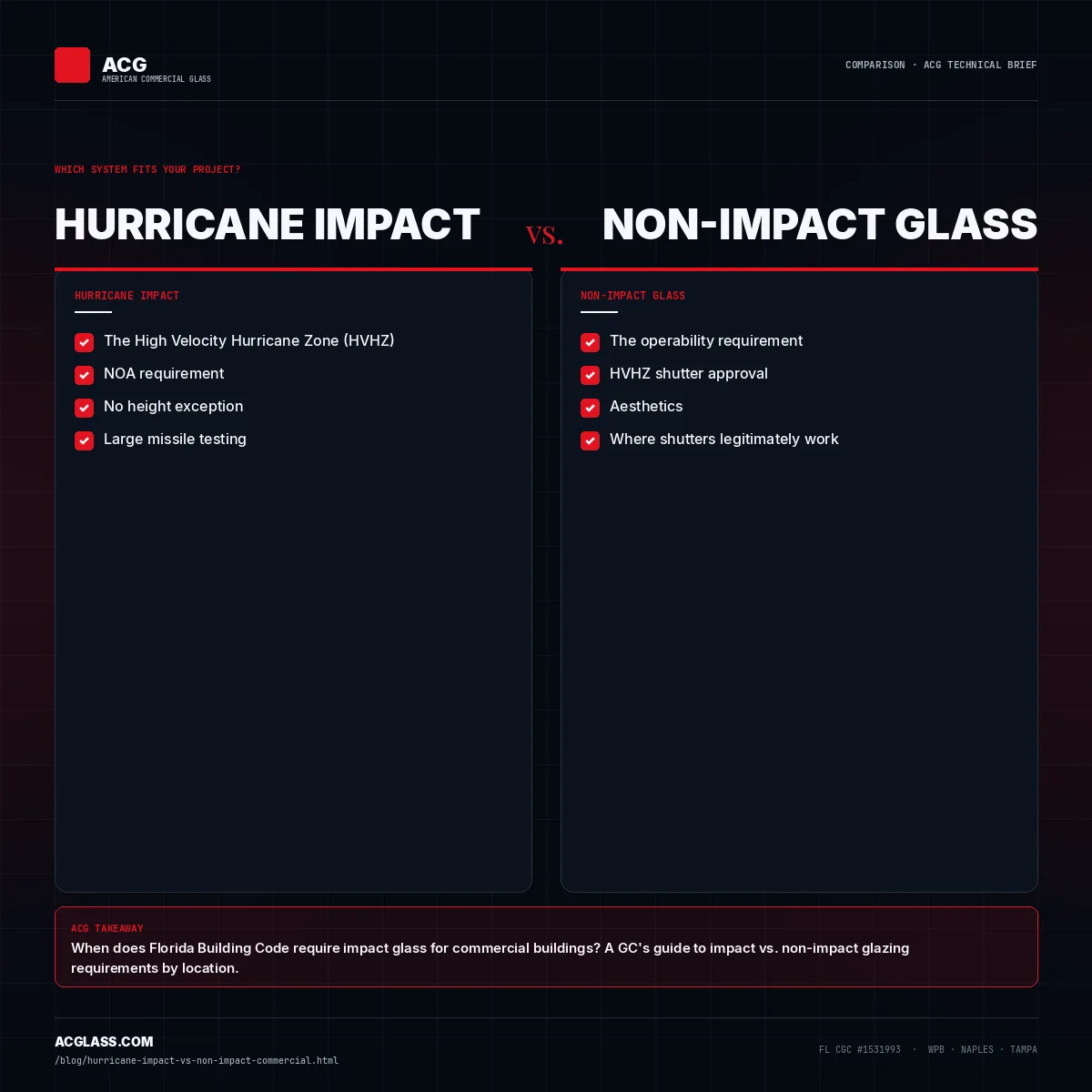
NOA requirement: All exterior glazing products used in the HVHZ must have Miami-Dade County Notice of Acceptance (NOA) approval. Florida product approval alone (issued by the Florida Department of Business and Professional Regulation) is not sufficient in the HVHZ - the product must have a Miami-Dade NOA, which involves a separate testing and approval process administered by Miami-Dade's product approval division.
No height exception: In wind-borne debris regions outside the HVHZ, the impact requirement applies to glazing within the lower 60 feet of a building - above 60 feet, the glazing is outside the typical debris flight zone and non-impact glazing is permissible. In the HVHZ, this height exception does not exist: all exterior glazing requires NOA-approved impact protection regardless of floor level.
Large missile testing: HVHZ products must pass both large-missile (9-pound 2x4 at 50 fps) and small-missile (2-gram steel ball at 130 fps) impact tests. Both tests must be passed as a complete assembly - the glass unit, frame, glazing compound, and anchorage together - not just the glass alone.
When Can Shutters Substitute for Impact Glass?
Florida Building Code outside the HVHZ allows approved opening protection systems - shutters, removable panels, or other tested products - as an alternative to impact-rated glazing. This is explicitly permitted under FBC 1609.1.2(1)(b). But there are conditions and practical limitations that make shutters rarely the right choice for commercial projects.
The operability requirement: Shutters must actually be deployed before a storm event. If a building is occupied by a commercial tenant who isn't reliably going to deploy shutters before a storm, the opening protection strategy fails operationally even if it passes code technically. For owner-occupied commercial buildings or industrial facilities, this may be manageable. For multi-tenant commercial buildings, retail, or mixed-use - it's a liability exposure that most building owners prefer to avoid.
HVHZ shutter approval: In the HVHZ, shutters themselves must carry Miami-Dade NOA approval. This is a narrower product set than for non-HVHZ locations, and the cost difference between NOA-approved shutters and impact-rated glazing is often not significant enough to justify the operability complications.
Aesthetics: On commercial facades, shutter tracks and hardware are a visible element. Most architects and owners on commercial projects specify impact glazing to preserve facade aesthetics - the storefront or curtainwall looks the same whether a storm is approaching or not.
Where shutters legitimately work: Existing buildings undergoing renovation where replacing glazing is cost-prohibitive. Single-tenant industrial or warehouse facilities with reliable storm deployment protocols. Projects where the budget difference between shuttered non-impact and impact glazing is significant and the owner accepts the operational requirements.
Non-HVHZ Commercial Projects: The Decision Matrix
For commercial projects outside Miami-Dade and Broward counties, the impact decision depends on the specific design wind speed at the project site. Here's a simplified matrix:
- V < 130 mph, more than 1 mile from coast: No impact requirement. Standard wind-load-compliant glazing. ASTM E283, E330, E331 performance testing as specified.
- V < 130 mph, within 1 mile of coast: Wind-borne debris region. Impact or approved protection required in lower 60 feet. Confirm whether project site actually falls within the 1-mile zone.
- 130 mph ≤ V < 140 mph: Wind-borne debris region throughout. Impact or approved protection in lower 60 feet. Florida product approval required.
- V ≥ 140 mph (most of South Florida): Impact or approved protection throughout. Florida product approval required. For HVHZ projects, NOA required.
Cost Comparison: Impact vs. Non-Impact
These cost premiums should be evaluated against the full alternative: the cost of an approved shutter system (installed, not just the shutter hardware cost), the operational requirements for deployment, and the ongoing maintenance and replacement liability. For most commercial projects in Florida's coastal regions, impact glazing is the right answer - both economically and operationally.
ACG reviews the wind speed requirements for every project and confirms the applicable protection requirement before pricing. If there's an opportunity to use non-impact glazing on a portion of a project - upper floors above 60 feet, for example, on an inland project - we'll identify it. If the spec calls for impact throughout and the code actually requires it throughout, we'll confirm that too. The GC shouldn't have to figure this out without the glazing sub's input.