
Commercial storefront glass doesn't last forever. Most systems are designed for 20-30 years of service life. But Florida's heat, humidity, and hurricane season can accelerate that timeline. Here's how to know when you're past the point of repair and into replacement territory.
Signs You Need to Replace Your Storefront Glass
1. Foggy or Hazy Glass Between the Panes
This is the most common sign, and it's unmistakable. You see fog, haze, or condensation permanently stuck between the two panes of glass. It doesn't wipe off because it's on the inside of the sealed unit.
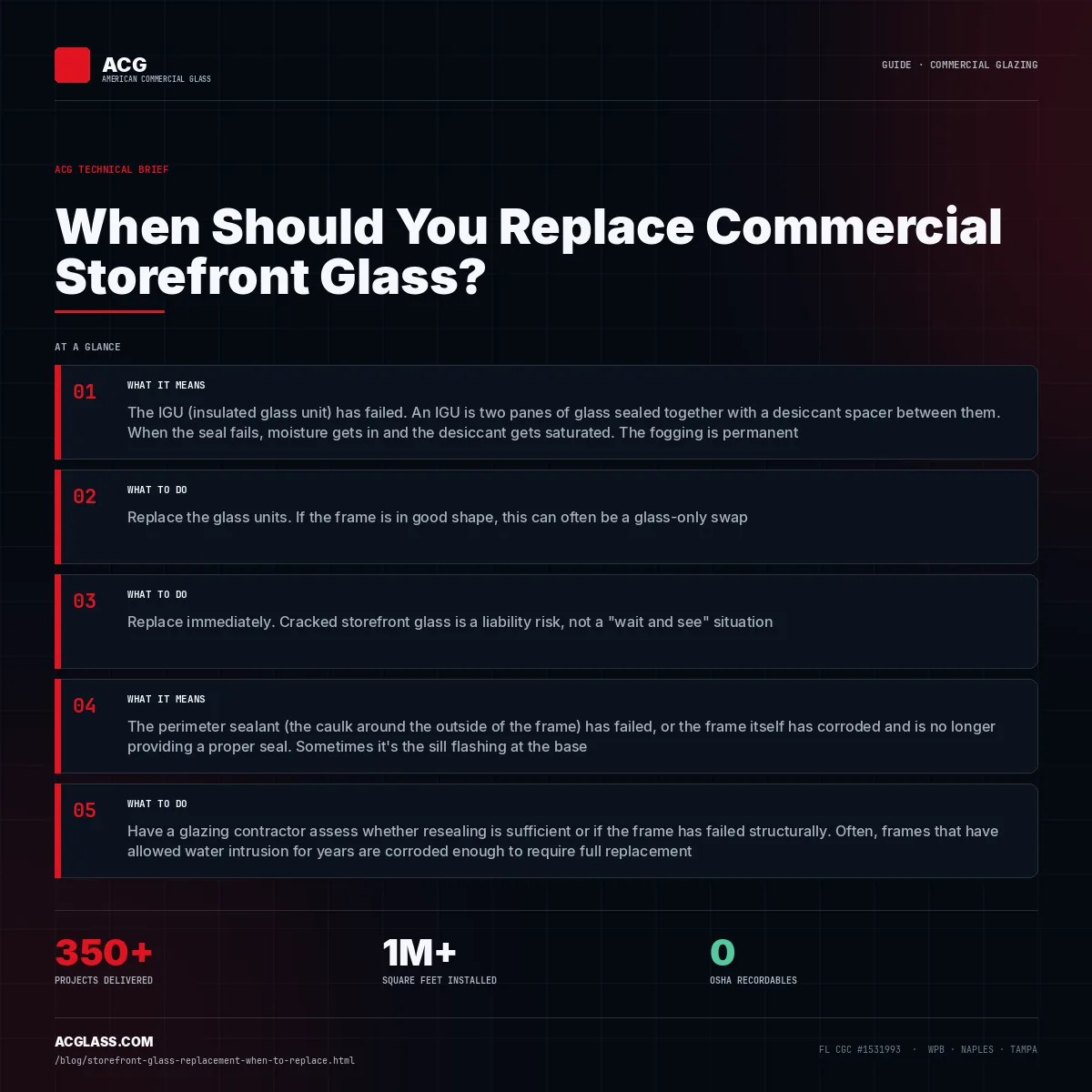
What it means: The IGU (insulated glass unit) has failed. An IGU is two panes of glass sealed together with a desiccant spacer between them. When the seal fails, moisture gets in and the desiccant gets saturated. The fogging is permanent.
What to do: Replace the glass units. If the frame is in good shape, this can often be a glass-only swap.
2. Visible Cracks or Chips
Cracked glass is a safety issue and a code issue. Tempered glass in commercial storefronts is typically required by code. Once tempered glass cracks, it can shatter completely with very little additional force.
What to do: Replace immediately. Cracked storefront glass is a liability risk, not a "wait and see" situation.
3. Water Staining or Water Intrusion Inside the Building
Water stains on the sill, on flooring near the storefront, or on the wall below the glass are signs the system is no longer waterproof. In Florida, water intrusion causes mold fast. This is an urgent repair.
What it means: The perimeter sealant (the caulk around the outside of the frame) has failed, or the frame itself has corroded and is no longer providing a proper seal. Sometimes it's the sill flashing at the base.
What to do: Have a glazing contractor assess whether resealing is sufficient or if the frame has failed structurally. Often, frames that have allowed water intrusion for years are corroded enough to require full replacement.
4. Drafts Near the Storefront
If you can feel air movement near the glass on a windy day, the system is not performing properly. This wastes energy and can cause comfort complaints from tenants.
In Florida, it also means the system isn't performing to its rated design pressure - which is a code issue on buildings that require specific wind pressure performance.
5. Failed or Sticking Door Hardware
Storefront doors that don't close properly, don't latch, drag on the threshold, or have broken closers create security risks and ADA compliance issues. Hardware failure is often a sign that the frame has shifted or corroded.
Sometimes hardware replacement alone resolves this. But if the door frame has deformed or the threshold has failed, you're looking at frame replacement.
6. Code Violations - Impact Requirements
This one catches property owners off guard. If your building is in an area that now requires impact-rated glazing, and your current storefront doesn't meet that requirement, you may be required to upgrade at your next permit - even if the glass looks fine.
Florida has updated its wind zone maps multiple times. Buildings that were compliant when built may not be compliant with current code. This becomes an issue during a renovation permit or a change-of-use permit.
See our guide: Hurricane Impact Windows for Commercial Buildings in Florida
Glass-Only Replacement vs Full System Replacement
The right choice depends on the condition of your frame.
| Scenario | Recommendation | Approx. Cost |
|---|---|---|
| Failed IGU seals, frame in good shape | Glass-only replacement | By scope |
| Corroded frame, water damage, failed seals | Full system replacement | By scope |
| Non-impact glass in HVHZ | Full system replacement (code upgrade) | By scope |
| Storefront 20+ years old with multiple issues | Full system replacement | By scope |
How Long Does Replacement Take?
A glass-only replacement (IGU swap) on a typical retail storefront can be done in 1-2 days once the new glass arrives. Fabricating replacement glass units typically takes 2-4 weeks.
A full storefront replacement takes longer. See our full breakdown: How Long Does Storefront Glass Installation Take?
Will the Business Need to Close During Replacement?
For glass-only swaps, usually not. We can work one panel at a time and keep the building secure overnight.
For full system replacement, there may be a short period (typically 1-2 days per section) where the opening is temporarily covered. We coordinate timing with building owners and tenants to minimize disruption.
ACG Glass Replacement in Florida
Our commercial storefront services include full replacement assessments. We'll evaluate your existing system, give you a recommendation on glass-only vs. full replacement, and provide a scope and price within 48 hours of reviewing your plans or photos.
We serve the full state from three offices: West Palm Beach, Naples, and Tampa. Call us at (772) 486-7711 or send us your plans.
Frequently Asked Questions
What are the signs that commercial storefront glass needs to be replaced?
The main signs are: foggy or hazy glass between panes (failed IGU seal), visible cracks or chips in the glass, water staining inside the building near the glass, condensation on the inside of the glass, drafts near the frame, hardware that sticks or fails to latch, and frames that show visible corrosion or separation at the sealant joints.
Can you replace just the glass without replacing the whole storefront?
Sometimes. If the aluminum frame is in good condition and the new glass units will fit the existing frame dimensions, you can often replace just the glass inserts. This is called a glass-only replacement or an IGU replacement. However, if the frame is corroded, out of tolerance, or doesn't meet current code requirements for wind resistance, you'll need to replace the full system.