
Florida has the strictest commercial window requirements in the country. If you're building, renovating, or replacing glass on a commercial building in Florida, you need to understand the impact rating system - before you buy a single piece of glass.
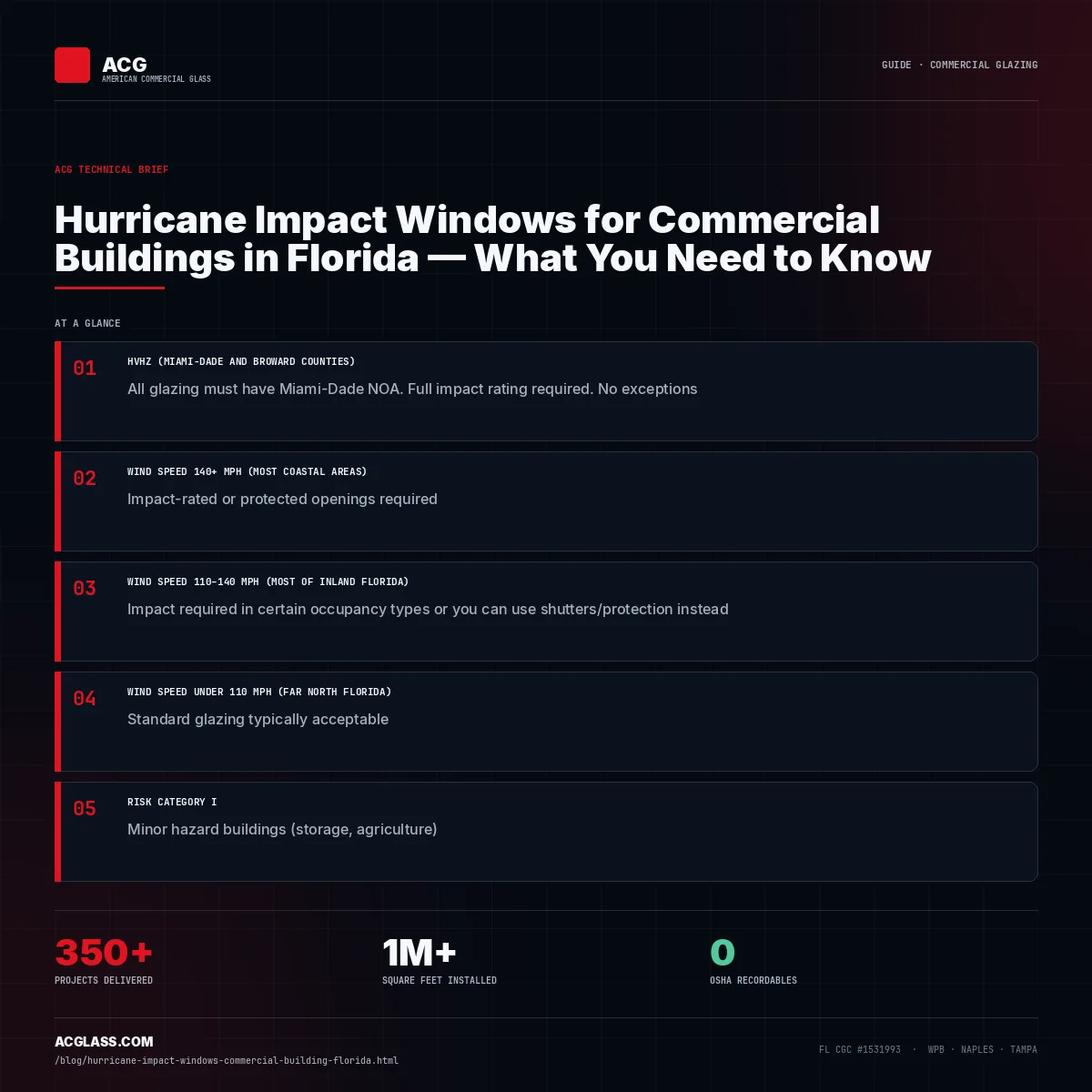
The Short Version: Do You Need Impact Glass?
Almost certainly yes - somewhere in your building. Here's the simple version:
- HVHZ (Miami-Dade and Broward counties): All glazing must have Miami-Dade NOA. Full impact rating required. No exceptions.
- Wind Speed 140+ mph (most coastal areas): Impact-rated or protected openings required.
- Wind Speed 110-140 mph (most of inland Florida): Impact required in certain occupancy types or you can use shutters/protection instead.
- Wind Speed under 110 mph (far North Florida): Standard glazing typically acceptable.
| Zone / Area | Requirement | Approval Needed |
|---|---|---|
| Miami-Dade & Broward (HVHZ) | Full Impact - Large Missile | Miami-Dade NOA |
| Coastal FL (140+ mph) | Impact or Shutters | FL Product Approval |
| Inland FL (110-140 mph) | Impact or Protection (Risk Cat. dependent) | FL Product Approval |
| North FL (under 110 mph) | Standard code compliant | FL Product Approval |
What Is Impact-Rated Glass?
Impact-rated glass is not just thick glass. It is a specific type of laminated glass designed to stay in place when struck by debris during a hurricane.
Regular glass breaks and shatters. When a window in a building shatters during a storm, the pressure inside the building spikes. This can blow off the roof and collapse the structure.
Impact glass stays in the frame even when it breaks. The glass has a plastic interlayer (like a car windshield) that holds the pieces together. The frame is also reinforced to stay anchored during extreme wind pressure.
What Is Large Missile Impact Testing?
This is the specific test that certifies impact-rated glazing. Here's what happens in the test lab:
- A 9-pound 2×4 piece of lumber is fired at the glass at 50 feet per second (about 34 mph)
- The missile hits the glass three times at different locations
- The glass must not allow the missile to penetrate through
- After the missile test, the assembly is pressurized with cyclic wind load testing
- The frame and glass must maintain integrity throughout
Products that pass receive a test report. That test report is part of the Florida Product Approval or Miami-Dade NOA documentation.
Small Missile Impact is a different, less stringent test. It uses small steel balls instead of lumber. Small Missile Impact is acceptable in some situations but does NOT meet the standard required in the HVHZ or for most commercial buildings in Florida's primary wind zones.
Florida Product Approval vs Miami-Dade NOA
This is the part that trips up a lot of property owners and even some contractors.
Florida Product Approval (FL PA) is issued by the Florida Department of Business and Professional Regulation. It is required statewide for any fenestration product installed in Florida. Products with a FL PA number can be installed anywhere in Florida except the HVHZ.
Miami-Dade Notice of Acceptance (NOA) is issued by Miami-Dade County. Products must pass more stringent TAS (Test Application Standard) tests to receive an NOA. An NOA is required for all glazing products installed in Miami-Dade and Broward counties (the HVHZ). Products with an NOA are also valid everywhere else in Florida.
The key rule: FL PA only = cannot be used in HVHZ. NOA = can be used anywhere in Florida.
Our impact windows and doors for Florida page covers this in detail, with the NOA documentation we carry for our standard systems.
What About Risk Categories?
Florida Building Code uses Risk Categories (I through IV) to determine how strictly a building must be protected. Higher risk = stricter requirements.
- Risk Category I: Minor hazard buildings (storage, agriculture)
- Risk Category II: Standard commercial buildings
- Risk Category III: Schools, hospitals, emergency shelters
- Risk Category IV: Essential facilities (fire stations, EOCs)
A school in Hillsborough County (Risk Category III) has stricter glazing requirements than a strip mall in the same county (Risk Category II) even though they're in the same wind zone.
Your structural engineer or architect of record determines the Risk Category for your project. Make sure your glazing contractor sees this designation before they price the scope.
Can You Use Shutters Instead of Impact Glass?
In some zones, yes. Shutters (approved protective systems) can substitute for impact-rated glazing on windows. However, shutters are generally not practical for storefronts or large commercial glass areas. And in the HVHZ, impact glass is typically required regardless.
For most commercial construction in Florida, impact-rated glass is the better solution. It is permanent, requires no deployment, and is increasingly required by insurance carriers anyway.
ACG and Florida Impact Compliance
Every glazing system we install carries the correct product approvals for its location. We carry both FL PA and Miami-Dade NOA-listed products. For buildings in the HVHZ, we use only NOA-certified systems.
Our team handles full code compliance documentation - product approval submittals, test reports, and PE-stamped calculations where required. We install commercial glass across Florida, including in the HVHZ.
See our commercial glazing services or send us your plans to confirm what your project requires.
Frequently Asked Questions
Do commercial buildings in Florida need hurricane impact windows?
It depends on the location. All of Florida requires glazing that meets Florida Building Code wind resistance requirements. Buildings in the High Velocity Hurricane Zone (HVHZ) - primarily Miami-Dade and Broward counties - require products with a Miami-Dade Notice of Acceptance (NOA) that passes Large Missile Impact testing. Buildings elsewhere in Florida need impact-rated or protected openings based on the local wind speed and building risk category.
What is Large Missile Impact testing for commercial windows?
Large Missile Impact testing is the standard used to certify impact-rated glazing. A 9-pound 2x4 lumber piece is fired at the glass at 50 feet per second in a laboratory. The glass must not allow the missile to penetrate, and the frame must maintain structural integrity. After the missile test, the assembly also undergoes cyclic wind pressure testing. Products that pass receive certification for use in hurricane-prone areas.
What is the difference between a Florida Product Approval and a Miami-Dade NOA?
A Florida Product Approval (FL PA) is issued by the Florida Department of Business and Professional Regulation and is valid statewide - including most of Florida's coastal areas. A Miami-Dade Notice of Acceptance (NOA) is issued by Miami-Dade County and is required for the High Velocity Hurricane Zone, which covers Miami-Dade and Broward counties. Products with an NOA are valid everywhere in Florida. Products with only an FL PA are not valid in the HVHZ.