
Storefront and curtainwall both look like "glass building exterior" - but they are fundamentally different structural systems. Using the wrong one is expensive. Here's how to know which system your project needs.
The Simple Decision Tree
Answer these questions in order:
- Is the glass wall under 15 feet tall and contained within one floor?
→ If yes: Storefront - Does the glass span from one floor slab to the next?
→ If yes: Window Wall (for floor-to-floor spans in multifamily/mid-rise) - Does the glass need to span multiple floors and anchor continuously to a structural frame?
→ If yes: Curtainwall
The Cost Difference (and Why)
| System | Cost / SF | Height Limit | Building Type |
|---|---|---|---|
| Storefront | By scope | 12-15 ft typical | 1-3 story retail, office |
| Window Wall | By scope | Floor-to-floor | Mid-rise multifamily, office |
| Curtainwall | By scope | No structural limit | High-rise, towers, institutions |
What Is Storefront?
A storefront system is a non-structural glazing system. It fills a framed opening in a building's exterior wall. The building structure - concrete, masonry, or steel framing - supports the system above and below.
Storefront is ideal for:
- Single-story retail and restaurant buildings
- Ground-floor lobbies of low-to-mid-rise buildings
- Office building entrances
- Medical offices and urgent care clinics
- Any single-floor application under 15 feet
Learn more: What Is a Storefront Glazing System?
What Is Curtainwall?
Curtainwall is a structural glazing system. It hangs on the outside of a building's structural frame and spans from floor slab to floor slab - or continuously across multiple stories. The curtainwall carries its own weight and transfers wind loads to the structure through engineered anchors.
Curtainwall is required when:
- The glass wall spans more than one floor
- The glass wall exceeds ~15 feet in height without intermediate structural support
- The architecture calls for a continuous glass surface from the ground to the roof
- The building is a high-rise where the glass envelope is the exterior wall
The premium over storefront reflects the structural engineering, heavier extrusions, complex anchoring, and specialized installation methods required.
Our curtainwall installation team handles full-building glazing scopes.
What Is Window Wall (and When Is It Used)?
Window wall is a third system that often gets confused with both storefront and curtainwall. It sits between them in terms of performance and cost.
Window wall spans from floor slab to floor slab on multifamily or mid-rise buildings. It is not structural like curtainwall - it bears on each floor slab. It is thicker and more thermally performant than storefront.
Window wall is ideal for:
- 5-15 story multifamily buildings
- Mid-rise office buildings
- Buildings where floor-to-floor glazing is desired without full curtainwall cost
The Common Mistake: Specifying Storefront When You Need Curtainwall
Architects and owners sometimes try to save money by specifying storefront in a curtainwall application. This is a problem for several reasons:
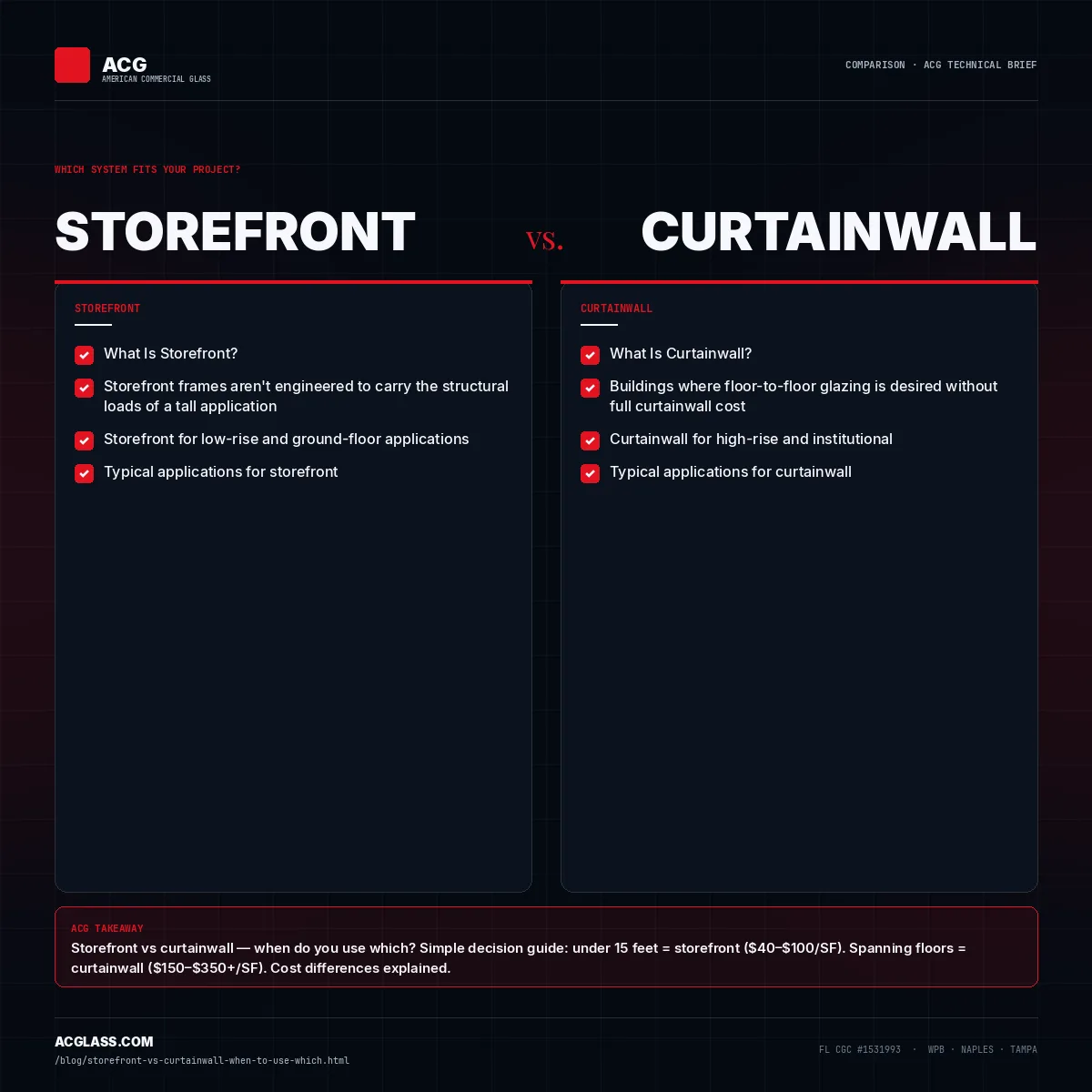
- Storefront frames aren't engineered to carry the structural loads of a tall application
- The system will deflect excessively under wind load, potentially cracking glass
- It won't meet the design pressure requirements on the structural drawings
- It won't pass plan review or inspection
The reverse mistake - specifying curtainwall when storefront would work - wastes money. A ground-floor retail space that's only 12 feet tall does not need curtainwall.
What ACG Can Help You Specify
If you're not sure which system is right, we can review your drawings and tell you in 24 hours. We install all three system types:
- Storefront for low-rise and ground-floor applications
- Window wall for multifamily and mid-rise
- Curtainwall for high-rise and institutional
Our Tampa commercial glazing team and our South Florida offices handle all system types. Send us your plans and we'll confirm the right system and return a complete scope in 48 hours.
Frequently Asked Questions
What is the main difference between storefront and curtainwall?
A storefront system sits in an opening in a wall and is supported by the building structure at head and sill. It does not carry structural loads. A curtainwall is a separate structural system that hangs on the outside of the building frame, spans from floor to floor, and carries its own wind and gravity loads independently of the interior building structure.
How tall can a storefront system go?
Most storefront systems are rated for heights up to 12-15 feet. Beyond that, the aluminum extrusions become too flexible to meet deflection requirements without additional engineering. For taller applications spanning multiple floors, curtainwall is the correct system.