
When someone says "commercial glass," they could mean a dozen different things. The type of glass matters - for safety, for energy performance, for code compliance, and for cost. Here's what you actually need to know.
The Main Types of Commercial Glass
Tempered Glass
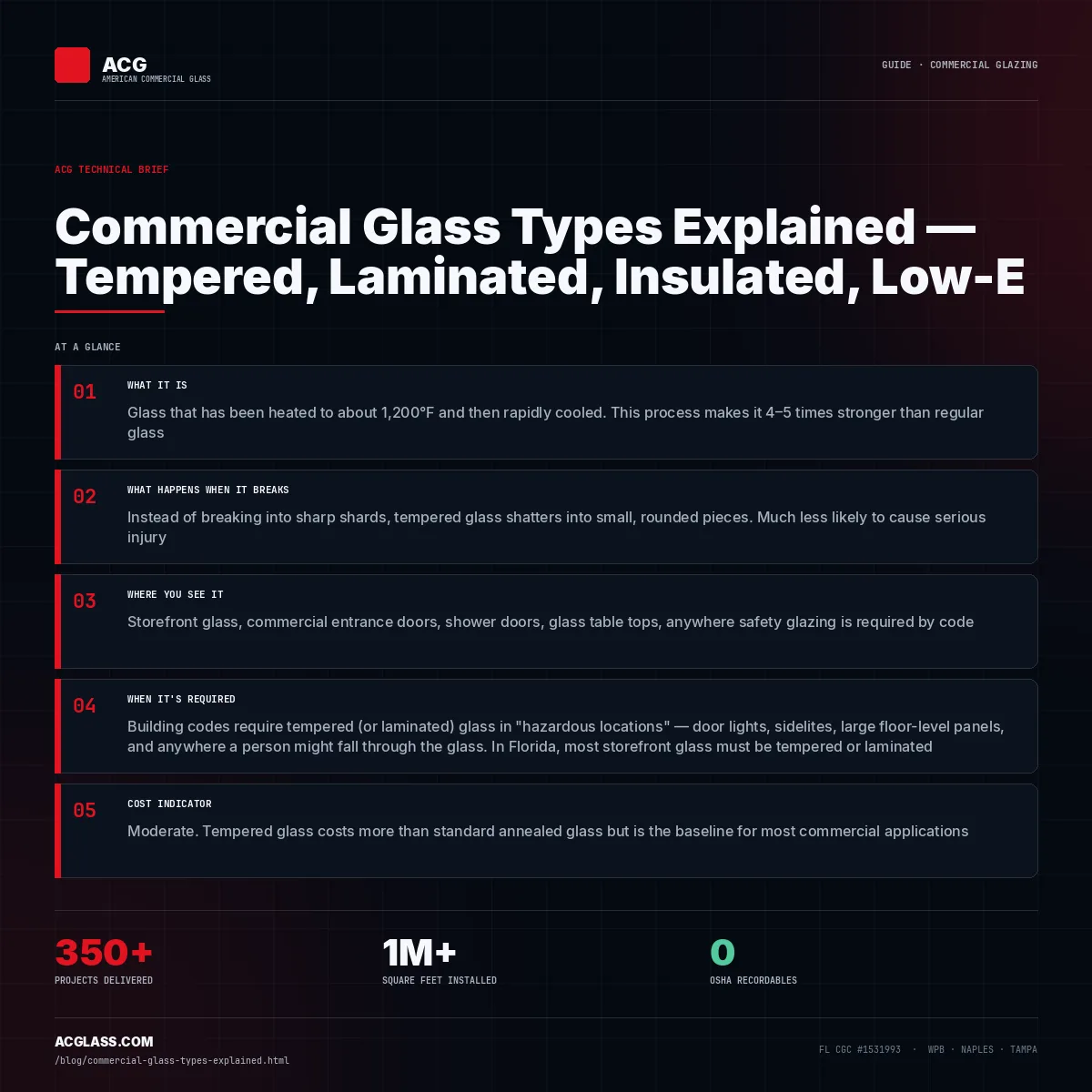
What it is: Glass that has been heated to about 1,200°F and then rapidly cooled. This process makes it 4-5 times stronger than regular glass.
What happens when it breaks: Instead of breaking into sharp shards, tempered glass shatters into small, rounded pieces. Much less likely to cause serious injury.
Where you see it: Storefront glass, commercial entrance doors, shower doors, glass table tops, anywhere safety glazing is required by code.
When it's required: Building codes require tempered (or laminated) glass in "hazardous locations" - door lights, sidelites, large floor-level panels, and anywhere a person might fall through the glass. In Florida, most storefront glass must be tempered or laminated.
Cost indicator: Moderate. Tempered glass costs more than standard annealed glass but is the baseline for most commercial applications.
Laminated Glass
What it is: Two or more panes of glass with a plastic interlayer (usually PVB - polyvinyl butyral) bonded between them. Like a car windshield.
What happens when it breaks: The interlayer holds the glass together. The glass cracks but does not fall out of the frame. This is critical for hurricane resistance.
Where you see it: Impact-rated storefronts, curtainwall systems in HVHZ, skylights, overhead glazing, and any application where glass fallout is a concern.
When it's required: Required in Florida for impact-rated glazing (to meet Large Missile Impact test standards) and for overhead glass applications.
Cost indicator: Higher than tempered. Laminated glass adds the interlayer fabrication cost.
Insulated Glass Unit (IGU)
What it is: Two panes of glass sealed together with a spacer between them. The sealed space is filled with air or an inert gas (usually argon or krypton) for better thermal performance.
What it does: The sealed air space dramatically reduces heat transfer through the glass. An IGU is much more energy-efficient than a single pane of glass.
Where you see it: Virtually all commercial buildings today. Single-pane glass is essentially obsolete in commercial construction.
When it fails: When the edge seal breaks, moisture enters the sealed space and the unit appears foggy. This is called seal failure. The glass must be replaced - the seal cannot be repaired.
See our guide: When Should You Replace Commercial Storefront Glass?
Cost indicator: Standard commercial IGUs are relatively cost-effective. Specialty configurations (triple-pane, gas fills, custom spacers) cost more.
Low-E Glass
What it is: Glass with a microscopically thin metallic coating applied to one surface. "Low-E" stands for low emissivity - it reduces how much infrared heat the glass radiates or transmits.
What it does: In hot climates like Florida, Low-E glass reflects solar heat away from the building. It lets visible light in but blocks most of the heat. This reduces cooling loads significantly.
Where you see it: Almost every commercial building built in Florida in the last 15 years. You may notice a slight tint or reflective quality from outside.
When it's required: Florida Building Code requires fenestration products to meet specific Solar Heat Gain Coefficient (SHGC) and U-factor requirements. Standard clear glass doesn't meet these requirements. Low-E glass typically does.
Cost indicator: Low-E coatings add a small cost premium to the glass. The energy savings over time more than offset the upfront cost.
Impact Glass (Laminated + Tested)
What it is: Laminated glass that has been tested to specific impact resistance standards. "Impact glass" isn't a glass type per se - it's a laminated glass configuration that has passed Large Missile Impact or Small Missile Impact testing.
What it does: Stays intact during a hurricane. When struck by debris, the glass cracks but the interlayer holds it in place, maintaining the building envelope.
Where you see it: Required throughout South Florida (HVHZ) and in wind zones above 130 mph. Common in all coastal Florida commercial buildings.
When it's required: See our detailed guide: Hurricane Impact Windows for Commercial Buildings in Florida
Cost indicator: Highest of the glass types listed here. Impact glass is more expensive to fabricate and the frames must also be reinforced.
Glass Type Comparison Table
| Glass Type | Safety | Energy | Hurricane | Cost |
|---|---|---|---|---|
| Tempered | High | None | No | Moderate |
| Laminated | High | None | If tested | Moderate-High |
| IGU | Base | High | No | Moderate |
| Low-E IGU | Base | Very High | No | Moderate |
| Impact (Lam. IGU) | Very High | High | Yes | High |
Real-World Combinations
In practice, most commercial glass units combine several of these properties. Here are common configurations:
- Tempered Low-E IGU: The standard for most Florida commercial storefronts outside the HVHZ. Tempered for safety, Low-E for energy code compliance, IGU for thermal performance.
- Laminated Low-E IGU (Impact): Required in HVHZ and coastal areas. Both panes may be tempered, with a laminated interlayer and Low-E coating on one surface.
- Spandrel Glass: Opaque (usually painted or filmed on the back) glass used to conceal floor slabs and beams between vision glass areas. Typically tempered.
What's Right for Your Project?
The right glass for your project depends on:
- Location (HVHZ, coastal, inland)
- Building type and risk category
- Energy code requirements for your county
- Architect's specifications
Our commercial glazing services include full glass specification recommendations. We'll tell you exactly what your project requires and why.
Need a bid? Send us your plans and we'll specify the right glass and return a complete scope in 48 hours. We handle storefront installation across Florida from our three offices.
Frequently Asked Questions
What is the difference between tempered and laminated glass?
Tempered glass is heat-treated to be stronger than standard glass. When it breaks, it shatters into small, relatively harmless pieces. Laminated glass has a plastic interlayer between two glass panes that holds the glass together when it breaks. Impact-rated glass uses laminated glass. Tempered glass is used for safety; laminated glass is used for both safety and security (including hurricane resistance).
What is Low-E glass and do I need it in Florida?
Low-E (low emissivity) glass has a microscopic coating that reflects infrared heat while allowing visible light to pass through. In Florida's hot climate, Low-E glass significantly reduces heat gain, which lowers cooling costs. Florida Building Code requires Low-E or equivalent thermal performance (specific SHGC values) for most commercial buildings statewide.
What is an insulated glass unit (IGU)?
An insulated glass unit (IGU) is two or more panes of glass sealed together with a spacer between them. The sealed air or gas space between the panes provides thermal insulation. When the seal fails, moisture enters and the unit appears foggy - that's when the IGU needs to be replaced.