
From a GC's perspective, the commercial storefront scope often looks like a single line item: "install storefront." In practice, it's a multi-stage process with specific sequencing requirements, trade dependencies, documentation milestones, and potential failure points at each stage. Understanding the process - not just the end result - is what allows a GC to manage the glazing scope effectively rather than just react to problems when they surface.
Stage 1: Submittals
The storefront installation process begins with submittals, not with aluminum hitting the job site. Submittals for a commercial storefront scope include: shop drawings for each storefront system showing frame profiles, anchor conditions, glass specifications, sill flashing details, and door hardware schedules; product data sheets for the aluminum system, glass, hardware, and sealants; Florida Product Approval documentation for every exterior component; and PE-stamped anchor calculations for projects in high-wind zones or HVHZ.
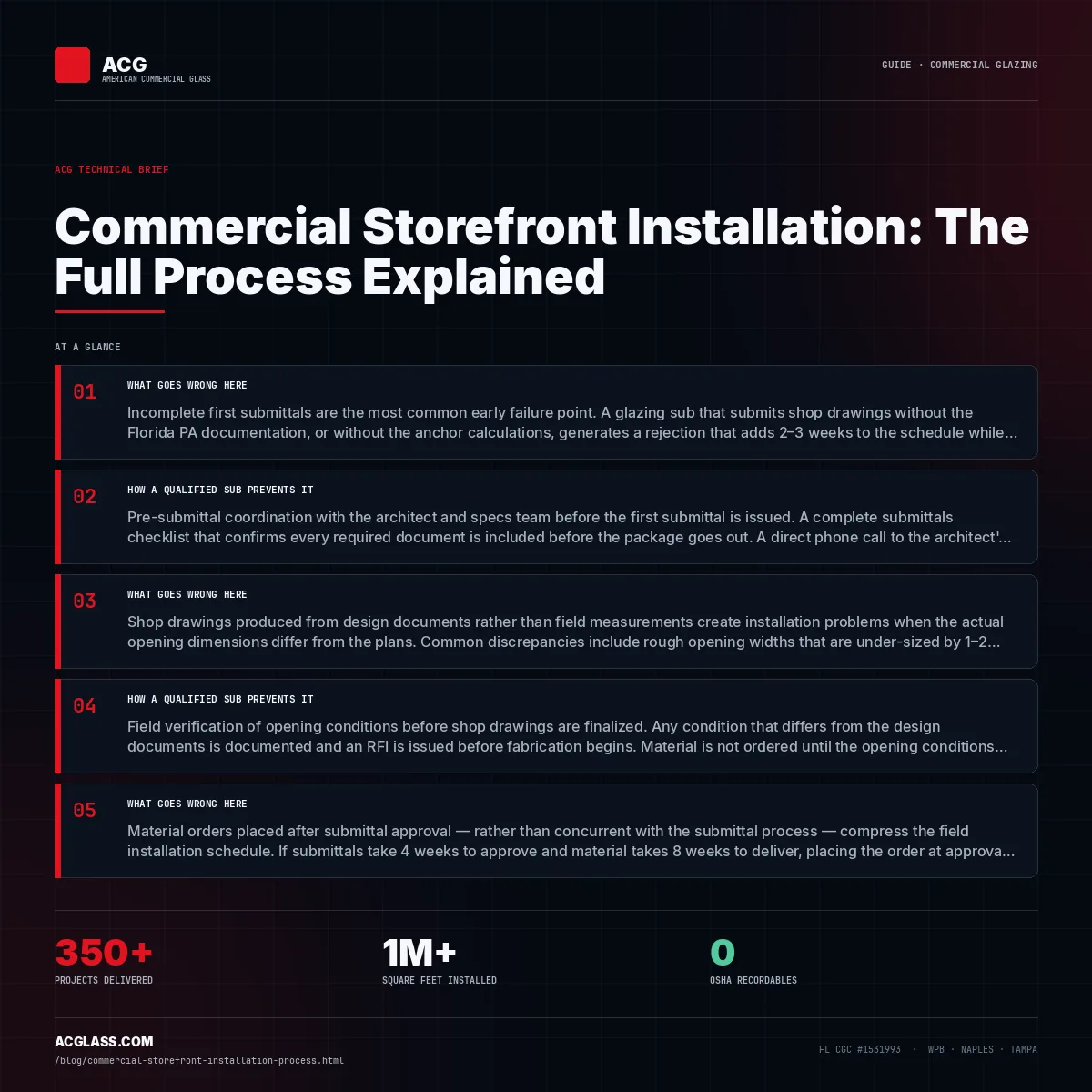
What goes wrong here: Incomplete first submittals are the most common early failure point. A glazing sub that submits shop drawings without the Florida PA documentation, or without the anchor calculations, generates a rejection that adds 2-3 weeks to the schedule while the sub corrects and resubmits. The second most common problem is a submittal that doesn't match the specified system - the sub proposes a substitution without flagging it as such, and the architect's review process becomes an extended RFI cycle.
How a qualified sub prevents it: Pre-submittal coordination with the architect and specs team before the first submittal is issued. A complete submittals checklist that confirms every required document is included before the package goes out. A direct phone call to the architect's team to confirm submittal format preferences. At ACG, first submittal packages are reviewed internally before delivery to confirm completeness against the project spec.
Stage 2: Shop Drawings
Shop drawings are the technical drawings that show exactly how the storefront will be fabricated and installed - specific to this project's dimensions, anchor conditions, and opening configurations. They are derived from field-verified measurements and must reflect the actual as-built conditions, not just the architect's design intent drawings.
Shop drawings show: frame member profiles and sizes, glass lite dimensions, anchor type and spacing, sill conditions and drainage design, head conditions and flashing, door frame details and door swing clearances, and hardware rough-in locations.
What goes wrong here: Shop drawings produced from design documents rather than field measurements create installation problems when the actual opening dimensions differ from the plans. Common discrepancies include rough opening widths that are under-sized by 1-2 inches, slab edges that aren't flush or plumb, and head conditions that don't match the design detail. If the glazing sub fabricates material to drawing dimensions without field verification, the material arrives and doesn't fit.
How a qualified sub prevents it: Field verification of opening conditions before shop drawings are finalized. Any condition that differs from the design documents is documented and an RFI is issued before fabrication begins. Material is not ordered until the opening conditions are verified - or, if lead times require early ordering, oversized material is ordered with field-cut allowances built in.
Stage 3: Product Approval and Material Procurement
After submittals are approved, the glazing sub finalizes the material order. For commercial storefront in Florida, this means: confirming the specified aluminum system has a valid Florida PA (and NOA if in HVHZ), ordering the correct glass specification (impact-rated laminated glass in wind-borne debris regions), and confirming all door hardware is code-compliant and coordinated with the door schedule.
Material lead times for commercial storefront are typically 6-10 weeks from order date to delivery, depending on system, glass specification, and current manufacturer backlogs. In HVHZ, impact-rated laminated glass with a Miami-Dade NOA adds lead time and limits manufacturer options.
What goes wrong here: Material orders placed after submittal approval - rather than concurrent with the submittal process - compress the field installation schedule. If submittals take 4 weeks to approve and material takes 8 weeks to deliver, placing the order at approval means 12 weeks from contract execution to material on site. A competent glazing sub places a preliminary material order within 1-2 weeks of contract execution, based on preliminary quantities, and adjusts when submittals are approved.
How a qualified sub prevents it: Early material procurement planning. Identify long-lead items - specialty glass, impact-rated laminated lites, non-standard hardware - and order them early. Confirm Florida PA/NOA status for every product before ordering. Track lead times against the master schedule weekly.
Stage 4: Field Installation
Field installation of commercial storefront follows a defined sequence: sill preparation and anchor installation, frame erection starting with the bottom rail, vertical mullion installation, head installation, glass setting, glazing bead installation, and door installation including hardware.
The GC's role in the field installation phase is ensuring the opening conditions are ready: floors and slabs at the correct elevation, rough openings plumb and dimensionally accurate, masonry or stud backup complete, waterproofing or flashing behind the frame condition completed before the frame is set, and adjacent trades coordinated so the glazing crew has clear access to the openings.
What goes wrong here: Opening conditions that aren't ready when the glazing crew arrives. This is the single most common cause of schedule impact in the field installation phase - and it's usually the GC's problem, not the glazing sub's. A glazing crew that arrives to find floors not poured, openings blocked by other trades, or waterproofing incomplete cannot install and must demobilize. Remobilization costs time and money. The second most common issue is glass breakage during delivery or handling - without replacement units pre-ordered, broken glass can delay project completion by weeks.
How a qualified sub prevents it: Pre-installation site readiness checklist, submitted to the GC superintendent at least 5 business days before scheduled installation. If conditions are not ready, the sub flags it and adjusts the schedule before mobilizing. On glass breakage: a qualified sub maintains a buffer stock of standard glass lites for common sizes and has a replacement order process that minimizes downtime.
Stage 5: Caulking and Sealants
Perimeter sealant - the caulk joint between the storefront frame and the adjacent construction - is the last line of defense against water infiltration. On a commercial project, the sealant specification typically includes: a backer rod to control joint depth, an approved sealant product (typically a silicone or polyurethane sealant meeting ASTM C920), and proper surface preparation (clean, dry, primed surfaces per the sealant manufacturer's instructions).
What goes wrong here: Sealant applied over contaminated surfaces - paint overspray, form release compound, dirt - fails adhesion and allows water infiltration within months. Sealant applied without a backer rod is too thin and fails cohesively under thermal movement. Sealant that isn't tooled properly has voids. These failures don't show up at inspection - they show up as water intrusion complaints after occupancy.
How a qualified sub prevents it: Surface preparation is as important as the sealant itself. The glazing crew cleans and primes all sealant substrates before application. Backer rod is installed to the correct diameter for the joint width. Sealant is tooled within the application window. A final sealant inspection is performed before the crew demobilizes.
Stage 6: Punch List and Closeout
The punch list phase covers final inspection, adjustment, and documentation. Hardware is adjusted for proper operation - door closers set for the correct sweep speed and latching force, panic hardware tested for code-compliant release force, thresholds verified at the correct height. Glass is inspected for fabrication defects, chips, or installation scratches. Frame alignment is checked. Sealant is inspected for voids or adhesion gaps.
Closeout documentation typically includes: warranty documentation for the glazing system and hardware, Florida Product Approval numbers for all installed products (required in the project closeout file for inspection), and maintenance instructions for hardware and sealants.
What goes wrong here: Incomplete closeout documentation is a common cause of final inspection delays in Florida. If the Florida PA numbers aren't in the closeout file, or if warranty documentation is missing, the building official may hold the final inspection until the documentation is produced.
ACG: The Full Process, Every Project
American Commercial Glass manages every stage of the commercial storefront installation process - from first submittal to closeout documentation - on commercial projects across Florida. Our project managers track submittals, material procurement, field readiness, and inspection status in real time. We don't wait for the GC to ask where things stand - we communicate proactively, before problems become surprises.
Send us your plans and we'll return a detailed storefront scope within 48 hours.
Frequently Asked Questions
How long does the commercial storefront installation process take from contract to completion?
From contract execution to punch list sign-off, a typical commercial storefront scope runs 14-20 weeks on a medium-complexity project. The breakdown: submittal preparation (1-2 weeks), submittal review and approval (2-4 weeks), material procurement and fabrication (6-10 weeks), field installation (1-3 weeks), caulking (1 week), and punch list (1-2 weeks). The longest and most schedule-critical phase is procurement - delayed material orders are the most common cause of glazing schedule overruns.
What are the most common causes of storefront installation delays?
In order: (1) Late or incomplete submittals extending the review-and-approval cycle; (2) Material orders placed too late - after submittal approval rather than concurrent with the submittal process; (3) Opening conditions not ready when material arrives on site; (4) Anchor conflicts discovered during installation due to lack of coordination; and (5) Glass breakage without replacement units on order. A qualified glazing PM anticipates all of these and builds mitigation into the schedule from day one.
What does the storefront punch list typically include?
A commercial storefront punch list covers: door hardware adjustment (closer speed, latch alignment, threshold gap), glass quality inspection (scratches, chips, fabrication defects), sealant inspection (voids, adhesion failures), frame alignment verification, glazing bead seating, and operating hardware function testing. In Florida, it also includes verifying all Florida Product Approval documentation is in the project closeout file - incomplete documentation is a common cause of final inspection delays.