
Florida has the most complex commercial window code in the country. Two separate regulatory systems - wind/impact requirements and energy code requirements - both apply to every glazing product. Here's how they work.
The Two Parts of Florida's Commercial Window Code
Every commercial window or glazing system in Florida must satisfy two independent code systems:
- Structural/Impact requirements - based on location's wind speed, building risk category, and whether the building is in the HVHZ
- Energy code requirements - based on SHGC and U-factor performance values set by the Florida Energy Code
A product can pass structural requirements but fail energy code, or vice versa. Both must be satisfied before a product can be installed on a permitted commercial project.
Wind Zones and Design Pressure
Florida's wind requirements are based on the ASCE 7 wind speed maps. Different counties have different minimum design wind speeds:
| Region | County Examples | Approx. Wind Speed | Impact Required? |
|---|---|---|---|
| HVHZ | Miami-Dade, Broward | 175-180+ mph | Yes - NOA required |
| South FL Coast | Palm Beach, Monroe, Collier coast | 150-175 mph | Yes - FL PA |
| Central FL Coast | Sarasota, Charlotte, Hillsborough coast | 130-150 mph | Yes - FL PA |
| Inland Central FL | Orange, Hillsborough inland, Pinellas | 120-130 mph | Risk Cat. dependent |
| North FL Panhandle | Leon, Alachua, inland counties | 100-115 mph | Sometimes not required |
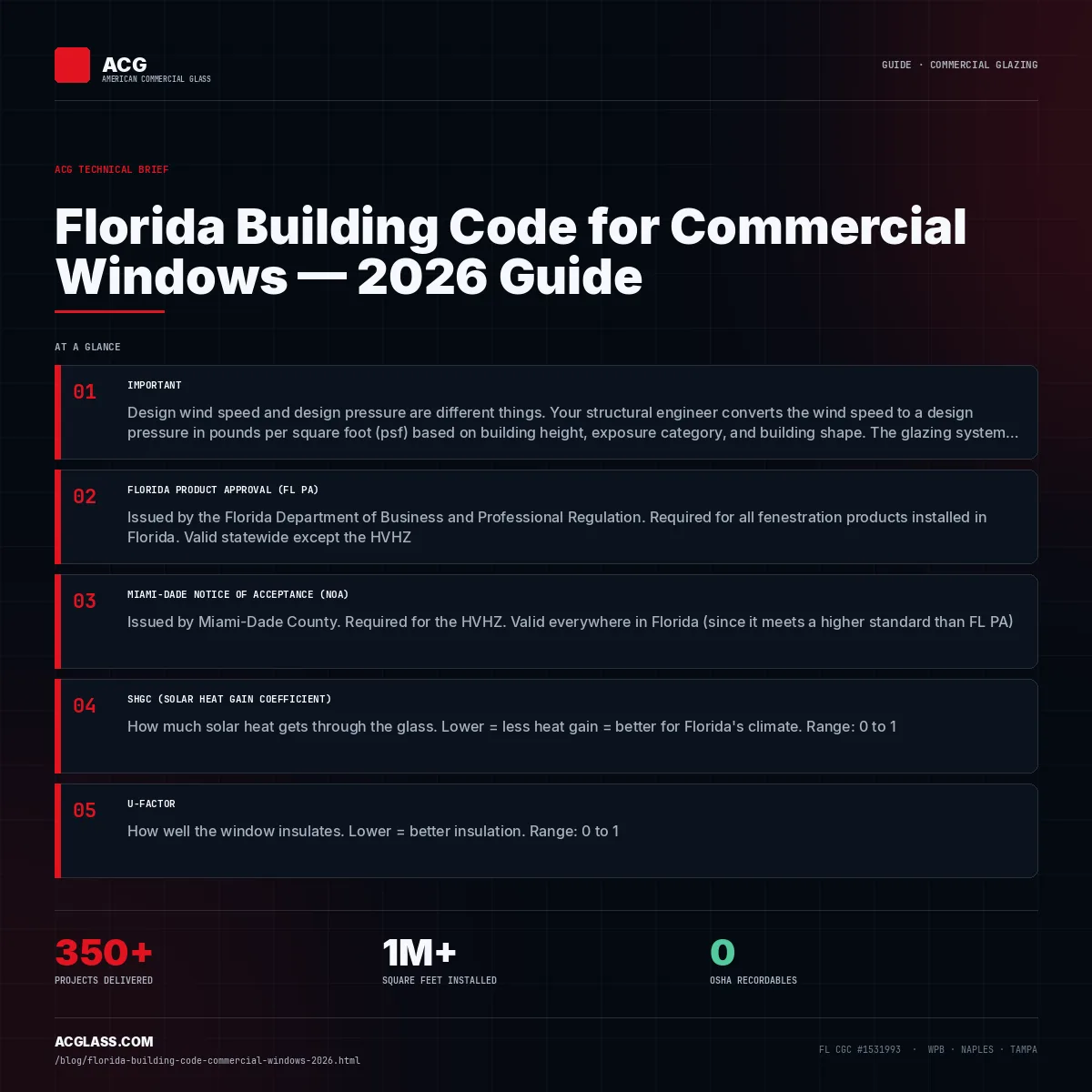
Important: Design wind speed and design pressure are different things. Your structural engineer converts the wind speed to a design pressure in pounds per square foot (psf) based on building height, exposure category, and building shape. The glazing system must have a product approval that covers that psf value at the actual glass size being used.
The HVHZ: Florida's Strictest Zone
The High Velocity Hurricane Zone (HVHZ) covers Miami-Dade and Broward counties. It is the strictest building zone in the United States for fenestration requirements.
What makes HVHZ different:
- All glazing products must have a Miami-Dade Notice of Acceptance (NOA)
- Products must be tested to TAS (Test Application Standard) protocols, which are more stringent than standard ASTM tests
- Large Missile Impact testing is required for all openings - no exceptions
- Installation must follow the exact NOA installation instructions; deviation voids the approval
- Inspections are more rigorous and documentation requirements are stricter
See our detailed HVHZ guide: Hurricane Impact Windows for Commercial Buildings in Florida
Florida Product Approval vs Miami-Dade NOA
There are two approval pathways for glazing products in Florida:
Florida Product Approval (FL PA): Issued by the Florida Department of Business and Professional Regulation. Required for all fenestration products installed in Florida. Valid statewide except the HVHZ.
Miami-Dade Notice of Acceptance (NOA): Issued by Miami-Dade County. Required for the HVHZ. Valid everywhere in Florida (since it meets a higher standard than FL PA).
Simple rule: If the product has an NOA, it can be installed anywhere in Florida. If it only has an FL PA, it cannot be used in Miami-Dade or Broward.
Energy Code Requirements
Florida's Energy Code (based on ASHRAE 90.1 and the Florida Building Code, Energy Volume) sets thermal performance requirements for commercial fenestration.
Key Metrics
- SHGC (Solar Heat Gain Coefficient): How much solar heat gets through the glass. Lower = less heat gain = better for Florida's climate. Range: 0 to 1.
- U-factor: How well the window insulates. Lower = better insulation. Range: 0 to 1.
Florida Requirements by Climate Zone
Most of Florida falls in ASHRAE Climate Zone 2 (hot-humid). The requirements for Climate Zone 2 commercial glazing under ASHRAE 90.1-2019 (which Florida's code references) are approximately:
- SHGC: Maximum 0.25 for most orientations (exception for north-facing glazing)
- U-factor: Maximum 0.50 for vertical glazing with thermally broken frames
- North Florida (Climate Zone 3) has slightly different values
Standard clear glass doesn't meet these requirements. Almost all commercial projects in Florida use Low-E coated insulated glass units (IGUs) to comply. See our commercial glass types guide for a breakdown of Low-E glass options.
What This Means for Your Project
Before your glazing contractor can specify and price a system, they need to know:
- The project address (to determine wind zone and HVHZ status)
- The building's Risk Category (I through IV)
- The design pressures from the structural drawings (in psf)
- The maximum opening sizes for the glazing system
With these four pieces of information, a qualified glazing contractor can select the right product and confirm code compliance before you spend money on fabrication.
ACG handles storefront installation in Florida and all code compliance documentation - product approval submittals, test reports, and PE-stamped calculations where required. We cover all Florida wind zones.
Common Code Compliance Mistakes
- Using FL PA products in the HVHZ. These will not pass inspection. Every product in Miami-Dade and Broward must have an NOA.
- Specifying the wrong glass size for the PA. Product approvals list maximum allowable glass sizes. Exceeding those sizes requires an engineering analysis or a different product.
- Missing SHGC requirements. Architects sometimes specify clear glass for aesthetics without checking the energy code. The project then fails the energy compliance review.
- Non-impact products in coastal areas. Buildings within 1 mile of the coast in most of South and Central Florida require impact-rated glazing. Non-impact glass doesn't meet the wind zone requirements regardless of frame strength.
If you have questions about what your specific project requires, send us your plans. We'll confirm the code requirements and specify the right system within 48 hours.
Frequently Asked Questions
What wind speed is required for commercial windows in Florida?
It depends on location. Florida's wind speed requirements range from 100 mph in parts of the Panhandle to 180+ mph in the Florida Keys. The design wind speed for your project is determined by your county's location on the ASCE 7 wind speed map and the building's Risk Category. Your structural engineer determines the required design pressure (in psf), and the glazing system must have a product approval rating that meets or exceeds that pressure.
What are the Florida energy code requirements for commercial windows?
Florida's energy code requires commercial fenestration to meet minimum performance for Solar Heat Gain Coefficient (SHGC) and U-factor. For most commercial buildings in Florida (Climate Zone 2), the maximum SHGC is 0.25 and the maximum U-factor is 0.50 for vertical glazing. Low-E glass with an insulated frame is typically required to meet these values.
What is the HVHZ and what counties are in it?
The High Velocity Hurricane Zone (HVHZ) is the most stringent wind zone in Florida. It currently includes Miami-Dade County and Broward County. All glazing products used in the HVHZ must carry a Miami-Dade Notice of Acceptance (NOA). Products approved only under the standard Florida Product Approval process are not acceptable in the HVHZ.