
ADA compliance on commercial entrances is non-negotiable - and automatic door systems are frequently the means of compliance. Getting the installation right the first time requires understanding what the ADA actually requires, not just assuming the door hardware handles it.
The ADA Framework for Accessible Entrances
The Americans with Disabilities Act Accessibility Guidelines (ADAAG) and the ADA Standards for Accessible Design govern accessible entrance requirements. These standards set minimum requirements for:
- Door clear width
- Approach clearances (maneuvering clearance)
- Threshold height
- Hardware operability
- Closing speed
- Operating force
For automatic doors, many of these requirements are simplified because the door operator eliminates the need for users to apply force. But automatic doors introduce their own set of compliance requirements related to sensor coverage, door open time, and safety features.
Clear Width Requirements
ADA requires a minimum 32-inch clear opening width for accessible doors, measured when the door is in the 90° open position. For doors with two leaves, this applies to each active leaf independently, or the combined clear width must meet requirements for a single-leaf door depending on the application.
In practice, commercial entrances are typically specified wider than the minimum - 36-inch single doors and 48-inch or wider pair configurations are standard. But the clear width requirement is a minimum that must be verified for every accessible entrance, including sliding doors where the opening dimension must account for the door panels themselves.
Maneuvering Clearance
The approach clearance around accessible doors - the space needed for a wheelchair user to approach and operate the door - is one of the most frequently violated ADA requirements in commercial construction. The specific dimensions depend on:
- Whether the approach is from the latch side or hinge side
- Whether the door swings toward or away from the approach
- Whether the door has a closer or is automatic
- The specific reach ranges required
For automatic sliding doors, the maneuvering clearance requirements are more relaxed than for manual swing doors - another advantage of automatic entrances for accessible compliance.
Automatic Door-Specific Requirements
Automatic door systems (both sliding and swing operators) have their own compliance requirements:
Sensor Coverage
The activation sensor must detect approaching users at a distance that allows the door to be fully open before the user reaches the doorway. ANSI A156.10 (for automatic sliding doors) specifies the sensor coverage area requirements.
Door Open Time
The door must remain open long enough for users with mobility limitations to pass through. ANSI standards specify minimum open times based on the distance between the door and the activation point.
Safety Reverse
Automatic sliding doors must reverse if they contact an obstruction in their travel path. The contact force is limited, and the door must reverse within 2 seconds of contact. ACG sets and verifies this during commissioning.
Breakout
In emergency situations, automatic sliding doors must be openable manually. This is typically achieved through a breakout function that allows the door panels to swing out of the track when pushed. Allegion systems include this feature and ACG verifies its operation during commissioning.
Swing Door Operators
Low-energy automatic swing door operators (the common "push and hold" plate-activated doors) have specific requirements beyond manual swing doors:
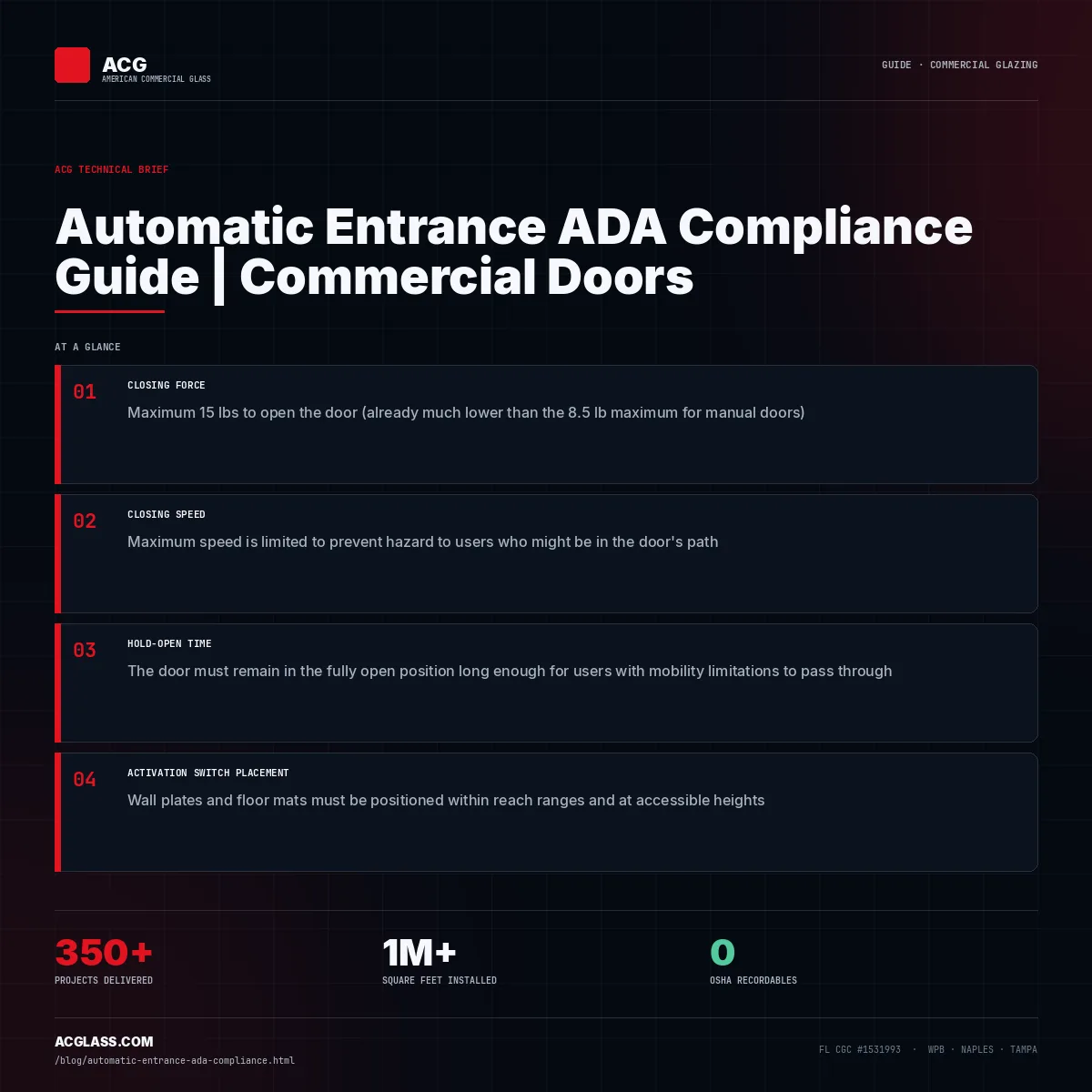
- Closing force: Maximum 15 lbs to open the door (already much lower than the 8.5 lb maximum for manual doors)
- Closing speed: Maximum speed is limited to prevent hazard to users who might be in the door's path
- Hold-open time: The door must remain in the fully open position long enough for users with mobility limitations to pass through
- Activation switch placement: Wall plates and floor mats must be positioned within reach ranges and at accessible heights
Documentation and Commissioning
ADA compliance for automatic entrances isn't just about getting the installation right - it's about documenting that it's right. ACG provides commissioning records for every automatic door installation including:
- Clear width measurements
- Sensor coverage verification
- Hold-open time measurements
- Safety reverse force testing
- Breakout force testing
This documentation supports the building's ADA certification and gives the owner the records needed to defend against future accessibility complaints.
Common Problems ACG Finds During Commissioning
The most frequent ADA issues ACG identifies and corrects during commissioning:
- Sensor timing set too short - door closing before users clear the opening
- Activation plates installed at the wrong height or in a location that doesn't provide ADA-compliant reach range
- Door panels slightly out of level, causing binding that requires force to operate
- Safety reverse not calibrated to the specified force limit
All of these are correctable at commissioning. None of them should show up as ADA deficiencies at inspection if the installation is properly commissioned. ACG's standard commissioning process catches and corrects them all before your inspector shows up.