
Commercial glazing is the single largest thermal weak point on most Florida buildings. In a climate that runs mechanical cooling 10 to 11 months per year, a poorly specified glass package doesn't just underperform on day one - it bleeds cooling cost across every year of the building's operating life. Better glazing changes that equation meaningfully. A 0.25 SHGC low-E IGU versus a 0.50 SHGC clear IGU on a 10,000 SF elevation can mean tens of thousands of dollars in annual cooling savings, and the payback often lands inside four years. What follows is the framework ACG uses to spec energy-reducing glazing on Florida commercial projects - the numbers, the products, and how to pencil the ROI before the bid goes out.

Where the Energy Is Actually Going
In a typical Florida commercial building, fenestration accounts for roughly 25 to 35 percent of total cooling load even though it makes up a much smaller fraction of the building envelope area. The reason is solar gain. Every square foot of sun-struck glazing delivers BTUs into the conditioned space that the HVAC system has to move back out. That's the energy cost that better glazing is built to eliminate, and in a climate that runs mechanical cooling 10 to 11 months per year, the savings show up on every utility bill.
The three glazing specifications that decide how much of the sun's energy gets through are Solar Heat Gain Coefficient (SHGC), U-factor, and Visible Transmittance (VT). For cooling-dominated climates like Florida, SHGC is the one that moves the operating cost needle the most.
SHGC: Florida's Most Important Glass Number
SHGC is a decimal from 0 to 1 that describes the fraction of incident solar radiation admitted through the glass - both directly transmitted and absorbed and re-radiated inward. A pane with SHGC 0.70 admits 70 percent of the sun's heat. A high-performance low-E IGU can drop that to 0.22 or lower without making the glass look dark.
To put that into real utility numbers: on a 10,000 SF south- or west-facing curtainwall elevation in Fort Lauderdale, the difference between SHGC 0.50 and SHGC 0.25 is roughly 180 to 220 tons of avoided cooling load at peak solar conditions.
The Florida Energy Code Floor
The Florida Building Code, Energy Conservation, 8th Edition sets prescriptive maximum SHGC values by Climate Zone. Most of Florida falls in Zones 1 or 2. The prescriptive maximum for non-residential fenestration is typically SHGC 0.25 for south/east/west orientations in Zone 1 - tight enough that low-E is effectively required on any meaningful glazing scope. Performance path and ASHRAE 90.1 compliance alternatives exist, but most commercial projects in Florida end up specifying low-E IGU as a baseline regardless of path.
Low-E Coatings: Soft Coat vs Hard Coat
Low-emissivity (low-E) coatings are microscopically thin metallic oxide layers applied to glass to reflect infrared radiation while transmitting visible light. There are two families worth knowing.
Hard coat (pyrolytic) low-E is deposited during the float glass manufacturing process at high temperature. It's durable, can be used as a single pane (rare in FL commercial), and handles bending and tempering well. Performance is moderate - SHGC typically 0.50 to 0.65.
Soft coat (magnetron sputtered) low-E is applied in a vacuum chamber after the glass is made. Performance is dramatically better - SHGC down to 0.18 to 0.28 on double-silver and triple-silver coatings - but soft coat must be protected inside a sealed IGU because the coating oxidizes if exposed to air. Essentially all high-performance commercial glass in Florida uses soft-coat low-E on the second surface of a double-pane IGU.
ESWindows operates an in-house Soft Coat Low-E production line in Barranquilla, which is one of the reasons ACG specs ESWindows glass on the majority of our commercial projects. The coating is manufactured in the same facility that assembles the IGU, which eliminates a handling step and tightens quality control on coating integrity. Read more about the ESWindows partnership and how the factory-controlled process flows into our work.
IGU Construction: Where Good Specs Go to Die
A high-performance glass coating is only as effective as the insulating glass unit it lives in. The IGU is two or three lites of glass separated by a spacer and sealed with a primary and secondary sealant, with the cavity filled with inert gas. The weak point is the perimeter seal, and in Florida's humidity that seal is under constant attack.
Argon Fill
Argon gas has lower thermal conductivity than air, reducing the U-factor of a standard 1-inch IGU from roughly 0.48 down to 0.28 when combined with low-E coating. Argon loss through the seal is typically 1 percent per year on well-built units - meaning a quality IGU still has over 80 percent of its argon at the 20-year mark. On poorly sealed units the loss rate can be 3 to 5 percent per year, and performance degrades noticeably by year 10.
Warm-Edge Spacers
Traditional aluminum spacer bars conduct heat through the IGU edge, creating a thermal short circuit that hurts U-factor and drives condensation at the glass perimeter. Warm-edge spacers (stainless steel, silicone foam, or composite) cut that edge conductance dramatically and are standard on ESWindows GW-7000 curtainwall units.
Pre-Glazed IGU Installation
Where the IGU gets assembled matters. ACG installs ES-8000 storefront pre-glazed as standard, which means the IGU is set into the frame under factory-controlled humidity and temperature before the system ever reaches the jobsite. Field glazing in Florida's humidity - especially during the rainy season - is where seal contamination starts, and contaminated seals fail early. Pre-glazed factory assembly adds measurable service life to the IGU and protects the energy performance you paid for.
A Simple ROI Framework
Energy savings from better glazing can be estimated with a simple per-SF annual framework. For a Florida commercial building with typical operating hours:
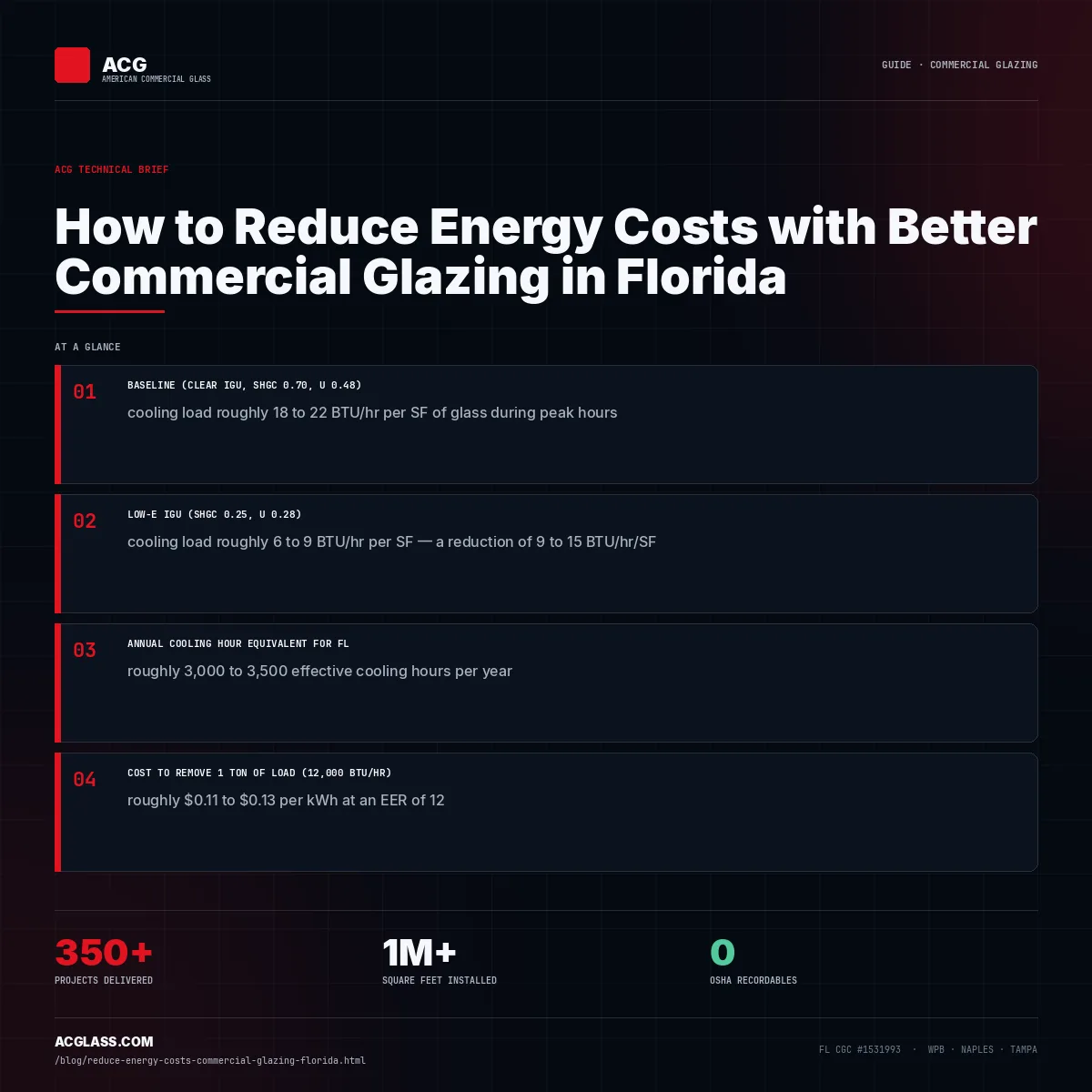
- Baseline (clear IGU, SHGC 0.70, U 0.48): cooling load roughly 18 to 22 BTU/hr per SF of glass during peak hours
- Low-E IGU (SHGC 0.25, U 0.28): cooling load roughly 6 to 9 BTU/hr per SF - a reduction of 9 to 15 BTU/hr/SF
- Annual cooling hour equivalent for FL: roughly 3,000 to 3,500 effective cooling hours per year
That's why the Florida Public Service Commission and most investor-owned utilities have grouped low-E IGU among the most consistently cost-effective commercial envelope upgrades available.
What It Looks Like on a Real Project
Specifying for Your Project
Getting the energy number right starts at the spec. For a ground-up Florida commercial project, specify low-E soft-coat on surface 2 of a dual-pane IGU, argon fill, warm-edge spacer, and SHGC under 0.30. For a retrofit where the existing frame is staying, IGU-only replacement can capture 80 percent of the performance upgrade at roughly half the cost of a full window replacement. Either way, the product approval (NOA or FL) has to match the wind-borne debris requirements of the jurisdiction.
If you're building or retrofitting in West Palm Beach or anywhere else in Florida and want a scope priced with energy performance calculated in, send plans via bid.html. We'll return a bid with SHGC, U-factor, and VT specified line-by-line so the energy numbers are visible, not buried.
Ready to get started?
ACG is a CGC-licensed Florida commercial glazing subcontractor (CGC1531993) headquartered in West Palm Beach. We price commercial Division 08 scopes across the state and return competitive, itemized bids within 48 hours. Send your plans and we'll have a scope back to you fast.