
Commercial storefront is the most frequently specified glazing system on a Florida project. It defines the ground-floor experience of almost every commercial building - retail, restaurant, hospitality, office lobby, medical, bank, quick-serve - and its selection drives cost, schedule, and long-term performance more than most other single choices in the envelope. Florida storefront specification is also more constrained than in other parts of the country. Impact requirements, HVHZ certification, salt-air durability, and solar heat management each narrow the field of acceptable products. Here's an updated 2026 guide to the storefront systems that actually work for Florida commercial applications, plus the glazing and finish selections that extend service life.

The Three Main Storefront System Categories
Florida commercial storefront specification divides into three practical categories, each with its own sweet spot.
1. ESWindows ES-8000 - The Workhorse
The ES-8000 is the most widely specified commercial storefront system in Florida commercial work, and for straightforward reasons. It carries current Miami-Dade NOAs and Florida Product Approvals, ships pre-glazed from the factory, installs faster than stick-built alternatives, and holds up in coastal service. The system uses a 2" x 4-1/2" thermally broken aluminum frame with dark bronze Kynar (AAMA 2605) as the standard finish - which is what you see on most Florida commercial ground floors because it survives 20+ years of sun and salt without degradation.
Pre-glazed is the key. ES-8000 storefront arrives at the jobsite as complete, factory-assembled units with glass already set in the frame. Field crews set the units into prepared openings - no field glazing, no on-site sealant cure concerns, no humidity-dependent edge seal exposure. The factory controls temperature and humidity during glazing, which produces more consistent edge seals and longer IGU service life than any field-glazed alternative. On a 4,000 SF storefront scope, ACG crews routinely install 1,000 SF per day using pre-glazed ES-8000 units. Stick-built systems, where frames are assembled on site and glass is glazed in the field, typically run 400 to 600 SF per day per crew.
ES-8000 is the right spec for retail, restaurant, quick-serve, medical, and most ground-floor commercial applications where the glazing is under 10 feet in height and the load calcs fit within the product's tested envelope. See the full ES-8000 overview.
2. Euro-Wall - Folding and Multi-Slide for Hospitality
Euro-Wall's folding and sliding systems are the specification answer for restaurants and hospitality concepts that need indoor-outdoor operability. The folding systems open entire wall sections to the exterior - common on Florida restaurant patios, clubhouse dining, and hotel amenity spaces. Euro-Wall's impact-rated product line carries current NOAs and Florida Product Approvals for HVHZ and non-HVHZ applications.
Lead times run 8-12 weeks. On projects like Wave Food Hall Cocoa Beach, ACG has installed Euro-Wall folding systems in combination with commercial storefront framing for the fixed sections - the combination delivers the programmatic flexibility of an operable wall without blowing up the budget on non-operable sections.
See the Euro-Wall product overview for system options.
3. Heavy-Wall Commercial Systems (ESWindows)
For larger storefront spans, higher wind zones, taller single-story glazing (over 12 feet), or specifically-specified systems, heavy-wall commercial products from ESWindows (ESWindows ES-8000, ES-CS1325), ESWindows (ESWindows ES-9500, ESWindows ES-CS1325), or ESWindows are the typical answer. These systems use deeper frame profiles (2-1/2" x 6", 3" x 6", or larger), stronger anchorage, and higher structural capacity than ES-8000.
Heavy-wall systems usually install stick-built in the field, which makes them slower than pre-glazed alternatives but allows for project-specific customization. Lead times are comparable to ES-8000 at 6-8 weeks.
Glazing Options for Florida Storefronts
The framing system is only half the spec. The glazing inside it drives performance on solar heat gain, sound attenuation, thermal transmittance, and safety.
9/16" Laminated Impact IGU - The Default
A typical buildup: 1/4" clear tempered / 0.090" PVB or SGP interlayer / 1/4" tempered / 1/2" air or argon airspace / 1/4" clear annealed or tempered inner lite. Total assembly thickness approximately 1". This is the default Florida commercial storefront glazing and works for the majority of applications.
Tinted Interlayers and Gray Glass
For high solar exposure - west-facing storefronts, unshaded south orientations - tinted glass reduces interior heat loads and glare. Gray and bronze tints are standard; blue-green tints are common in hospitality. Tinted glass is typically applied to the outer lite of the IGU, combined with surface-2 low-E coating for maximum solar rejection.
Low-E Coated Glass
Soft-coat Low-E (surface 2 of the outer lite) is standard on any commercial application that must meet the Florida Building Code, Energy Conservation's prescriptive SHGC requirements. Target SHGC 0.25-0.35 for most Florida commercial uses. Guardian SunGuard SNX 51/23, Vitro Solarban 67, and ESWindows' factory-applied Soft Coat Low-E are the commonly specified products.
Ceramic Frit and Silk-Screen Patterns
Retail and hospitality projects increasingly specify ceramic frit patterns - baked-on ceramic ink in geometric or architectural patterns - for privacy, solar shading, or aesthetic effect.
Framing Finishes - What Holds Up in Florida
Florida storefront finishes are a place where cutting corners shows up at the 7-year mark. Three options, in descending order of durability:
AAMA 2605 (Kynar 500 / PVDF)
The 70% fluoropolymer paint system is the defensible spec for any coastal Florida storefront. Dark bronze is the most common color and accounts for the majority of ACG's installed storefront finishes. Black, medium bronze, silver metallic, and custom colors are all available; custom colors add roughly 2-4 weeks to lead time. AAMA 2605 finishes routinely show 20+ years of color and gloss retention.
AAMA 2604
A 50% PVDF spec, lower-grade than 2605. Acceptable for interior applications and mild exterior exposures, but not recommended for direct-coastal Florida projects.
Class I Anodized (AAMA 611)
Electrochemical oxide finish. Acceptable for inland and semi-rural projects, reasonable in urban non-coastal contexts. For direct coastal exposure - within 1 mile of the Atlantic or Gulf - anodized is not a defensible 20-year spec.
Impact Ratings - HVHZ, LMI, SMI
For Florida commercial storefront, the impact rating requirement depends on county and height above grade:
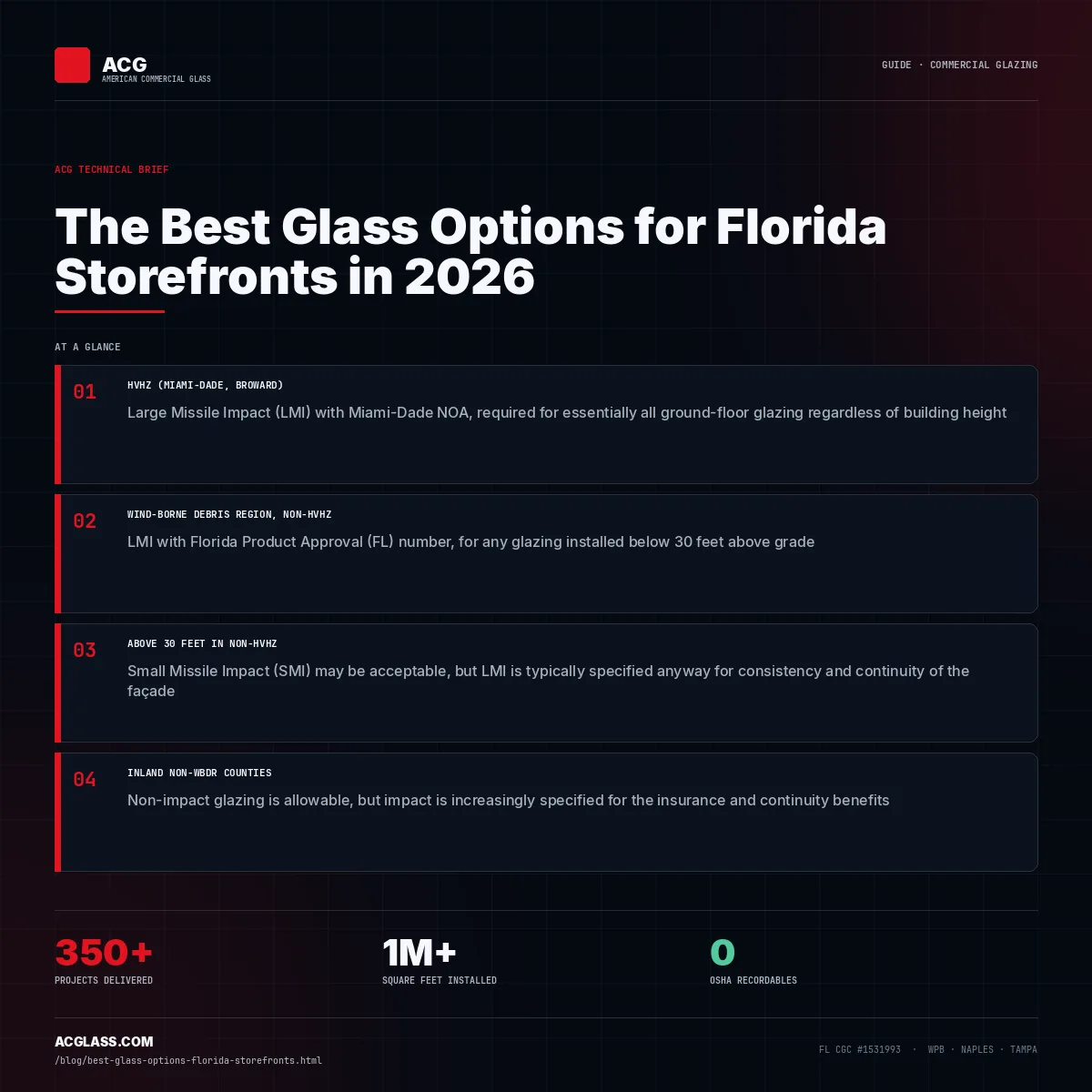
- HVHZ (Miami-Dade, Broward): Large Missile Impact (LMI) with Miami-Dade NOA, required for essentially all ground-floor glazing regardless of building height
- Wind-borne debris region, non-HVHZ: LMI with Florida Product Approval (FL) number, for any glazing installed below 30 feet above grade
- Above 30 feet in non-HVHZ: Small Missile Impact (SMI) may be acceptable, but LMI is typically specified anyway for consistency and continuity of the façade
- Inland non-WBDR counties: Non-impact glazing is allowable, but impact is increasingly specified for the insurance and continuity benefits
Example Florida Commercial Storefront Specs
Retail Strip Center, Coastal South Florida
- System: ES-8000 impact storefront, pre-glazed
- Framing: Dark bronze AAMA 2605, 2" x 4-1/2" thermally broken
- Glazing: 9/16" laminated impact IGU, PVB interlayer, surface 2 Guardian SNX 51/23
- Impact: LMI, Miami-Dade NOA
Restaurant with Operable Patio, Treasure Coast
- Fixed sections: ES-8000 impact storefront, pre-glazed
- Operable sections: Euro-Wall HS-Slim folding system, impact-rated
- Framing: Dark bronze AAMA 2605
- Glazing: 9/16" laminated impact IGU
Hotel Lobby, West Coast Florida
- System: ESWindows ES-8000 XT storefront, stick-built
- Framing: Clear anodized AAMA 2605 (protected from direct salt exposure by overhang)
- Glazing: 9/16" laminated impact IGU with light gray interlayer, Solarban 67
- Impact: LMI, Florida Product Approval
Real examples from ACG's portfolio - across both our West Palm Beach and Tampa service territories - include Wave Food Hall (multi-tenant food hall with ES-8000 + Euro-Wall) and Atlantic Fields Performance Center (clubhouse amenity with mixed storefront and window wall).
Ready to get started?
Storefront selection drives the look, cost, schedule, and service life of a Florida commercial project. Send plans and specs and ACG returns system recommendations, glazing options, and priced alternates inside 48 hours.