
Specifying a commercial storefront seems straightforward until you realize how many decisions go into a complete spec. Frame depth, thermal break, glass type, hardware, ADA, wind loads, finish - each choice affects performance, cost, lead time, and whether your project passes inspection. This guide walks through every decision.
1. Frame Depth Selection
Frame depth controls two things: how much of your framing is visible (the "sightline") and what glass thickness the system can accommodate. Deeper frames handle larger spans and heavier glass.
| Frame Depth | Max Span | Glass Thickness | Common Use |
|---|---|---|---|
| 2" | Up to 5 ft | Up to 1" IGU | Interior partitions, low-span retail |
| 2.5" | Up to 7 ft | Up to 1.25" IGU | Most Florida commercial projects - standard choice |
| 4.5" | Up to 10 ft | Up to 1.5" IGU | High wind zones, large lites, heavy impact glass |
| 6" | Up to 14 ft | Up to 2" IGU | Very large openings, high-pressure HVHZ applications |
For most Florida commercial projects - retail, office, mixed-use - specify 2.5-inch as your starting depth. It accommodates the most common glass configurations and comes with the widest product approval coverage. Upgrade to 4.5-inch when your structural engineer's wind pressure calculations require it, or when your glass size exceeds what 2.5-inch can support.
2. Thermal Break Options
Standard aluminum storefront is a thermal bridge. Aluminum is highly conductive - heat flows through the frame from outside to inside (and vice versa) almost unimpeded. This wrecks your whole-assembly U-value even with good glass.
A thermal break adds a plastic (usually polyamide) barrier between the interior and exterior portions of the frame. The plastic has much lower thermal conductivity, dramatically improving the frame's thermal performance.
Florida Energy Code (ASHRAE 90.1-2019 as adopted by the 8th Edition FBC) requires commercial fenestration to meet U-factor and SHGC requirements. Most Florida commercial projects cannot meet these requirements without thermally broken frames and Low-E glass. Specify thermally broken storefront on all climate-controlled commercial buildings.
3. Glass Selection
Insulating Glass Unit (IGU)
Minimum spec for any climate-controlled commercial building. Dual-pane with 1/2" or 5/8" air or argon-filled cavity. Single-pane is not acceptable for energy code compliance on heated/cooled commercial spaces.
Low-E Coating
Required for Florida energy compliance. Low-emissivity coatings reflect infrared heat - they keep solar heat out in summer and conditioned air in year-round. For South Florida and coastal projects, specify Low-E with SHGC of 0.25 or lower on west and south exposures. Solarban 70XL, Solarban 90, or equivalent are common choices.
Impact-Rated Laminated Glass
Required in HVHZ (Miami-Dade and Broward). Strongly recommended for all Florida coastal commercial projects. Impact laminated glass combines two or more glass panes with a PVB or SGP interlayer. When broken, the interlayer holds glass in place - meeting both Florida large missile impact testing and ASTM E1886/E1996 requirements. Specify impact-rated glass with a current FL PA or Miami-Dade NOA.
Tinted Glass
Solar tints (bronze, grey, blue-green) reduce SHGC without a coating. Often combined with Low-E for maximum solar control on south-facing facades. Note that tinted glass changes the appearance of your facade significantly - coordinate with the design team and owner.
Spandrel Glass
Spandrel glass covers floor edges, mechanical equipment, or structural elements. It's opaque from the exterior - back-painted or ceramic frit on the #2 surface. For insulated spandrel panels, use a shadow box assembly with 1-inch air gap between the spandrel glass and back insulation. Coordinate spandrel color with vision glass tint for a consistent appearance.
4. Door Hardware and ADA Compliance
Florida commercial storefront doors must comply with ADA (Americans with Disabilities Act) accessibility requirements. Key requirements:
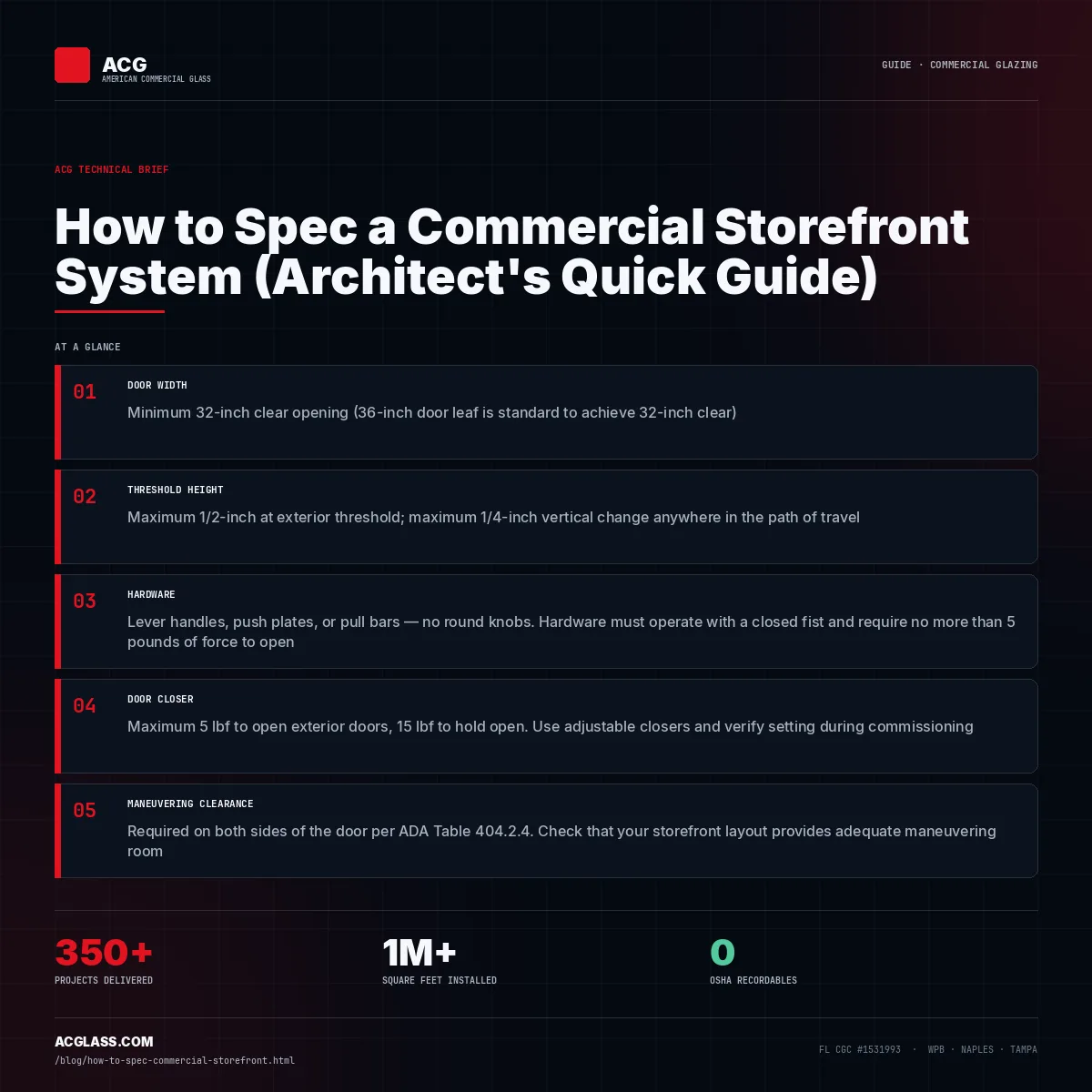
- Door width: Minimum 32-inch clear opening (36-inch door leaf is standard to achieve 32-inch clear)
- Threshold height: Maximum 1/2-inch at exterior threshold; maximum 1/4-inch vertical change anywhere in the path of travel
- Hardware: Lever handles, push plates, or pull bars - no round knobs. Hardware must operate with a closed fist and require no more than 5 pounds of force to open
- Door closer: Maximum 5 lbf to open exterior doors, 15 lbf to hold open. Use adjustable closers and verify setting during commissioning
- Maneuvering clearance: Required on both sides of the door per ADA Table 404.2.4. Check that your storefront layout provides adequate maneuvering room
5. Florida Wind Load Requirements
Florida commercial storefronts must be engineered for the design wind pressure at the project location. The structural engineer of record calculates the design pressure using ASCE 7-22 (adopted by Florida). The glazing contractor uses this pressure to verify that the specified system can span the required heights and widths.
Key points for architects:
- Specify the design wind pressure in your spec (provide the EOR's value)
- Require the glazing sub to submit engineering calculations verifying the system meets design pressure
- For HVHZ projects, require Miami-Dade NOA that covers your wind pressure conditions
- Corner zones have higher pressures than field zones - your layout may require different glass thickness or frame depth at corners
6. Finish Options
Aluminum storefront is available in three main finish categories:
- Mill finish: Raw aluminum - used only in non-exposed interior applications. Never specify for exterior commercial.
- Anodized: Electrochemical process that creates a durable oxide layer. Standard colors: clear anodize (bright silver), dark bronze, black. Best durability in Florida's salt air and UV environment. 70-80% of Florida exterior storefront is anodized.
- Painted (Kynar 500 / PVDF): Two-coat or three-coat paint system baked onto the aluminum. Available in thousands of colors. Good durability, but fade and chalk more than anodized in Florida's UV environment over 15+ years. Use for custom colors; specify Kynar 500 (PVDF) - not polyester.
For Florida coastal projects within 3,000 feet of salt water, specify Class I anodize (0.7 mil minimum) or premium Kynar 500 paint with a barrier primer. Salt air attacks standard finishes faster than expected.
For a full discussion of storefront systems available in Florida, see our guide on the what is a storefront glazing system. When you're ready to get a bid, see our guide on how to get a glazing bid in Florida. ACG works with top storefront manufacturers - see our manufacturer partners for system options. For installation specifics, see our commercial storefront installer page, the Florida commercial storefront installer hub, and city keepers such as the West Palm Beach commercial storefront installer.
Frequently Asked Questions
What frame depth should I specify for a commercial storefront?
For most Florida commercial projects, start with 2.5-inch frame depth. It handles spans up to 7 feet, accommodates 1- to 1.25-inch IGUs including most impact glass, and has the widest product approval coverage. Upgrade to 4.5-inch when wind pressure calculations require it, or when glass sizes exceed 2.5-inch system limits.
Do I need a thermal break on a storefront in Florida?
Yes - Florida Energy Code requires commercial fenestration to meet U-factor and SHGC requirements. Most Florida commercial projects cannot meet these requirements without thermally broken frames and Low-E glass. Specify thermally broken storefront on all climate-controlled commercial buildings.
What glass should I specify for a Florida commercial storefront?
Specify: dual-pane IGU, Low-E coating (SHGC 0.25 or lower for south/west facades), and impact-rated laminated glass for HVHZ or coastal projects. For spandrel areas, use back-painted or ceramic-frit opaque glass in a shadow box assembly. Coordinate spandrel color with vision glass appearance.