
Specifying glass for a commercial building in Florida is a different exercise than specifying it almost anywhere else in the country. The combination of hurricane wind loads, sustained high solar radiation, year-round humidity, salt-laden coastal air, and intense UV creates a set of performance demands that no single glass product solves on its own. The right specification is almost always a layered assembly - laminated for impact, low-E for solar control, insulated for thermal performance, with framing finishes engineered for corrosion resistance. Here's how the major commercial glass types stack up against Florida's four critical climate factors, and what a competent Division 08 spec looks like in 2026.

The Four Climate Factors That Drive Florida Glass Specification
Every commercial glazing decision in Florida traces back to four environmental pressures. A good spec addresses all four. A weak spec addresses one or two and leaves the owner with performance problems that surface 3-7 years into service.
- Hurricane and wind load → drives laminated impact glass and structurally-rated framing
- Solar heat gain and radiant heat → drives low-E coatings and tinted/reflective interlayers
- Humidity and UV exposure → drives glazing seal chemistry and IGU spacer selection
- Salt air corrosion → drives framing finish (AAMA 2605 vs anodized) and fastener metallurgy
The following sections cover each factor and what a correct spec includes.
Hurricane Wind Load - Laminated Impact Glass
Florida Building Code requires wind-borne debris resistance for any glazing in the wind-borne debris region (which covers nearly all coastal counties) installed below 30 feet above grade. Two glass solutions meet the requirement: laminated impact glass or non-impact glass with code-approved shutters. For commercial projects, laminated impact is effectively the only practical choice - shutters are operationally impractical for businesses that need continuous visibility, tenant access, and staff time to avoid storing and deploying shutters before every storm warning.
Laminated impact glass uses a PVB (polyvinyl butyral) or SGP (SentryGlas) interlayer bonded between two lites of tempered or heat-strengthened glass. The interlayer holds the glass together when fractured by a 9-pound 2x4 projectile traveling 34 mph (the ASTM E1886 Large Missile Impact test). For Florida commercial work, SGP interlayers are increasingly specified on taller buildings, structural silicone curtainwall applications, and high-UV coastal exposures - SGP is roughly five times stiffer than PVB and retains its clarity and bond strength longer in UV.
Solar Heat Gain - Low-E Coatings
Florida's sustained solar radiation - averaging 5.5 kWh per square meter per day on the Atlantic coast and up to 6.0 on the Gulf side - makes solar heat gain the most extensive single contributor to commercial building cooling loads. The Solar Heat Gain Coefficient (SHGC) measures how much of the incident solar energy transmits through the glass assembly. The Florida Building Code, Energy Conservation, 8th Edition sets prescriptive SHGC limits that vary by climate zone (Florida is mostly Zone 1A and 2A) and window-to-wall ratio.
Modern Low-E (low-emissivity) coatings are microscopically thin metallic oxide layers applied to the glass surface to reflect infrared energy while passing visible light. For Florida commercial work, the sweet spot is typically a high-performance soft-coat Low-E on surface 2 of the outer lite of an IGU (Insulating Glass Unit), targeting SHGC 0.25-0.35 with visible light transmission (VLT) of 40-60%. Products like Guardian SunGuard SNX 51/23, Vitro Solarban 67, and ESWindows' factory-applied Soft Coat Low-E hit that performance envelope.
ESWindows maintains a captive Soft Coat Low-E production line specifically for commercial impact applications - the coating is applied during the same production run as the laminated impact buildup, which eliminates a handling step and maintains tighter quality control over the coating's adhesion. See the ESWindows product overview for the available coating options.
Humidity and UV - Seal Quality and IGU Construction
Florida's average relative humidity hovers near 75% year-round, and the UV index regularly exceeds 10 on summer days. Both factors attack the weakest point of any insulating glass unit: the edge seal. A typical IGU uses a primary seal of polyisobutylene (PIB) for moisture vapor resistance, backed by a secondary seal (silicone, polysulfide, or polyurethane) for structural bond. When those seals degrade, the IGU fogs, loses its thermal performance, and eventually fails warranty.
For Florida commercial applications, the spec should call for:
- Warm-edge spacers (thermally-improved stainless or structural foam) rather than aluminum
- Silicone secondary seals for structural glazing applications
- Desiccant loading rated for the project's service environment
- IGU warranties of 10 years minimum on seal failure, with documented field performance data
Factory-glazed systems outperform field-glazed in Florida humidity for this exact reason. Pre-glazed storefronts - where the glass is set into the framing inside a climate-controlled factory rather than on a jobsite in 85% humidity - consistently achieve cleaner seals and longer IGU service life. Field glazing in Florida introduces dust, humidity, and sealant cure issues that factory environments eliminate. ACG installs ES-8000 storefronts pre-glazed for precisely this reason.
Salt Air Corrosion - Framing Finishes
Coastal Florida projects live in a salt-laden atmosphere that corrodes unprotected aluminum and standard fasteners within a few seasons. The two primary framing finish systems used on commercial glazing are:
- Anodized aluminum (Class I AAMA 611) - a hard electrochemical oxide layer; holds up well in mild marine environments but can chalk and pit within 10-15 years in direct coastal exposure
- Kynar 500 / PVDF painted (AAMA 2605) - a 70% fluoropolymer paint system rated for 20+ year color and gloss retention; the standard for high-end coastal commercial work
For any project within one mile of the Atlantic or Gulf coast, AAMA 2605 is the defensible spec. Anodized finishes will appear fine at turnover and then show degradation at the 7-12 year mark. Dark bronze Kynar is the most common commercial storefront finish specified in Florida; custom colors are available but add to lead time.
Fasteners should be 300-series stainless steel for any exterior glazing anchor. Standard galvanized or zinc-plated fasteners have no business on a Florida coastal project, regardless of what the plans show - substitutions to stainless are almost always worth the small premium.
Tempered vs Laminated vs IGU - When to Use Which
Tempered Glass
Heat-treated to roughly four times the breaking strength of annealed glass, tempered glass is required by code in safety glazing locations: doors, sidelites, storefronts near walking surfaces, tub and shower enclosures. Tempered is not impact-rated on its own - it is a safety glass, not a security or impact glass. Use where the code requires safety glazing and impact is not applicable.
Laminated Glass
Two lites bonded by an interlayer; required for impact zones, acoustic-rated partitions, and sloped overhead glazing. Laminated glass holds together when broken and blocks 99%+ of UV. On Florida commercial work, laminated glass is the workhorse.
Insulating Glass Units (IGU)
Two or more lites separated by a sealed air or argon-filled space. IGUs dramatically improve U-value (thermal transmittance) and reduce condensation risk. For air-conditioned commercial spaces in Florida, IGU construction is effectively mandatory for energy code compliance at meaningful window-to-wall ratios.
Laminated IGU
The combination spec: a laminated impact outer lite plus an annealed or tempered inner lite separated by a sealed spacer. This is the default commercial spec for Florida - impact protection plus thermal performance plus Low-E coating options. 9/16" laminated impact + 1/2" airspace + 1/4" annealed inner lite is a common buildup.
A Representative Florida Commercial Spec
Here is what a competent Florida commercial glazing spec looks like on paper:
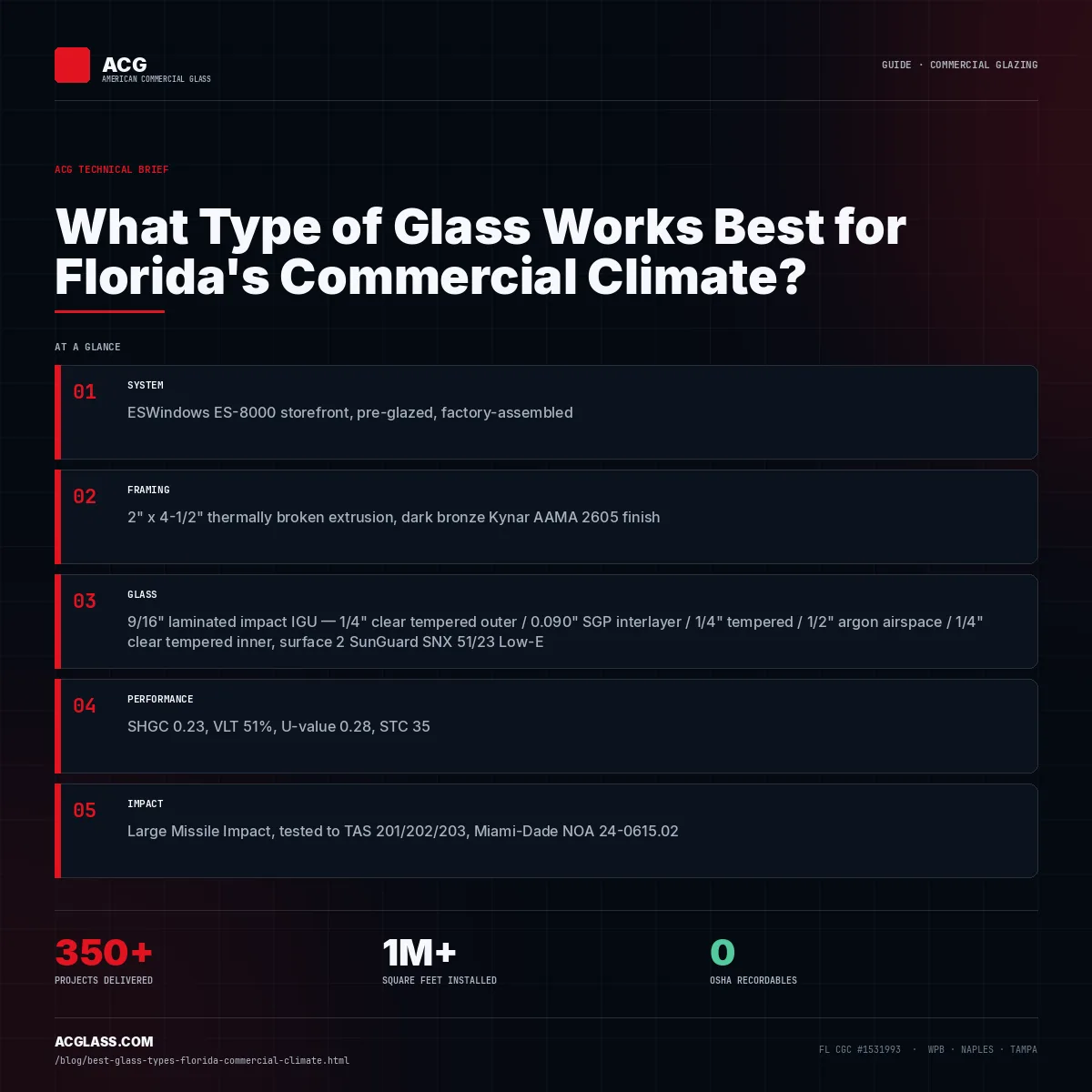
- System: ESWindows ES-8000 storefront, pre-glazed, factory-assembled
- Framing: 2" x 4-1/2" thermally broken extrusion, dark bronze Kynar AAMA 2605 finish
- Glass: 9/16" laminated impact IGU - 1/4" clear tempered outer / 0.090" SGP interlayer / 1/4" tempered / 1/2" argon airspace / 1/4" clear tempered inner, surface 2 SunGuard SNX 51/23 Low-E
- Performance: SHGC 0.23, VLT 51%, U-value 0.28, STC 35
- Impact: Large Missile Impact, tested to TAS 201/202/203
- Fasteners: 304 stainless, per NOA anchor schedule
- Warranty: 10-year IGU seal, 20-year finish, manufacturer-backed
That spec survives Florida. Everything short of it has trade-offs that surface at some point during the service life.
Where ACG Fits
ACG specifies and installs commercial glazing systems matched to each project's actual exposure and performance requirements. On a resort project like Eau Palm Beach Resort & Spa, that means direct-coastal AAMA 2605 framing with SGP interlayers. On a clubhouse like Gulf Harbour Country Club, the spec leans toward high-performance Low-E to manage the lobby's solar exposure. On an interior Tampa office build-out, the envelope calculus shifts toward thermal performance over impact, and the spec changes accordingly. The system is always the combination, not any single component.
Ready to get started?
ACG can review your project specs against Florida climate realities and recommend system combinations that balance code compliance, performance, and budget. Send plans and specs for a 48-hour response.