
Selecting the right glass for a commercial project in Florida isn't just a product decision - it's a code compliance decision, an energy performance decision, and a long-term durability decision. Florida's climate, wind exposure, and hurricane code create requirements that don't exist in most other states. This guide covers the primary commercial glass types, how each performs, when each is used, and what you need to know about Florida code compliance for each.
Note on cost ranges: Glass pricing varies by size, quantity, configuration, coating, and current market conditions. The cost ranges in this guide are rough reference points intended to give relative context across glass types, not project-specific quotes. Contact ACG for current pricing on your specific project.
Tempered Glass
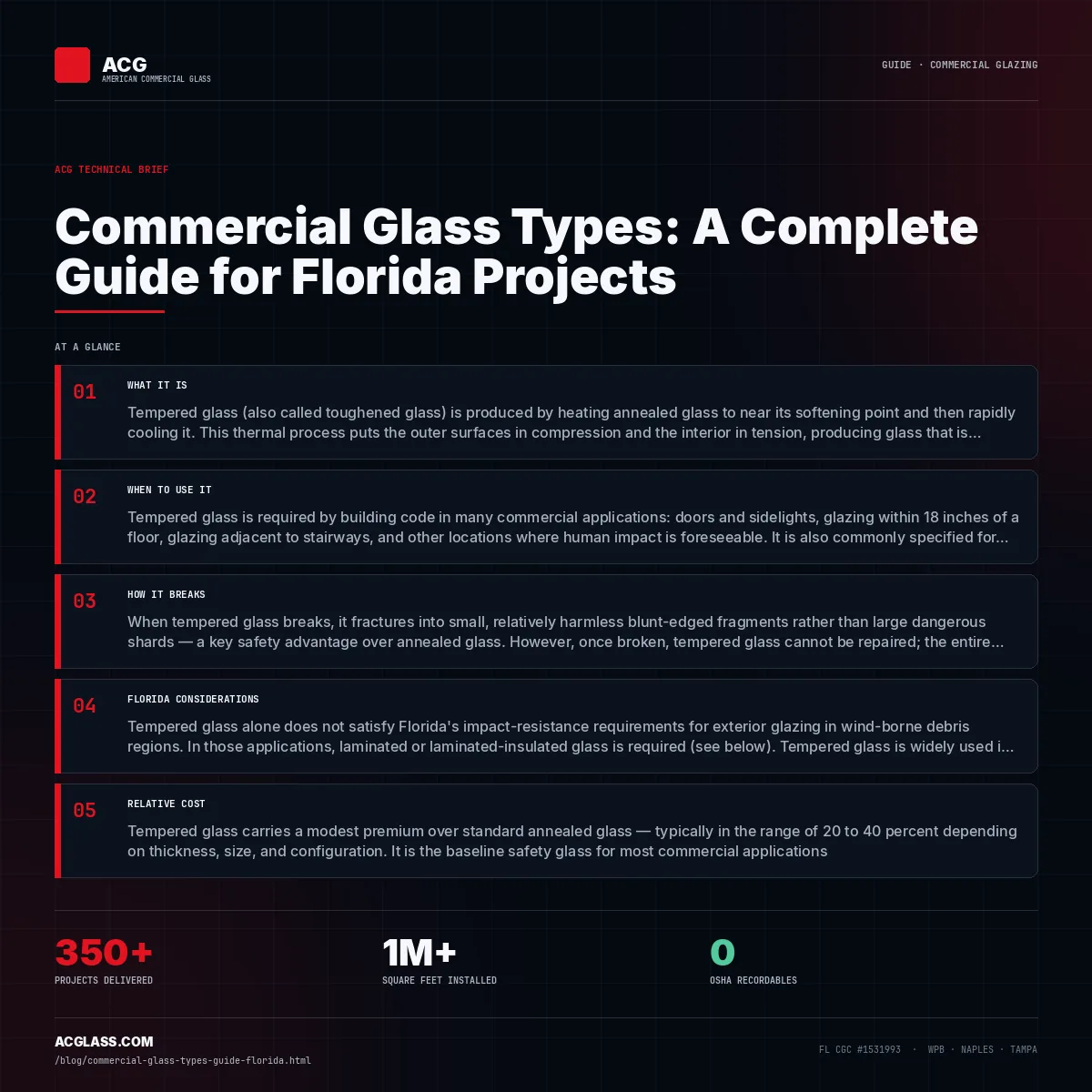
What it is: Tempered glass (also called toughened glass) is produced by heating annealed glass to near its softening point and then rapidly cooling it. This thermal process puts the outer surfaces in compression and the interior in tension, producing glass that is approximately four times stronger than standard annealed glass of the same thickness.
When to use it: Tempered glass is required by building code in many commercial applications: doors and sidelights, glazing within 18 inches of a floor, glazing adjacent to stairways, and other locations where human impact is foreseeable. It is also commonly specified for commercial storefronts, interior partitions, and applications where safety glazing is needed but a secondary containment layer (lamination) is not required.
How it breaks: When tempered glass breaks, it fractures into small, relatively harmless blunt-edged fragments rather than large dangerous shards - a key safety advantage over annealed glass. However, once broken, tempered glass cannot be repaired; the entire unit must be replaced.
Florida considerations: Tempered glass alone does not satisfy Florida's impact-resistance requirements for exterior glazing in wind-borne debris regions. In those applications, laminated or laminated-insulated glass is required (see below). Tempered glass is widely used in interior commercial applications and in exterior applications where impact requirements are not triggered.
Relative cost: Tempered glass carries a modest premium over standard annealed glass - typically in the range of 20 to 40 percent depending on thickness, size, and configuration. It is the baseline safety glass for most commercial applications.
Laminated Glass
What it is: Laminated glass consists of two or more glass lites bonded together with one or more interlayers of polyvinyl butyral (PVB), SentryGlas (SGP), or other interlayer materials. If the glass breaks, the interlayer holds the fragments in place, preventing them from falling or flying. The assembly remains in place until replaced.
When to use it: Laminated glass is used in applications requiring secondary containment - overhead glazing (skylights, canopies), glass floors, high-risk safety glazing locations, hurricane-rated applications, sound attenuation applications, and anywhere the code or design requires that broken glass remain in the opening. SGP interlayers are used for structural applications where the glass must retain load capacity after breakage.
Florida considerations: For exterior glazing in Florida's wind-borne debris regions, laminated glass (or impact-rated insulated glass with a laminated inner lite) is typically required to provide the secondary barrier that contains glass fragments if the outer lite is broken by windborne debris. Impact-rated laminated glass assemblies must be tested and approved under applicable standards and carry either a Florida Product Approval (FL#) or a Miami-Dade NOA for HVHZ applications.
Relative cost: Laminated glass carries a meaningful premium over tempered glass alone - typically 50 to 100 percent or more depending on the interlayer type (PVB vs. SGP), thickness, and size. The premium is justified by the performance characteristics required in impact and safety applications.
Insulated Glass Units (IGU)
What it is: An insulated glass unit (IGU, also called double-pane or double-glazing) consists of two or more glass lites separated by a spacer and sealed at the perimeter, with the cavity filled with air or an inert gas (typically argon or krypton). The air space significantly reduces thermal conductivity compared to single-pane glass, improving the unit's U-factor (thermal resistance).
When to use it: IGUs are standard on virtually all commercial exterior glazing applications where energy performance matters - which is essentially all commercial buildings in Florida under the energy code. Single-pane glass does not typically meet Florida's commercial energy code requirements for exterior glazing. Most commercial storefronts, curtainwall, and window wall systems in Florida use some form of IGU.
Construction: A typical commercial IGU for a Florida project might be configured as: 1/4" tempered outboard lite + 1/2" argon-filled space with warm-edge spacer + 1/4" tempered inboard lite, with a Low-E coating on one of the interior glass surfaces. The specific configuration is driven by energy code compliance requirements (U-factor and SHGC targets) and structural requirements (glass size, design pressure).
Florida considerations: In Florida's wind-borne debris regions, the outboard lite of an IGU for exterior applications is typically required to be laminated (or the unit as a whole must be impact-rated) to satisfy opening protection requirements. This produces what's called an impact-rated IGU - a unit where the outboard lite is laminated, the inboard lite is tempered, and the assembly as a whole has been tested and approved for impact resistance.
Relative cost: Standard commercial IGUs carry a significant premium over single-pane glass, reflecting the complexity of the manufacturing process and the materials involved. Impact-rated IGUs add a further premium for the laminated outboard lite and impact testing certification.
Low-E Glass
What it is: Low-emissivity (Low-E) glass has a microscopically thin metallic or metallic oxide coating applied to one surface of the glass. This coating reflects infrared radiation (heat) while allowing visible light to pass through, reducing the amount of solar heat gain that enters the building without significantly reducing daylighting.
When to use it: Low-E glass is standard on commercial exterior glazing in Florida. The state's energy code requires low Solar Heat Gain Coefficients (SHGC) for commercial exterior glazing, and Low-E coatings are the primary technology used to achieve code-compliant SHGC values. Different Low-E coating types offer different combinations of visible light transmittance (VT), SHGC, and U-factor - the right choice depends on orientation, climate zone, building type, and energy modeling.
Types: Hard-coat Low-E (pyrolytic) is applied during the float glass manufacturing process and is more durable but less thermally efficient. Soft-coat Low-E (sputtered) is applied after manufacture in a vacuum deposition process, offering superior thermal performance but requiring the coated surface to be protected within an IGU (it cannot be exposed to air or moisture). Soft-coat Low-E is by far the most common type used in commercial IGUs.
Florida considerations: In Florida's hot and humid climate, cooling loads dominate. Low-E coatings that maximize solar heat rejection (low SHGC) are prioritized over those that maximize thermal insulation (low U-factor), which matters more in northern heating-dominated climates. Solar-control Low-E coatings from manufacturers like Vitro (Solarban series), Guardian (SunGuard series), and AGC (Planibel series) are commonly specified for Florida commercial projects.
Relative cost: Low-E coatings add a modest premium to an IGU - typically in the range of 10 to 25 percent over clear glass of the same configuration. High-performance solar-control coatings carry a higher premium than standard Low-E. In most cases, the energy cost savings easily justify the glass cost premium over the building's life.
Impact-Rated Glass
What it is: Impact-rated glass (also called hurricane glass or impact glass) is a glass assembly that has been tested and certified to resist windborne debris impact under a defined test standard. For Florida, the applicable standards include ASTM E1886/E1996 for large and small missile impact testing and TAS 201/202/203 for Miami-Dade NOA testing. An impact-rated assembly withstands the test protocol (debris impact followed by cyclic wind pressure loading) without allowing through-penetration of the framed opening.
When to use it: Impact-rated glazing is required in Florida's wind-borne debris regions for commercial exterior glazing, unless shutters or other approved opening protection systems are used instead. For most commercial buildings, permanently integrated impact glazing is the standard approach - shutters are rarely practical on commercial projects. The requirement applies to windows, storefronts, curtainwall, and any other exterior glazing system on the building envelope.
Construction: Impact-rated assemblies always include at least one laminated glass lite - the lamination provides the secondary barrier that prevents the opening from being breached even if the outer glass surface cracks under impact. The specific glass makeup (thicknesses, interlayer type, number of lites) is determined by the system's testing and approval documentation.
Florida considerations: Every impact-rated assembly used in Florida must have a Florida Product Approval (FL#) or, in Miami-Dade and Broward HVHZ counties, a Miami-Dade NOA. The approval documents the tested system - frame, glass, anchoring, and installation requirements - and this approved configuration must be followed exactly in the field. Substituting glass or frame components not included in the approval invalidates the approval and creates code compliance and warranty problems.
Relative cost: Impact-rated glass carries a significant premium over standard clear glass - the laminated construction and test certification add substantial cost. The premium varies by system type, glass size, and configuration. For most Florida commercial projects, impact glass is simply the baseline expectation, and the cost is built into project budgets accordingly.
Fire-Rated Glass
What it is: Fire-rated glass is a specialized category of glazing tested and certified to resist fire for a defined period. Fire-rated glass assemblies are rated by the duration they must resist fire (typically 20 minutes, 45 minutes, 60 minutes, 90 minutes, or 120 minutes) and by what they must resist - either flame and smoke only (fire protection), or flame, smoke, and radiant heat transmission (fire resistance/temperature rise limits).
When to use it: Fire-rated glazing is required by building code wherever the International Building Code (and Florida Building Code) require fire-rated construction at openings - fire-rated walls, fire barriers, fire partitions, horizontal exits, and corridors. Common applications include glass walls in egress corridors, stairwell enclosures, lobby fire separations, and glass door assemblies in fire-rated walls.
Types: Wired glass (the historic standard) is still used in some applications but has lower impact resistance than modern alternatives. Ceramics (like Pyrobel or Pyrostop) provide fire protection but allow significant radiant heat transmission. For applications requiring both fire protection and temperature rise limits (hose stream test requirements or fully fire-resistive ratings), specialty products like Pilkington Pyrostop, SAFTI FIRST SuperLite, or Vetrotech products are used - these are significantly more expensive than standard ceramics.
Florida considerations: Fire-rated glass in Florida must meet both the fire rating requirements and applicable glazing code requirements for the location - which may include safety glazing (tempered or laminated) and, for exterior applications, impact rating. Combining fire-rated and impact-rated requirements in a single assembly is technically complex and requires careful product selection. Not all fire-rated products are available in impact-rated configurations.
Relative cost: Fire-rated glass is the most expensive common commercial glass type by a significant margin. Products with high fire ratings and temperature rise limits can cost several times more than standard commercial IGU. Lead times are also typically longer than standard glass. Budget and schedule appropriately for any scope that includes fire-rated glazing. ACG installs a range of fire-rated systems - see our fire-rated glass page for details.
Tinted and Reflective Glass
What it is: Tinted glass is produced by adding metallic oxides to the glass batch during manufacturing, producing a body-tinted glass that absorbs a portion of solar radiation. Common tint colors include bronze, gray, green, and blue-green. Reflective glass has a metallic or metallic oxide coating applied to the surface that reflects solar radiation and creates a mirror-like appearance from the exterior.
When to use it: Tinted and reflective glass is used for solar heat control, glare reduction, privacy, and aesthetic purposes. Tints are common in commercial storefront and window applications where moderate solar control is needed without the visual appearance of a reflective building. High-reflectance reflective coatings are more common on larger commercial and office buildings where aggressive solar control is desired and the architectural intent calls for a reflective facade.
Florida considerations: In Florida's climate, tinted and reflective glass are valuable tools for reducing solar heat gain. However, they must meet the same code requirements as any other exterior glazing - energy code compliance (SHGC and U-factor), Florida Product Approval for impact applications, and safety glazing requirements. Tinted and reflective glass is almost always used in IGU configurations for commercial buildings to achieve required thermal performance levels. Combining tinted or reflective glass with Low-E coatings and laminated construction is common for high-performance Florida facades.
Relative cost: Standard body-tinted glass carries a modest premium over clear glass of the same thickness. High-performance reflective coatings, particularly custom or proprietary colors, can carry a more significant premium. Color consistency across large facades is a quality consideration - glass from different production runs can have visible color variation, and specifying glass from the same production lot for visible areas is good practice on architecturally prominent facades.
Glass Type Comparison: Florida Commercial Applications
| Glass Type | Safety Glazing | HVHZ Capable | Energy Code | Relative Cost |
|---|---|---|---|---|
| Tempered | Yes | No (alone) | Needs Low-E IGU | $ |
| Laminated | Yes | Yes (tested config) | Needs Low-E IGU | $$ |
| IGU (insulated) | With tempered lites | With lam outboard | Standard for FL | $$ |
| Low-E | With safety glass | With lam + approval | Standard for FL | $$ (add to IGU) |
| Impact-rated | Yes | Yes (with NOA) | With Low-E | $$$ |
| Fire-rated | Yes | Limited products | Interior applications | $$$$ |
| Tinted / Reflective | With safety glass | Yes (in approved system) | Helps with SHGC | $-$$ |
Choosing the Right Glass for Your Florida Project
In practice, most Florida commercial glazing scopes use some combination of these glass types - not a single type across the whole project. A typical approach for an exterior commercial storefront or window wall in a wind-borne debris region might be: impact-rated insulated glass unit with a laminated outboard lite, a tempered inboard lite, an argon-filled cavity, and a solar-control Low-E coating on the inboard face of the outboard lite. That single assembly satisfies safety glazing requirements, impact requirements, and energy code requirements simultaneously.
The specific glass configuration for any given application is determined by the combination of:
Code requirements. Safety glazing, impact rating, fire rating, energy code - all are mandatory code minimums. The glass specification must meet all applicable requirements for the application and location.
Structural requirements. The glass lites must be sized and configured to resist the design pressures calculated by the structural engineer for each glazing location. Thicker glass, larger lites, and certain configurations have structural implications that must be verified against the design pressure requirements.
Energy performance targets. The energy consultant or mechanical engineer sets U-factor and SHGC targets for the glazing scope based on energy code compliance modeling. The glass specification must hit those targets.
Architectural intent. Tint, reflectance, visible light transmittance, and aesthetic appearance are driven by the architect's design intent and the owner's program requirements.
ACG works with GCs, architects, and owners at the product selection stage to identify glass specifications that satisfy all of these requirements efficiently. We have working relationships with major glass manufacturers including Vitro, Guardian, and AGC, and we specify from current product lines that have current Florida Product Approvals. See our manufacturer partners page, our portfolio of completed Florida projects, and our full glazing services. When you're ready to price a specific glass specification, use the Scope Engine or send us your drawings directly.
Frequently Asked Questions
Does all exterior glass in Florida need to be impact-rated?
Not all exterior glazing in Florida requires impact rating, but a large portion does. The requirement is triggered by the project's location within a wind-borne debris region, which is determined by the basic wind speed at the site and proximity to the coast. Projects in wind-borne debris regions must use either impact-rated glazing or approved opening protection systems (shutters) for the exterior openings. Your project's structural drawings and the local AHJ will confirm the applicable requirements for your specific site.
What is the difference between impact-rated glass and hurricane glass?
"Hurricane glass" is a colloquial term for impact-rated glazing - glass that has been tested and certified to resist windborne debris impact under applicable test standards. There is no product called "hurricane glass" in the building code; the technical term is impact-resistant glazing or impact-rated glazing, and the product must carry a Florida Product Approval (FL#) or Miami-Dade NOA documenting its tested performance.
Can impact-rated glass also be Low-E?
Yes. Impact-rated insulated glass units routinely incorporate Low-E coatings to meet energy code requirements. The Low-E coating is applied to one of the interior glass surfaces in the IGU, and the outboard lite is laminated for impact resistance. This combination is the standard configuration for exterior commercial glazing in Florida's wind-borne debris regions.