
Florida's climate makes indoor-outdoor dining more than a design trend - it's a genuine competitive advantage for restaurants and hospitality venues. A space that opens to the outdoors on a perfect January evening in Palm Beach or Naples feels completely different from a sealed, air-conditioned dining room. Bi-fold glass wall systems make that transformation possible - and done right, they can operate year-round, withstand Florida's weather, and become the defining architectural element of a hospitality space. Done wrong, they leak, they fail in wind, they get stuck, and they become an expensive problem.
What Are Bi-Fold Glass Walls?
Bi-fold glass walls - also called folding glass walls, operable glass walls, or multi-fold systems - are frameless or aluminum-framed glass panel systems that fold and stack like an accordion to open a large glazed wall completely. Individual glass panels are connected by hinges and track in a top or bottom rail (or both), allowing the entire wall to fold to one or both sides of the opening.
When closed, a bi-fold glass wall functions as a glazed partition or exterior wall - transparent, weathertight, and capable of meeting applicable thermal and structural performance requirements. When open, the wall folds away completely, eliminating the boundary between interior and exterior space.
The transformation this creates in a restaurant or hospitality venue is dramatic. A 30-foot glazed wall that opens fully to a terrace or pool deck doubles the effective dining area, improves the guest experience, and creates memorable spaces that drive reservations, return visits, and social media presence. It's one of the highest-impact design moves available in hospitality construction - and it's increasingly standard on new resort, hotel, and restaurant projects in South Florida.
Key System Types: NanaWall and Eurowall
The commercial bi-fold and folding glass wall market is served by a range of manufacturers. Two systems that ACG has installed extensively in Florida's hospitality market are NanaWall and the Eurowall sliding glass door system.
NanaWall Systems
NanaWall is a California-based manufacturer of folding and sliding glass wall systems with a broad commercial product range. Their HS60 and HS160 folding systems are among the most widely specified bi-fold configurations for high-end commercial and hospitality applications. NanaWall products are available in thermally broken aluminum frames, offer a range of glass options including impact-rated laminated glass for Florida applications, and can be configured to fold to one side or split and fold to both sides.
NanaWall systems are engineered and tested for structural performance - a critical requirement for Florida's wind environment. Products are available with Florida Product Approvals for the applicable wind zones, and the company provides engineering support for permit documentation. On hospitality projects where the aesthetic standard is high, NanaWall's hardware quality, finish options, and custom panel configurations make it a premium choice.
Eurowall Sliding Systems
The Eurowall system - a frameless or slim-frame sliding glass panel system - takes a different approach: rather than folding like an accordion, Eurowall panels slide and stack, with panels that shift laterally into a stack on one or both sides of the opening. The result is a similar transformation of the space, with a slightly different aesthetic - frameless or near-frameless glass with minimal visual interruption when closed and a compact stacked panel configuration when open.
ACG installed the Eurowall system at Waxin's on Clematis Street in West Palm Beach, transforming what was a traditional storefront facade into a fully operable glass wall that opens the restaurant's street-facing dining area to the pedestrian environment on Clematis Street. The project demonstrates how the right folding glass system can redefine a hospitality concept's relationship to its urban context.
How Bi-Fold Glass Walls Transform Hospitality Spaces
The business case for bi-fold glass walls in Florida restaurants and hospitality venues is straightforward. Florida's climate allows outdoor dining almost year-round - October through April is reliably beautiful, and even summer evenings on a breezy terrace can be pleasant with the right orientation. A restaurant that can dynamically transform between enclosed and open configurations captures both the indoor dining market and the outdoor dining market without operating two separate physical areas.
Beyond seat count, the perception effect matters enormously. A dining room that opens to the outdoors feels larger, more dynamic, and more memorable than one that doesn't. It photographs better, which matters for social media-driven marketing in the hospitality industry. It creates a sense of arrival and occasion that guests associate with quality.
ACG's work on the Eau Palm Beach Resort illustrates this at the luxury end - where glazing is integral to the resort's indoor-outdoor character and the spaces that create the brand experience. On a different scale, the Wave Food Hall at Cocoa Beach demonstrates how folding and operable glass systems create the open, casual, beach-facing energy that defines food hall hospitality.
Design Considerations for Florida Hospitality Projects
Opening Dimension and Panel Configuration
The most fundamental design decision is the opening dimension and the panel configuration - how many panels, what width each panel, where the stack lands when open, and whether the system folds to one side or both. Wider panels mean fewer frames (better view when closed) but more weight per panel and more structural demand at each hinge point. Narrower panels are easier to operate and allow finer adjustment of the opening, but they add frame lines in the view.
Most commercial bi-fold systems accommodate individual panel widths from approximately 18 inches to 36 inches, with panel heights from floor to ceiling - commonly 8 to 12 feet in restaurant applications. An opening that's 30 feet wide at 10 feet tall, configured with 24-inch panels, would require 15 panels folding to one or both sides.
Floor Track vs. Top-Hung Systems
Bi-fold systems can be supported from below (floor track), from above (top-hung), or both. Top-hung systems are preferred for most hospitality applications because they eliminate the floor track that guests must step over - a tripping hazard and an operational nuisance. Top-hung systems require a structural header capable of carrying the glass load, which must be accounted for in the structural design of the opening. Floor track systems are simpler structurally but require attention to detail in the threshold design for accessibility compliance.
Threshold and Weather Seal Design
The threshold - the transition between the interior floor and the exterior surface at the base of the glass wall - is one of the most operationally critical details in a bi-fold glass wall installation. A threshold that's not properly designed creates water infiltration in rain, accessibility issues under ADA requirements, and operational problems (panels that catch or drag). On Florida hospitality projects, where the system will experience both daily rain events in summer and occasional tropical storm conditions, the threshold detail deserves careful design attention from both the architect and the glazing contractor.
Florida Wind Load Requirements for Folding Glass Walls
Folding glass wall systems in Florida must meet the same structural wind load requirements as any other commercial glazing product - they are exterior building envelope components and must be designed and approved accordingly. This is where many hospitality projects run into problems: the architectural vision calls for a folding glass wall, but the wind load requirements of the project location require more engineering than the system specification originally anticipated.
Florida's design wind pressures for commercial buildings are determined by ASCE 7, with the Florida Building Code imposing additional requirements. In coastal South Florida markets - Palm Beach, Miami, Fort Lauderdale - design pressures in the 45-80 PSF range are common. In the HVHZ (Miami-Dade and Broward counties), every product must carry a Miami-Dade Notice of Acceptance for the applicable wind pressure and impact resistance.
Not every bi-fold glass wall product has Florida Product Approvals in the wind pressure range required for all project locations. Confirming product availability and approval status before specifying - not after the architect has set the design on a specific system - is essential. ACG's estimating team can advise on product availability and product approval status in specific Florida markets at the early design stage.
Impact-Rated Bi-Fold Glass Walls
In Florida's wind-borne debris regions - which include most of the state's coastal markets - exterior glazing panels must be impact-rated or protected by impact-rated shutters. For bi-fold glass walls used as exterior walls in these markets, impact-rated glass is almost always the practical choice: shutters on a folding glass wall system are operationally cumbersome and architecturally inappropriate for hospitality applications.
Impact-rated bi-fold glass is available from major manufacturers, though it narrows the product selection compared to non-impact configurations. The glass in an impact-rated panel is a laminated assembly - typically heat-strengthened or tempered laminated glass with an SGP or PVB interlayer. This glass is slightly heavier than standard tempered, which affects the structural load on the frame, header, and hardware - all of which must be accounted for in the system engineering.
Impact-rated configurations are available for both NanaWall and Eurowall system families and are standard on ACG's hospitality projects in coastal Florida markets.
Cost Range: What to Budget for a Bi-Fold Glass Wall
Bi-fold glass walls are among the more expensive glazing systems on a per-square-foot basis, reflecting their complexity, precision manufacturing, and hardware quality requirements. For Florida commercial and hospitality applications in 2026:
| System Type | Installed Cost Range | Notes |
|---|---|---|
| Standard (non-impact) bi-fold | By scope | Interior or low-wind-exposure applications |
| Impact-rated bi-fold (coastal FL) | By scope | Standard for exterior applications in wind-borne debris regions |
| Premium / custom configurations | By scope | Custom finishes, oversized panels, motorized operation, HVHZ |
These installed costs include the system, glass, hardware, threshold, installation labor, and shop drawings. They do not include structural header work, concrete slab modifications, or any exterior finish work at the threshold. Header structural reinforcement - which is almost always required for top-hung systems on large openings - should be confirmed with the structural engineer and budgeted separately.
Maintenance: What Owners Need to Know
A bi-fold glass wall that's properly installed and maintained will operate smoothly for years. One that's neglected will develop operational problems - panels that don't close completely, seals that degrade, hardware that corrodes - that become expensive to repair.
The key maintenance items for Florida hospitality environments are:
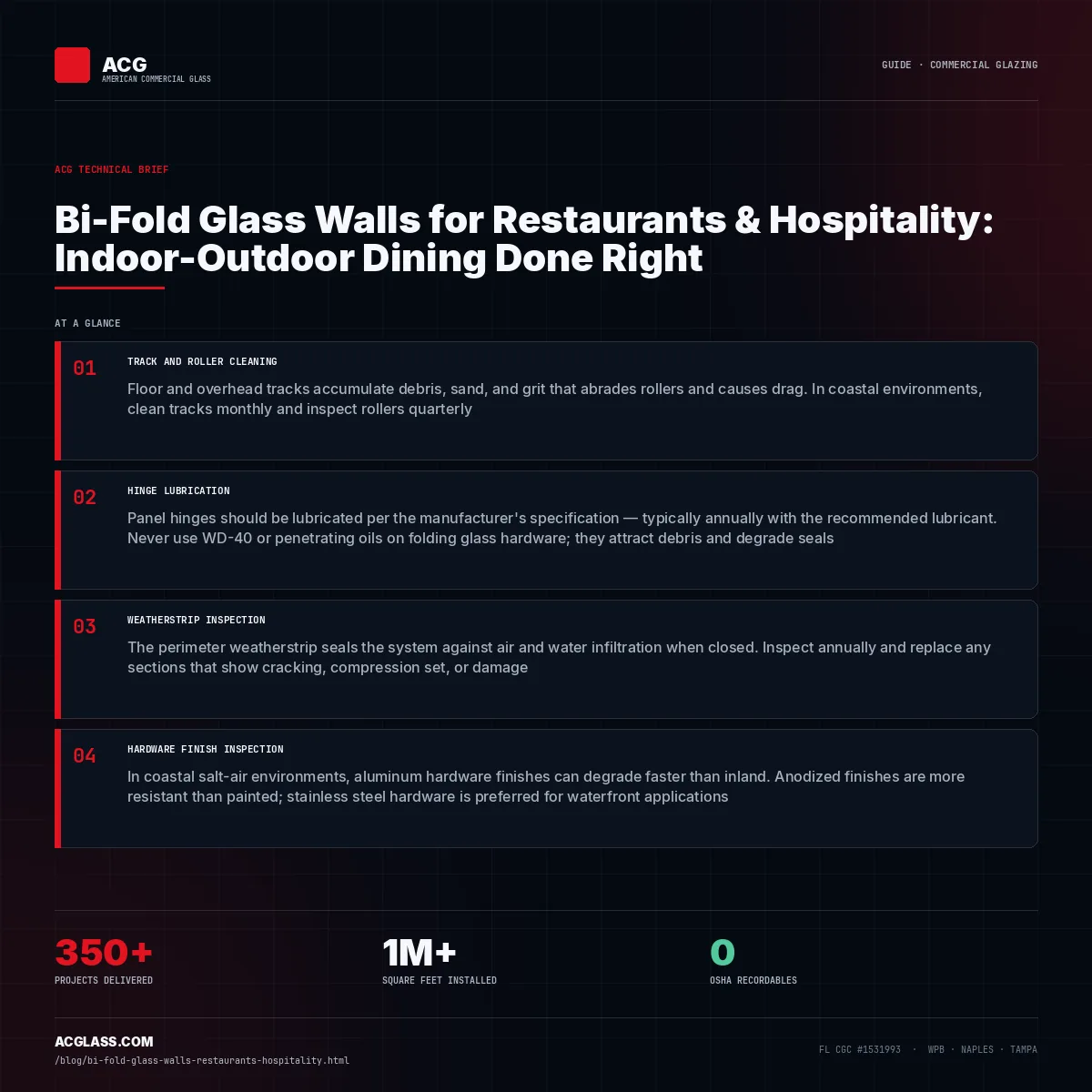
- Track and roller cleaning: Floor and overhead tracks accumulate debris, sand, and grit that abrades rollers and causes drag. In coastal environments, clean tracks monthly and inspect rollers quarterly.
- Hinge lubrication: Panel hinges should be lubricated per the manufacturer's specification - typically annually with the recommended lubricant. Never use WD-40 or penetrating oils on folding glass hardware; they attract debris and degrade seals.
- Weatherstrip inspection: The perimeter weatherstrip seals the system against air and water infiltration when closed. Inspect annually and replace any sections that show cracking, compression set, or damage.
- Hardware finish inspection: In coastal salt-air environments, aluminum hardware finishes can degrade faster than inland. Anodized finishes are more resistant than painted; stainless steel hardware is preferred for waterfront applications.
ACG provides maintenance guidance as part of project closeout on all hospitality glazing projects. If you're having operational issues with an existing folding glass wall system, our team can assess and advise - contact us to schedule a site visit.
ACG's Hospitality Glazing Portfolio
ACG has installed bi-fold and operable glass wall systems on some of Florida's most recognized hospitality projects. The Waxin's West Palm Beach installation used the Eurowall system to open the restaurant's street-facing facade on Clematis Street, creating the indoor-outdoor character that defines the concept. At the Eau Palm Beach Resort, large-format operable glazing systems are integral to the resort's coastal luxury character.
Browse our full project portfolio for the complete range of ACG's hospitality and restaurant glazing work. To discuss your project, use our Scope Engine for a preliminary estimate or send us your drawings directly.
Frequently Asked Questions
Can bi-fold glass walls meet Florida hurricane code?
Yes, when properly specified. Impact-rated bi-fold glass wall products with Florida Product Approvals or Miami-Dade NOAs (for HVHZ projects) are available from major manufacturers and can be designed for the required wind pressures. Confirm product availability and approval status early - not every system is approved for every wind zone.
Are bi-fold glass walls ADA compliant?
ADA compliance for bi-fold glass walls centers on the threshold design and operating force requirements. A threshold with a change in level must be beveled and must not exceed ADA height limits. Top-hung systems eliminate the floor track but still require a threshold detail at the panel base. Work with your architect and glazing contractor to confirm ADA compliance at the threshold and ensure the panels operate within ADA force limits when in use by guests.
How long does it take to get a bi-fold glass wall system?
Fabrication lead times for bi-fold and folding glass wall systems in 2026 are typically 14-20 weeks from order for standard configurations, and longer for custom panel sizes, special finishes, or highly customized configurations. The submittal process (shop drawings, product data, samples) must be completed before fabrication can begin - adding 6-10 weeks to the front end. Plan for a minimum of 6 months from contract to installation start for most bi-fold glass wall scopes.