
Frameless glass doors are a design decision with significant engineering consequences. The visual effect - a doorway that reads as pure glass, with hardware minimized or concealed - depends on getting glass thickness, hardware selection, floor detailing, and structural support correct well before the door is installed. For interior applications, the specification is relatively straightforward. For exterior Florida commercial applications, HVHZ impact requirements, hurricane wind loads, and the need for Florida Product Approval or Miami-Dade NOA documentation tighten the field of viable products substantially. This article walks through the four categories of frameless glass doors used in commercial work, the engineering and hardware considerations, and where each fits in a real project.

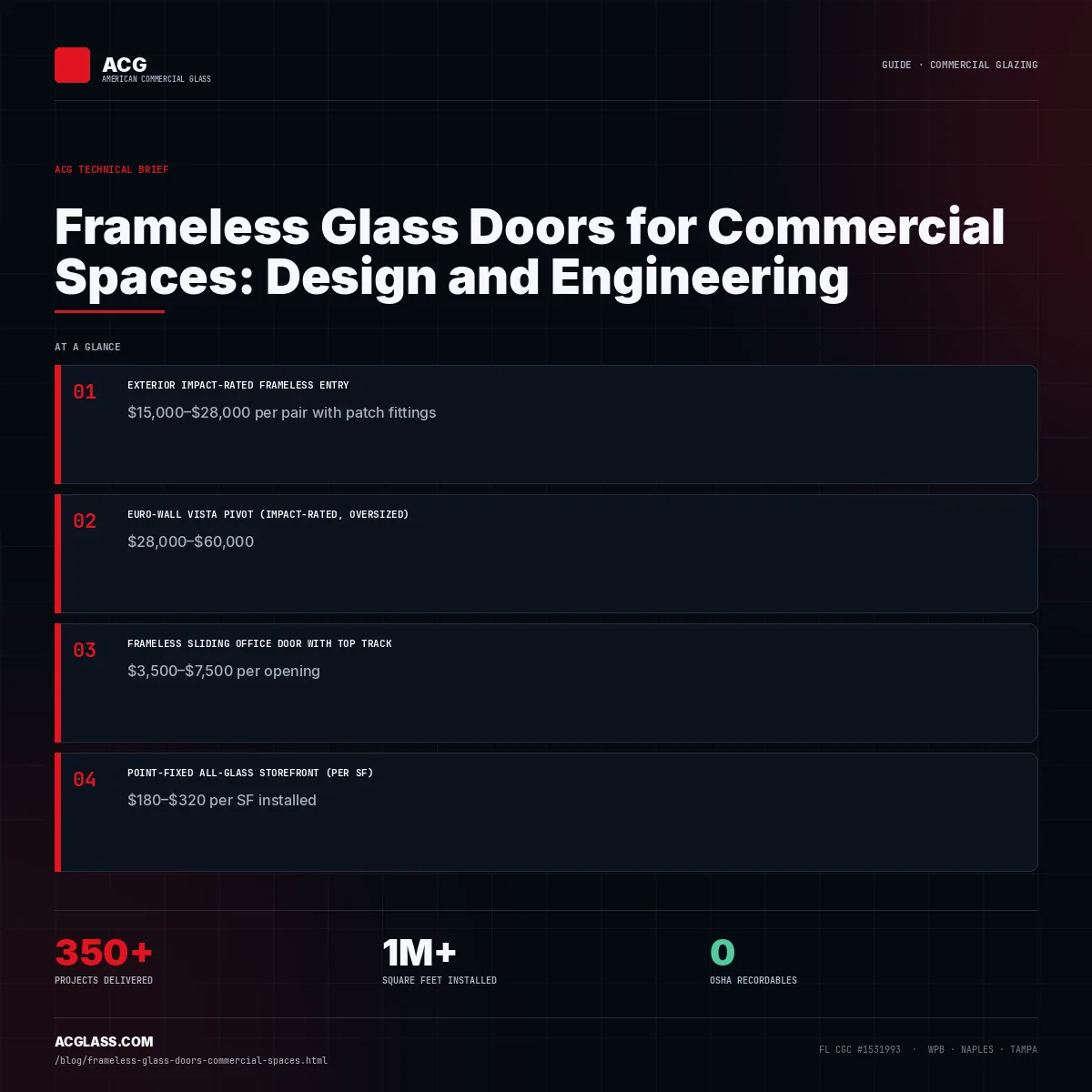
Four Categories of Frameless Glass Doors
The term "frameless glass door" covers a range of door types, each with different structural, hardware, and aesthetic characteristics. Understanding which category fits the application is the first step in getting the specification right.
1. Frameless Patch-Fitting Entry Doors
The classic all-glass entrance: a 1/2-inch tempered glass door, with brushed stainless or aluminum patch fittings at the top and bottom corners, hanging on floor-mounted closer with overhead pivot. The glass is usually paired with fixed sidelites and a transom, all assembled with point-fixed hardware rather than extruded frame. The effect is an entrance that reads as pure glass.
Structural spec: 1/2-inch tempered (or 9/16-inch laminated for impact-rated exterior applications). Height is typically limited to 10 feet before the glass deflection becomes operationally problematic. Patch fittings (Dorma, Crane, C.R. Laurence) are the standard hardware suppliers.
2. Pivot Doors
Pivot doors rotate on a vertical axis set inset from the door edge, rather than hanging from hinges at the edge. The result is a door that can be extraordinarily tall and wide - pivot doors up to 12 feet tall and 6 feet wide are routine on commercial projects. The pivot point is typically 1/3 of the way from a top edge, which distributes the weight across a concealed floor-mounted pivot at the bottom and a ceiling-mounted pivot at the top.
Pivot doors can be frameless all-glass (1/2-inch to 3/4-inch tempered/laminated) or framed with narrow-stile aluminum that reads nearly frameless. For impact-rated exterior pivots on Florida commercial projects, Euro-Wall's Vista Pivot is the product we most often specify - it carries Florida Product Approval for HVHZ and handles oversized commercial entries cleanly.
3. Frameless Sliding Office Doors
Interior office and conference room doors using frameless sliding systems have become standard in Class A commercial interiors. The door is a tempered glass panel running on either a top-mounted aluminum track or a barn-door style exposed steel rod. Handle is a pull-bar or patch fitting; no frame, no hinges, no typical door stop.
These systems work beautifully for privacy-when-needed, open-when-usual scenarios. They are not rated for acoustic performance - a sliding glass door against a finished opening will not give you STC 35 for a private conference room. If acoustic privacy is required, a swinging framed glass door with full perimeter seals is the correct choice.
4. All-Glass Storefronts with Point-Fixed Glazing
Some high-end commercial lobbies, retail flagships, and hospitality entries use point-fixed glazing - 3/4-inch to 1-inch tempered/laminated glass panels connected via stainless spider fittings to an armature or structural member behind. This eliminates vertical mullions across long storefront runs and gives an unbroken glass plane that is impossible to achieve with extruded framing.
The engineering complexity ramps up substantially. Each spider fitting is a structural connection, and the glass itself becomes a structural diaphragm. Impact rating on point-fixed glazing is achievable in Florida but requires engineered product approval - not all systems carry NOA.
Engineering Considerations
Glass Thickness and Composition
Frameless glass doors rely on the glass itself as the structural element. Thickness selection is driven by door size, operation frequency, and impact/security requirements.
| Door Type | Glass Spec | Height Limit | Width Limit |
|---|---|---|---|
| Interior frameless entry (patch fitting) | 1/2" tempered | 9' 0" | 3' 6" |
| Interior heavy-use entry | 3/4" tempered | 10' 0" | 4' 0" |
| Exterior impact-rated frameless | 9/16" laminated tempered | 8' 6" | 3' 6" |
| Commercial pivot door | 3/4" or 1" tempered/laminated | 12' 0" | 6' 0" |
| Frameless sliding office | 3/8" or 1/2" tempered | 9' 0" | 4' 6" |
Hardware Selection
Floor-mounted door closers (Dorma BTS, Rixson FS27) are the standard mechanism for frameless entry doors. They sit inside a concrete floor cavity with a stainless access plate flush to the finished floor. Critical detail: the floor cavity must be formed into the slab during construction, not chipped in after the fact. Retrofit floor closers are a common source of entry door issues.
For pivot doors, the bottom pivot is typically a roller-bearing or oil-damped mechanism with adjustable hold-open and closing speed. The top pivot is a simple bearing. Both are concealed - the only hardware visible is the pull.
Closers, pivots, and patch fittings should match throughout the project for visual consistency. Mixing Dorma hardware with C.R. Laurence patch fittings creates a slightly off look that is hard to diagnose but always obvious in finished photos.
Floor Plate and Threshold Detailing
Frameless doors require flush floor transitions. If the door swings over carpet, tile, and polished concrete, each material needs to be flush with the others. Transition details at the floor pivot or closer plate must be coordinated with the finish floor package - which means the architect, GC, glazing sub, and flooring sub all need to be aligned before the floor goes in. A missed floor pivot pocket is a painful change order.
Impact-Rating Complications
For the broader context on HVHZ and non-HVHZ impact requirements, see our HVHZ glazing requirements and Florida commercial hurricane code articles.
Exterior frameless entry doors in Florida must meet impact-rating requirements wherever the opening is within the wind-borne debris region. This is where product selection tightens. All-glass entry doors with patch fittings can be impact-rated, but the system must carry a Florida Product Approval or Miami-Dade NOA. Custom fabrication without approved documentation is not legal for exterior applications. We typically specify ESWindows entry systems or Euro-Wall Vista Pivot for impact-rated exterior frameless work - both have valid NOAs for commercial application.
Design Use Cases
Boutique Retail
All-glass entry with sidelites and transom conveys transparency and openness. For high-end brands, the entrance is part of the brand experience. Pivot doors at the entrance make the retail statement even stronger on larger storefront runs.
Executive Office Suites
Frameless sliding doors and interior glass partitions give executive suites the modern open feel without sacrificing the ability to close a meeting room. The sliding hardware disappears into the wall when open.
Hotel Lobbies and Hospitality
Grand pivot doors have become standard for hotel porte cocheres and hospitality entries. A 10-foot tall pivot door creates an arrival moment that a conventional swing pair cannot. On tropical and indoor-outdoor hospitality - restaurants, lobby bars, resort entries - Euro-Wall Vista Pivot or bifold glass wall systems create the transition between inside and out.
Restaurants
Restaurant entries often pair a frameless pivot entry with bifold or folding glass walls at the patio side. The effect is a completely openable facade during good weather, closable during rain or cold snaps, and still code-compliant for HVHZ where applicable.
See our commercial storefront systems and Euro-Wall distributor page for product specifications. Frameless glass doors are a design statement, a brand element, and a structural engineering challenge all at once. Getting them right requires a glazier who understands all three.
Ready to get started?
ACG is a CGC-licensed Florida commercial glazing subcontractor (CGC1531993) headquartered in West Palm Beach. Commercial Division 08 scope, statewide. Send plans and we return a detailed scope with system recommendations and 2026 pricing inside 48 hours.