
The glazing subcontractor you choose will have a direct impact on your project's schedule, inspection record, and final appearance. A bad glazing sub creates punch list items that linger for months, failed inspections that delay certificate of occupancy, and water intrusion callbacks that become your problem long after the project closes. This checklist covers every factor that separates a qualified commercial glazing contractor from one that will cost you money.
1. Verify the Correct Florida License
Florida has two distinct license types that come up in commercial glazing: the Certified General Contractor (CGC) license and specialty glazing licenses. Understanding which one your sub holds - and what it allows them to do - is the first gate in your vetting process.
A CGC license (like ACG's CGC1531993) allows a contractor to pull permits across all trades within the scope of a building project, including glazing. It's the broadest license category and the one you want to see from a commercial glazing sub working on permitted work. You can verify any Florida contractor license at the DBPR website using the license number - this takes about 30 seconds and should be non-negotiable on any project.
Also verify that the license is active, that the qualifier has not changed recently, and that there are no disciplinary actions or complaints on record. A recently changed qualifier on a license that was previously in good standing can be a yellow flag - it may indicate the original qualifier left the company.
What to Ask
Ask the sub directly: "What is your Florida license number?" Then verify it yourself. Any legitimate commercial glazing contractor will hand that number over without hesitation. If there's hedging, that's your answer.
2. Confirm Insurance Coverage and Certificates
Before any glazing sub sets foot on your site, you need current certificates of insurance on file. The minimum coverage you should require on a commercial glazing scope:
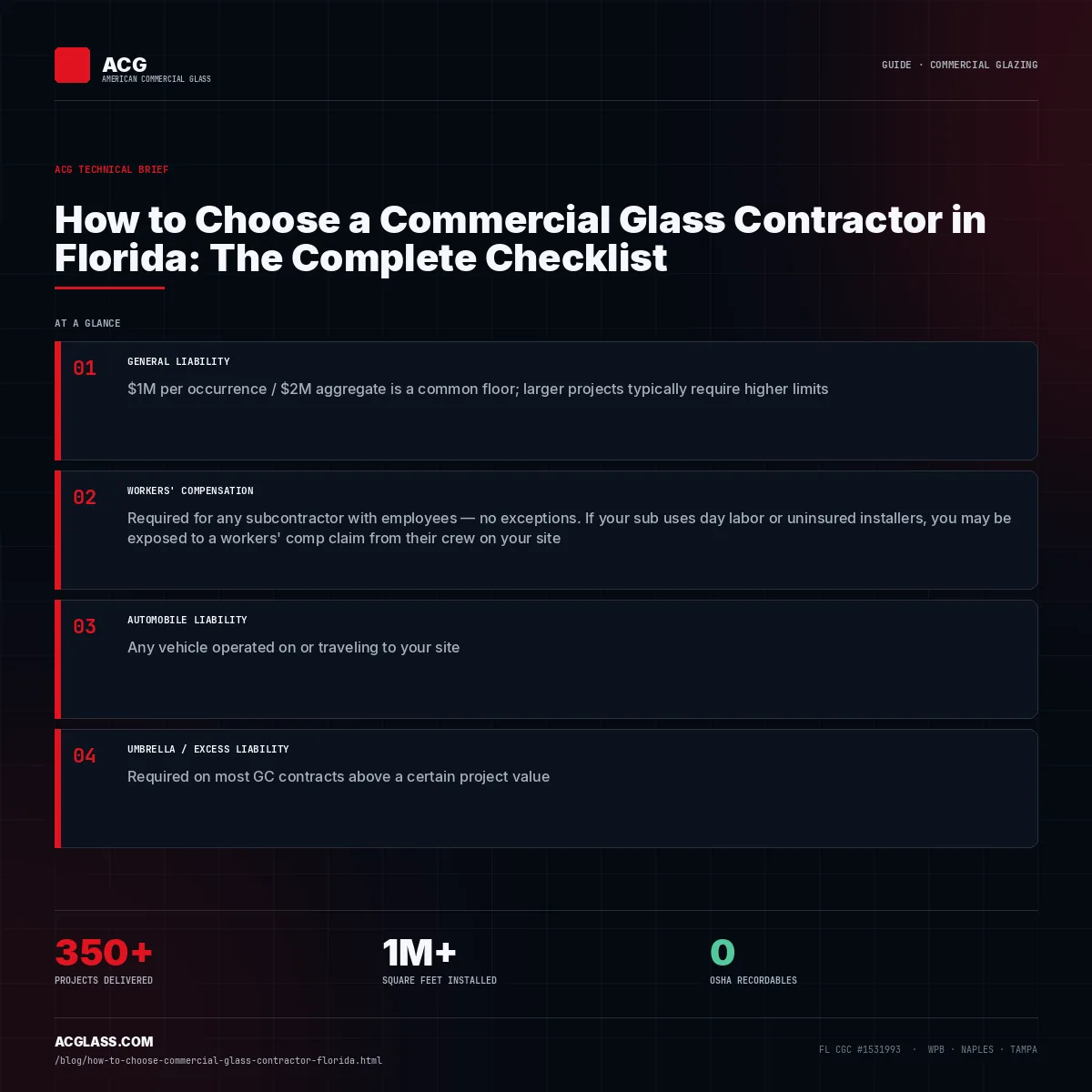
- General Liability: $1M per occurrence / $2M aggregate is a common floor; larger projects typically require higher limits
- Workers' Compensation: Required for any subcontractor with employees - no exceptions. If your sub uses day labor or uninsured installers, you may be exposed to a workers' comp claim from their crew on your site.
- Automobile Liability: Any vehicle operated on or traveling to your site
- Umbrella / Excess Liability: Required on most GC contracts above a certain project value
Require that your firm be named as an additional insured on the GL policy. This is standard in the industry and any commercial glazing sub should comply without pushback. If they resist naming you as an additional insured, that's a significant red flag.
Also verify that Workers' Compensation coverage is current - not just that a certificate exists. Certificates can be issued and then the policy lapses. Confirm the certificate date and call the insurance carrier to verify active coverage if the stakes are high.
3. Review the Portfolio for Comparable Projects
Licensing and insurance are table stakes. The real differentiator is whether your glazing sub has done work that is genuinely comparable to your project - in size, system type, building occupancy, and market. A contractor who has done nothing but single-story retail storefronts is not the right choice for a 12-story curtainwall project, regardless of their license.
Ask for a project list that includes: project name, owner/GC, location, square footage, system type (storefront, curtainwall, window wall, impact, fire-rated), and a reference contact. Then pick up the phone and call at least two of those references. Ask about schedule adherence, inspection record, quality of the submittal package, responsiveness to RFIs and change orders, and how punch list items were handled.
ACG's project portfolio documents completed projects across Florida, with system type, scale, and project context for each. That transparency is what you should expect from any serious glazing sub.
Red Flags in Portfolio Review
Be cautious if a sub can't provide a coherent project list, lists projects they can't give you a reference for, lists projects where they were a supplier rather than the installer, or provides photos that appear to be stock images rather than actual completed work.
4. Evaluate Manufacturer Partnerships
The commercial glazing industry is heavily manufacturer-driven. The major systems - storefront, curtainwall, window wall, automatic entrances, fire-rated assemblies - are all proprietary systems manufactured by companies like ESWindows, LKS, Allegion, and others. A qualified glazing contractor has established purchasing relationships with these manufacturers and, in many cases, holds distributor or fabricator status.
Why does this matter? Installers with direct manufacturer relationships get technical support, access to the specified product line, and help during the submittal and engineering process. A sub buying through a distributor at arm's length gets none of that - and on a complex project, manufacturer technical support is not optional.
Ask any prospective sub which manufacturers they hold direct accounts with, which systems they've installed most frequently, and whether they can provide manufacturer-issued warranty documentation upon project completion. See our services page for a breakdown of the systems ACG installs and the manufacturer relationships we maintain.
5. Assess the Bid Package Quality
A bid package from a commercial glazing sub tells you a great deal about how that sub operates. A thorough bid includes: a detailed scope letter with clear inclusions and exclusions, a square footage takeoff by system type, specific system recommendations with manufacturer and series identified, a glass specification, an allowance or unit price for scope items that can't be quantified without final drawings, and a list of clarifications and qualifications.
A thin bid - one page, no exclusions, no system identified - is not a sign of efficiency. It's a sign of a sub who is either inexperienced, doesn't understand the scope, or is planning to fill in the gaps with change orders. You may not catch the problem until you're six weeks into a job and the "base bid" starts generating RFCs.
Use our Scope Engine to generate a preliminary glazing scope before you even go to bid - it gives you a baseline to compare incoming sub proposals against and flags gaps in scope coverage early.
What to Compare Across Bids
When evaluating multiple bids, the number is not the only thing to compare. Verify that every bid covers the same scope. A bid that comes in 20% below the others is not necessarily a better deal - it may simply be missing 20% of the scope. Line up the exclusions lists side by side before you draw any conclusions from the numbers.
6. Confirm Florida Building Code and HVHZ Fluency
Florida's commercial glazing requirements are among the most complex in the country. The Florida Building Code (FBC) Seventh Edition establishes baseline requirements for wind load design, fenestration energy performance, and impact resistance in wind-borne debris regions. The High Velocity Hurricane Zone (HVHZ) - Miami-Dade and Broward counties - adds a further layer of product approval requirements that disqualify many otherwise code-compliant products.
Ask your prospective glazing sub how they handle product approvals, what their submittal process looks like for HVHZ projects, and who on their team is responsible for ensuring that installed products match their Florida Product Approvals (FPAs) and Miami-Dade Notices of Acceptance (NOAs). If they can't speak fluently to this process, they are not a qualified HVHZ glazing contractor, regardless of their license status.
See our related post on Florida Building Code commercial glazing requirements for a detailed breakdown of what the code requires and where most subs fall short.
7. Evaluate Technology and Project Management Practices
Commercial construction has become increasingly documentation-intensive, and glazing is no exception. Shop drawings, submittals, RFIs, product approval documentation, inspection reports, and punch list tracking all need to be managed systematically. A glazing sub whose project management consists of spreadsheets and email threads is a liability on a fast-moving project.
Ask what project management platform they use, how they handle RFI tracking, how they document inspections, and how they communicate schedule changes. A sub that uses construction management software - and can demonstrate that their team actually uses it - will be significantly easier to integrate into your project workflow.
ACG uses systematic project management tools to track submittals, RFIs, and inspection milestones in real time. This is not standard in the industry, and it's a genuine differentiator in terms of schedule transparency and issue resolution speed.
8. Assess Communication Style and Responsiveness
The best leading indicator of how a glazing sub will perform during construction is how they perform during the pre-award process. If they take a week to return a call before the job is awarded, what happens when there's a field problem at 6 AM on a Friday?
Pay attention to: how quickly they respond to requests for information, whether their communication is clear and specific or vague and hedging, whether they proactively identify issues in your drawings rather than waiting for you to ask, and whether they can articulate their scope of work without prompting. These behaviors don't change after award. What you see in the bid process is what you get in the field.
The ACG Standard
ACG - American Commercial Glass - is a licensed commercial glazing subcontractor operating under CGC1531993, headquartered in West Palm Beach. We deliver commercial glazing scopes across Florida. Our team returns complete bid packages - scope letter, takeoff, system recommendations, and pricing - within 48 hours of receiving drawings.
We maintain direct manufacturer relationships across the major commercial glazing product lines, hold full HVHZ documentation capability, and use systematic project management for real-time schedule and submittal tracking. Browse our portfolio to see the range and scale of our completed work, or reach out through our contact page to discuss your next project.
You can also review our full service offerings on the services page, or use the Scope Engine for a preliminary estimate before you go to bid.
The Vetting Checklist: Quick Reference
| Item | What to Verify | Red Flag |
|---|---|---|
| License | Active CGC or specialty license via DBPR | Hesitation to provide license number |
| Insurance | Current GL + WC certificates, AI endorsement | Resistance to adding you as additional insured |
| Portfolio | Comparable projects with verifiable references | No references available for listed projects |
| Manufacturers | Direct accounts with major glazing manufacturers | Buying only through distributors, no direct relationships |
| Bid quality | Detailed scope letter with clear exclusions | One-page bid with no exclusions listed |
| FBC / HVHZ | Can explain NOA/FPA process fluently | Unfamiliar with product approval requirements |
| Communication | Responsive, specific, proactive during bid process | Slow to respond before award |