
Interior glass partitions have become the defining element of modern commercial office design. The all-glass office front is now standard on Class A projects, and the expectations for acoustic performance, aesthetic quality, and installation precision have never been higher.
The Shift to Glass Offices
A decade ago, private offices were built with drywall and a window. Today, the default spec on Class A office projects is full-height glass - office fronts, conference rooms, demising walls, and collaborative spaces all defined by glass partition systems.
The drivers of this shift are well-documented:
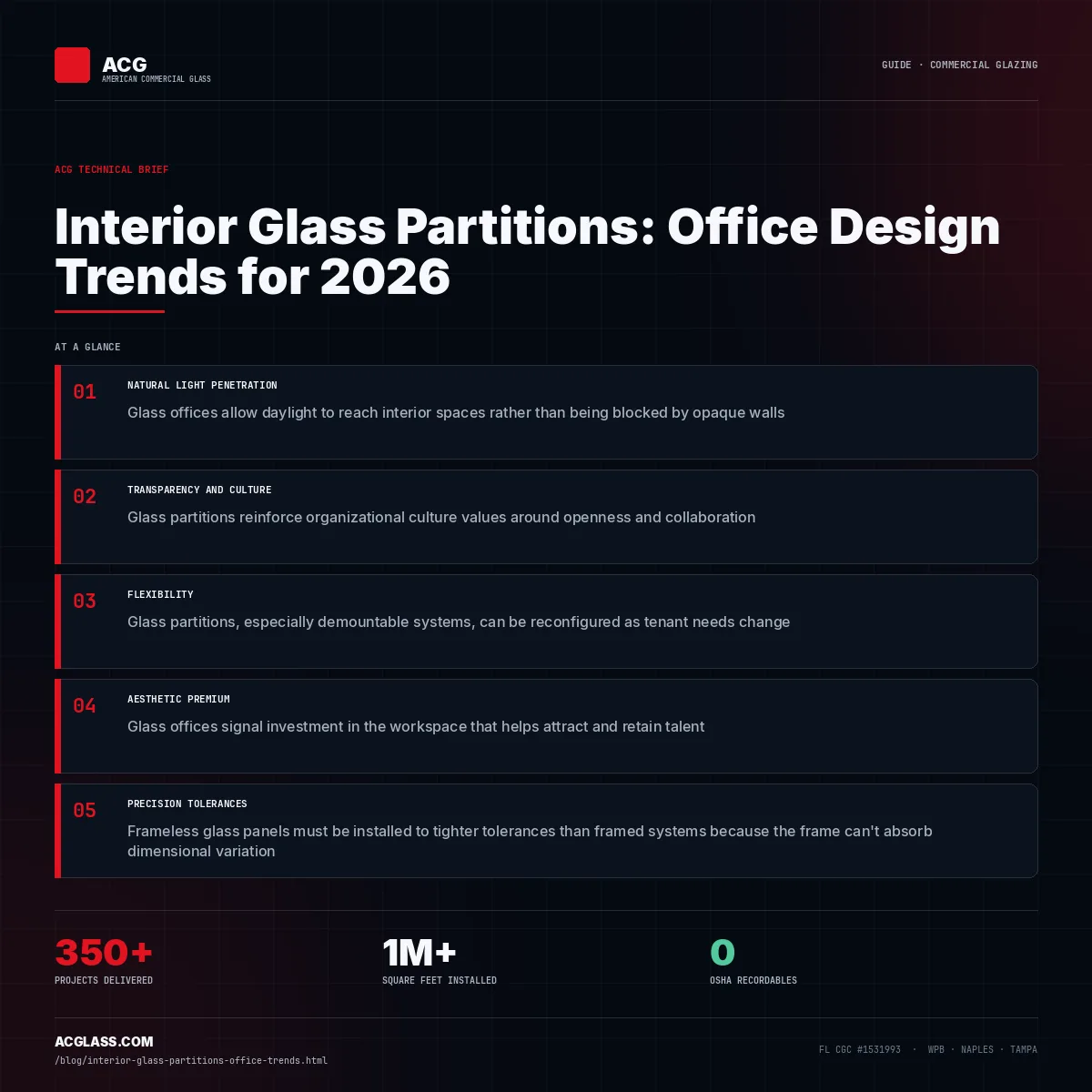
- Natural light penetration: Glass offices allow daylight to reach interior spaces rather than being blocked by opaque walls
- Transparency and culture: Glass partitions reinforce organizational culture values around openness and collaboration
- Flexibility: Glass partitions, especially demountable systems, can be reconfigured as tenant needs change
- Aesthetic premium: Glass offices signal investment in the workspace that helps attract and retain talent
The Acoustic Challenge
The biggest practical challenge with glass office environments is acoustic performance. Standard single-pane glass provides minimal sound attenuation - STC ratings in the mid-20s, which allows most conversation to be audible in adjacent spaces.
For private offices, conference rooms, and HR/legal/finance spaces, that's inadequate. Modern workplace design requires STC 40+ for most private office applications and STC 45-50+ for conference rooms and spaces with elevated confidentiality requirements.
Achieving these STC ratings with glass requires:
Laminated Acoustic Glass
Standard tempered glass provides virtually no acoustic benefit over a single pane. Laminated glass - two glass panes bonded with an interlayer - provides meaningful acoustic improvement through the mass-air-mass resonance effect. Acoustic PVB interlayers perform significantly better than standard safety PVB.
Edge Sealing
Sound travels through gaps much more efficiently than through solid materials. Glass partition systems that achieve high STC ratings use acoustic gaskets at every edge - top, bottom, and both sides - to eliminate the flanking paths that gap-and-crack sound transmission creates.
Structural Integration
Sound flanking through the partition's mounting structure is a major source of acoustic failure. Partitions that are poorly connected to the building's structural elements often achieve STC ratings in testing that they fail to deliver in the field because of flanking paths through the connections.
Frameless and Minimal-Frame Systems
The trend toward minimal visible framing continues. Frameless glass partitions - secured with point-fixed hardware or proprietary channel systems rather than visible aluminum framing - represent the premium end of the market.
Frameless systems have specific installation requirements:
- Precision tolerances: Frameless glass panels must be installed to tighter tolerances than framed systems because the frame can't absorb dimensional variation
- Structural substrate: Point-fixed hardware transfers loads directly to the building structure - the substrate must be designed to accept those loads
- Glass quality: In frameless applications, glass quality is more visible than in framed systems - distortion, surface quality, and edge quality all matter more
Switchable Privacy Glass
Electrochromic and PDLC (polymer dispersed liquid crystal) switchable glass allows partitions to transition between transparent and opaque states on demand. The technology is increasingly specified for conference rooms and executive offices where privacy requirements vary.
PDLC systems are the most common in commercial applications - they switch from translucent (frosted appearance when powered off) to clear (when powered on). The frosted state provides visual privacy without fully opaque walls, maintaining daylight transmission even in the private mode.
GC coordination requirements for switchable glass include:
- Low-voltage power to each switchable panel - typically 24V DC supplied by a dedicated power supply
- Control system integration - most systems use a wall switch or app control that needs to be coordinated with the electrical design
- Conduit routing in the partition framing or floor/ceiling connections
Demountable vs. Fixed Systems
Demountable glass partition systems are designed to be disassembled and relocated without damage to the host building. Fixed systems are more permanent. The choice affects:
- Lease negotiation: Some tenants prefer demountable systems because they can relocate them at lease expiration
- Acoustic performance: Fixed systems generally achieve better acoustic performance because they can use more permanent sealing methods
- Initial cost: Demountable systems typically cost more upfront
- Building owner preference: Some building owners prefer demountable systems because they restore the shell space cleanly at tenancy end
Installation Quality Standards
Interior glass partition installations are held to the finish-work quality standard - any visible imperfection at occupancy is a punchlist item. ACG's partition installations are measured to:
- Perfect plumb and level - the eye is quick to detect out-of-plumb glass in a finished interior
- Consistent joint widths - gaps between panels that vary by more than 1/16" are visible
- Clean transitions to ceiling grid, flooring, and drywall
- Hardware that operates smoothly and without visible play
If you have an office fit-out project coming up with interior glass partitions, ACG can provide the full scope - partition installation, hardware selection, acoustic analysis, and coordination with your ceiling and flooring trades. Send us your plans and we'll have a detailed scope back to you within 48 hours.