
Commercial glass damage rarely comes with an obvious answer on repair versus replace. A broken pane on an otherwise healthy storefront is clearly a repair. A storm-damaged curtainwall with frame deformation is clearly a replacement. Most real calls land somewhere in the middle - fogging spreading across a 12-year-old building, hardware failures on occupied entrances, scattered IGU failures, sealant breakdown that looks worse than it is. This is the decision framework ACG applies on commercial damage assessments across Florida.

The Decision Framework
Every commercial glass damage call comes down to four questions. Answering them honestly usually points to the right outcome without any ambiguity.
- Is the frame / structural assembly still sound? If yes, consider repair. If no, plan replacement.
- Is the failure isolated or systemic? One broken pane is a repair. Twelve fogged IGUs across a building might be a campaign.
- What's the cost of repair vs replacement? Sometimes repair is 40 percent of replacement cost, sometimes it's 90 percent - and the calculus changes at that margin.
- What's the remaining service life of the surrounding components? If the frame finish is chalking and hardware is failing anyway, replacing one IGU buys 2 years before the whole unit needs replacement. Better to replace now.
Scenario 1: Single Broken Pane (Impact, Vandalism, Debris)
A single pane broken in an otherwise healthy system is always a repair scenario. You replace the IGU, not the window. Frame, hardware, and sealants stay.
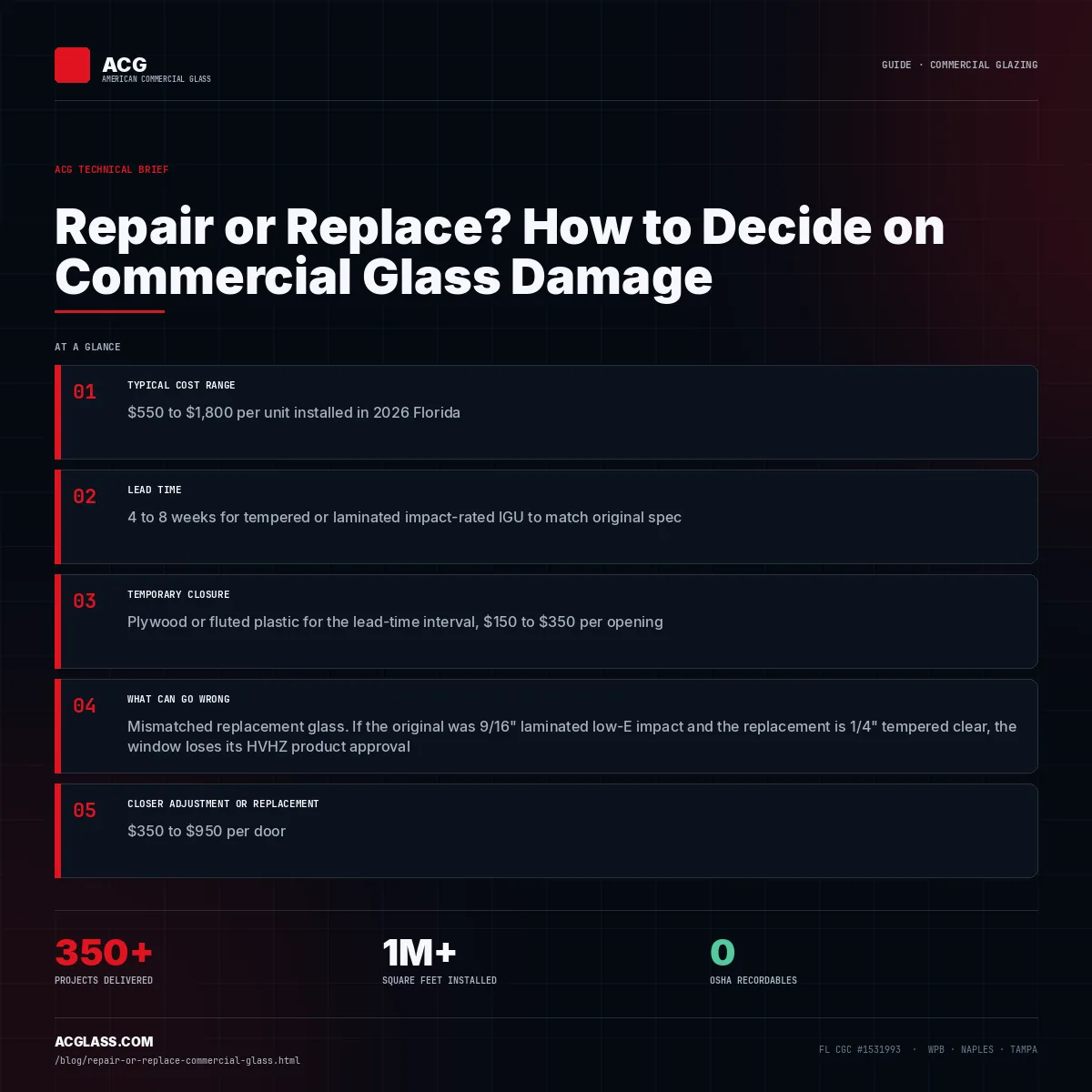
- Lead time: 4 to 8 weeks for tempered or laminated impact-rated IGU to match original spec
- What can go wrong: Mismatched replacement glass. If the original was 9/16" laminated low-E impact and the replacement is 1/4" tempered clear, the window loses its HVHZ product approval
Scenario 2: Impact Damage After a Storm
Post-hurricane or post-storm damage is a different category. The scope is larger and the frame and structural assembly need to be evaluated before deciding repair vs replace.
Assessment steps:
- Check frame for deformation or anchor pull-out at impacted openings
- Check adjacent openings for transferred structural loading
- Check sealants for delamination from the substrate
- Document everything photographically for the insurance claim before any repair begins
If frames are sound, proceed with IGU-only replacement and sealant refresh. If frames are deformed or anchors compromised, window unit replacement is the correct scope. Trying to repair bent or displaced frames usually compromises the product approval and creates liability on future storms. On post-storm projects, ACG coordinates directly with the owner's insurance adjuster and provides TAS 201/202/203 NOA documentation with the new product to keep the insurance claim clean.
Scenario 3: Spontaneous Breakage on Tempered Glass
Tempered glass can fail unexpectedly years after installation due to nickel sulfide (NiS) inclusions in the original glass body. Under thermal stress, the inclusion expands and the stored surface compression energy shatters the lite in the characteristic "dice" pattern.
NiS inclusion failure is almost always a single-lite event. The adjacent units are statistically unlikely to share the defect. Replace the affected unit, verify that no other lites show obvious surface defects, and monitor.
If your project included heat-soak-tested (HST) tempered glass - tested at elevated temperature to trigger latent NiS failures before install - the likelihood of in-service spontaneous breakage is reduced by about 95 percent.
Scenario 4: Door Hardware Failure
Commercial entrance door hardware - closers, pivots, hinges, exit devices, push/pull hardware - has a 10 to 15 year service life in Florida and usually fails gradually. Closer hydraulics leak. Pivots develop play. Weatherstripping compresses. These are maintenance-scope repairs, not replacement-scope events.
Common fixes:
Repair the hardware, keep the door.
Scenario 5: Widespread IGU Fogging (Campaign Decision)
This is the scenario where the one-at-a-time repair calculus flips. A building that's 15+ years old and has 10 to 15 percent of its IGUs showing fogging has the remaining 85 to 90 percent on the same clock. Continuing to replace one-by-one means glazier mobilizations every 3 to 6 months for the next 5 to 10 years, rising tenant complaints, and no clean warranty reset.
A campaign replacement consolidates the work. Everything gets planned, sequenced, priced as volume, and delivered on a single mobilization. The math:
| Approach | Cost per Unit | Scope / Trade-off |
|---|---|---|
| One-off IGU replacement | By scope | Each event has full mobilization cost |
| Campaign (50+ units) | By scope | Shared mobilization, volume IGU pricing |
| Full window replacement | By scope | Needed if frames also compromised |
Typical break-even point: if your building is projected to need more than 40 to 50 IGU replacements over the next 5 years, the campaign pencils out lower than incremental repairs.
Scenario 6: Sealant and Gasket Failure
Perimeter silicone sealant fails at year 10 to 15 in Florida exposure. Signs: chalky residue, loss of adhesion to the substrate, visible cracks, water intrusion during horizontal rain. This is always a repair, not a replacement scenario. Re-caulk the perimeter, replace failed gaskets, pressure-test if leaks continue.
It's unglamorous work that extends the life of the rest of the assembly by another 10 to 15 years.
How Warranty Factors In
On a building where the original glazing is still under warranty (typically 10 years on IGU, 10 years on finish, 5 years on hardware), the repair vs replace decision should always include a warranty claim review. ACG tracks warranty status on every commercial project we install and will file warranty claims on behalf of the owner where applicable.
The ACG Assessment Process
For any commercial glass damage question, ACG's assessment includes: (1) site walk and photo documentation, (2) spec identification (retrieve original submittals where available), (3) component condition grading by system, (4) prioritized repair plan with pricing for each scope option, and (5) warranty status review. The assessment is usually free on projects we're bidding to repair and carries a nominal fee otherwise.
Project examples where we've made these calls for owners: Gulf Harbour Country Club (post-storm assessment), iFLY Miami (IGU replacement planning). Full commercial glazing services include this kind of asset assessment alongside new construction.
If you have commercial glass damage in Tampa or anywhere in Florida and want a straight answer on repair vs replace, send photos and address via contact.html.
Ready to get started?
ACG is a CGC-licensed Florida commercial glazing subcontractor (CGC1531993) headquartered in West Palm Beach. We price commercial Division 08 scopes across the state and return competitive, itemized bids within 48 hours. Send your plans and we'll have a scope back to you fast.