
After five-plus years of commercial glazing work across Florida, a pattern emerges in the service calls and warranty visits. The same five problems account for probably 90 percent of commercial window issues in Florida buildings: IGU fogging, water intrusion, frame corrosion, gasket and weatherstripping failure, and door hardware wear. What's useful to know - and what most building owners don't - is that four of those five have almost nothing to do with the glass itself. They're installation issues, maintenance issues, or sealant issues. Understanding the difference tells you whether you need a glazing replacement, a maintenance visit, or a conversation with your original installer about warranty coverage. Here's the problem inventory, what causes each one in Florida specifically, and what the real fix looks like.
Problem 1: IGU Fogging (Seal Failure)
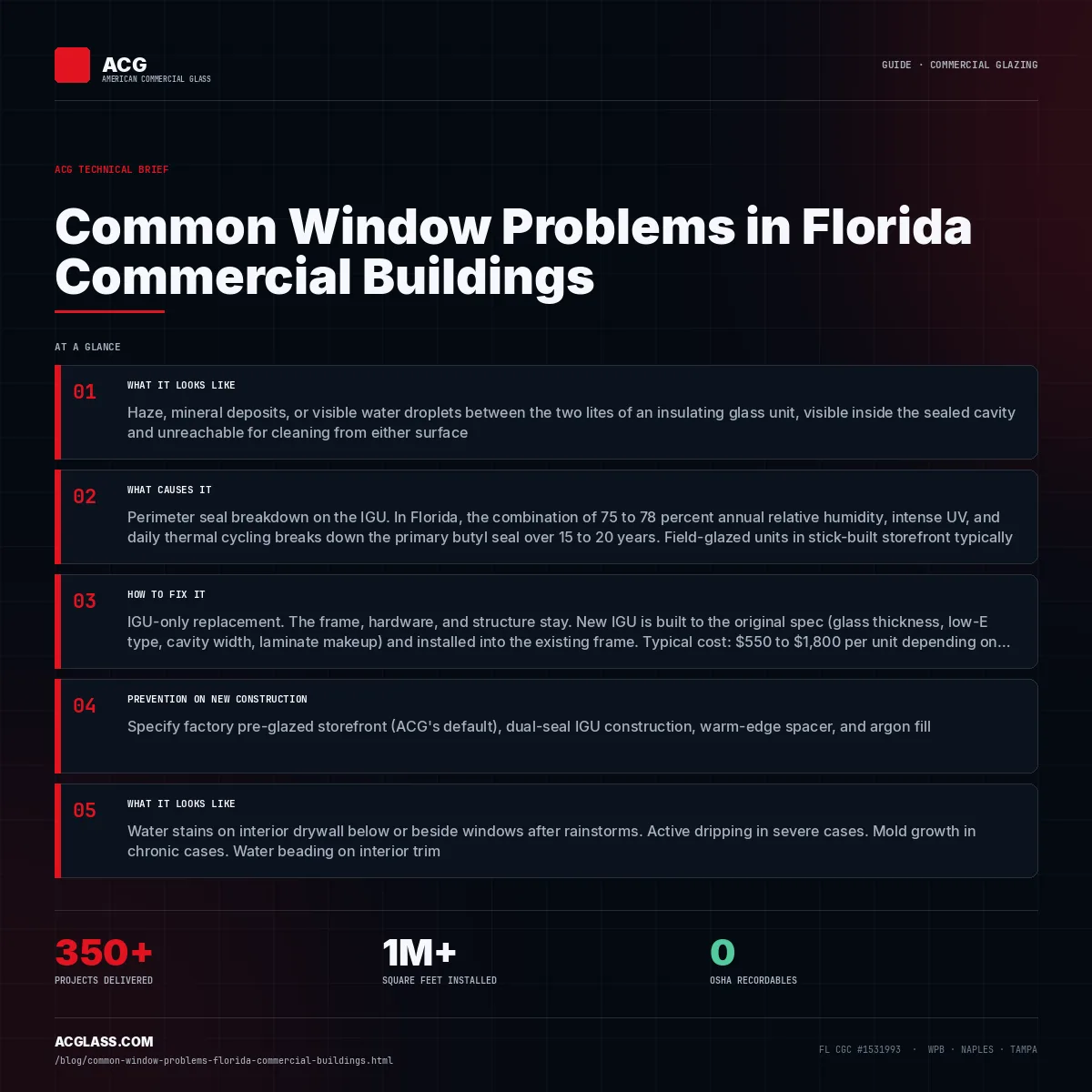
What it looks like: Haze, mineral deposits, or visible water droplets between the two lites of an insulating glass unit, visible inside the sealed cavity and unreachable for cleaning from either surface.
What causes it: Perimeter seal breakdown on the IGU. In Florida, the combination of 75 to 78 percent annual relative humidity, intense UV, and daily thermal cycling breaks down the primary butyl seal over 15 to 20 years. Field-glazed units in stick-built storefront typically fog 3 to 5 years earlier than factory pre-glazed units because of humidity trapped during the glazing process.
How to fix it: IGU-only replacement. The frame, hardware, and structure stay. New IGU is built to the original spec (glass thickness, low-E type, cavity width, laminate makeup) and installed into the existing frame. Lead time: 6 to 10 weeks from order.
Prevention on new construction: Specify factory pre-glazed storefront (ACG's default), dual-seal IGU construction, warm-edge spacer, and argon fill.
Problem 2: Water Intrusion
What it looks like: Water stains on interior drywall below or beside windows after rainstorms. Active dripping in severe cases. Mold growth in chronic cases. Water beading on interior trim.
What causes it: Almost never a glass problem. Water intrusion at commercial windows is nearly always traceable to one of four installation or sealant issues:
- Failed perimeter sealant - original caulking has aged out at year 10 to 15 and lost adhesion to the substrate
- Incorrect flashing - the original installer did not step-flash or pan-flash the rough opening correctly, and water getting behind the cladding has no drainage path
- Missing or failed weep system - storefront systems rely on internal weep holes to drain glazing pocket moisture. Blocked weeps (by paint, sealant, or debris) dam water at the sill
- Gasket compression set - EPDM or silicone gaskets have lost their memory and no longer seal against the glass edge
How to fix it: Diagnosis first. ASTM E1105 water penetration field testing can pinpoint the failure mode.
Prevention on new construction: CGC-licensed subs who understand TAS 202 water testing and follow manufacturer flashing details. This is where installer quality separates from installer price.
Problem 3: Frame Corrosion
What it looks like: Pitting, white oxide (for aluminum), rust bleed (for steel components), or bubbling paint on frame surfaces. Usually starts at horizontal surfaces and in corners where water pools.
What causes it: Coastal salt air combined with finish failure. Within 1,500 feet of the coast, salt deposits settle on frame surfaces daily and work through lower-tier finishes in 8 to 15 years. AAMA 2603 painted finishes are especially vulnerable. Fastener corrosion (using plain steel instead of stainless or galvanized) can bleed rust stains onto otherwise intact finishes.
How to fix it: Depends on severity. Deep pitting or through-section corrosion usually requires frame replacement. Galvanic corrosion from dissimilar metal fastener contact can be addressed by fastener replacement with proper isolation.
Prevention on new construction: Specify AAMA 2605 Kynar finish, 300-series stainless fasteners for coastal projects, and proper dissimilar-metal isolators at any steel-to-aluminum contact.
Problem 4: Gasket and Weatherstripping Failure
What it looks like: Audible air infiltration, drafts around window perimeter, visible gap between frame and sash at vent or operable units, water intrusion during horizontal rain, HVAC energy creep.
What causes it: UV degradation and compression set on EPDM, silicone, or polyvinyl gasket material. Florida UV loading cooks gaskets over 10 to 15 years. Operable vents with high cycle counts wear their gaskets faster than fixed glazing.
How to fix it: Gasket replacement is straightforward maintenance. Pull the failed gasket, clean the gasket channel, install new OEM or compatible replacement gasket. Usually done as part of a building-wide maintenance sweep rather than unit-by-unit.
Prevention on new construction: Specify silicone or EPDM gaskets with UV stabilizers (not PVC). Include in the O&M manual and build into the 10-year capital plan.
Problem 5: Door Hardware Wear
What it looks like: Door closers that won't hold the door, sagging pivots causing the door to rub the floor or frame, exit devices that don't retract cleanly, doors that swing wildly on windy days because closer hydraulics have failed.
What causes it: Normal wear combined with Florida conditions. Commercial entrance doors cycle 300 to 2,000 times per day in high-traffic applications. Hydraulic closers lose their oil charge over 8 to 12 years. Pivots develop play. Exit devices wear at the latch bolt and at the dogging mechanism. Salt air accelerates hardware component corrosion, particularly on lower-tier hardware spec.
How to fix it: Hardware service is scheduled maintenance. The door itself typically doesn't need replacement until year 25 to 35 if the original spec was medium-stile impact-rated aluminum.
Prevention on new construction: Specify BHMA Grade 1 hardware. For high-cycle applications, specify hardware rated for the actual cycle count expected.
Why Most "Window Problems" Are Installation Problems
Of the five problems above, four are either installation-dependent (water intrusion, frame corrosion from fastener choice) or maintenance issues (gaskets, hardware). Only IGU fogging is genuinely a product failure issue - and even that is significantly accelerated by poor install practices.
This is why we emphasize the installation quality factor so heavily. A commercial glazing scope installed by a crew that:
- Follows manufacturer flashing details exactly
- Installs pre-glazed units to avoid field-humidity IGU contamination
- Uses the correct fastener specs for the environmental exposure
- Pressure-tests per ASTM E1105 during punch
- Documents the install with NOA/FL compliance packages
... will produce a building with far fewer of the problems above over the next 20 years. That's what ACG's 5+ years of active commercial-only work buys the owner.
The Pre-Glazed Difference in Problem Prevention
Factory pre-glazed ES-8000 storefront from ESWindows ships with the IGU already sealed into the frame under controlled humidity. That single factor reduces fogging incidence, improves water-test pass rates, and eliminates the jobsite variable that causes early IGU failure. On projects like Wild Blue Clubhouse and Wave Food Hall Cocoa Beach, the pre-glazed install is a measurable part of why those buildings perform.
Action Plan for an Aging Building
If you're looking at a commercial building in Florida between 10 and 25 years old and starting to see any of these problems, the action plan is:
- Get a component-by-component assessment from a CGC-licensed glazing sub
- Categorize findings as immediate, 1-2 year, or 3-5 year scope
- Build a phased capital plan across 5 years
- Consolidate work into efficient mobilizations (don't send a glazier for every fogged unit)
- Reset warranty where new components are installed
Seeing problems in your Tampa or Florida commercial building? Send address and photos via contact.html for an assessment and phased plan.
Ready to get started?
ACG is a CGC-licensed Florida commercial glazing subcontractor (CGC1531993) headquartered in West Palm Beach. We price commercial Division 08 scopes across the state and return competitive, itemized bids within 48 hours. Send your plans and we'll have a scope back to you fast.