
ADA compliance on commercial glass doors is simple in concept and easy to get wrong in the field. A door that looks fine on the schedule and installs clean can still fail an accessibility audit if the clear width is off by half an inch, the threshold is a quarter inch too tall, or the hardware sits outside the reach range. On public-facing storefronts, medical office buildings, and any building subject to ADA Title III, those details determine whether the owner is collecting rent or defending a lawsuit. This guide walks through the ADA Standards for Accessible Design as they apply to commercial glass doors: clear width, thresholds, hardware, operating force, automatic entrances, safety glazing overlaps, and visibility marking on all-glass doors.

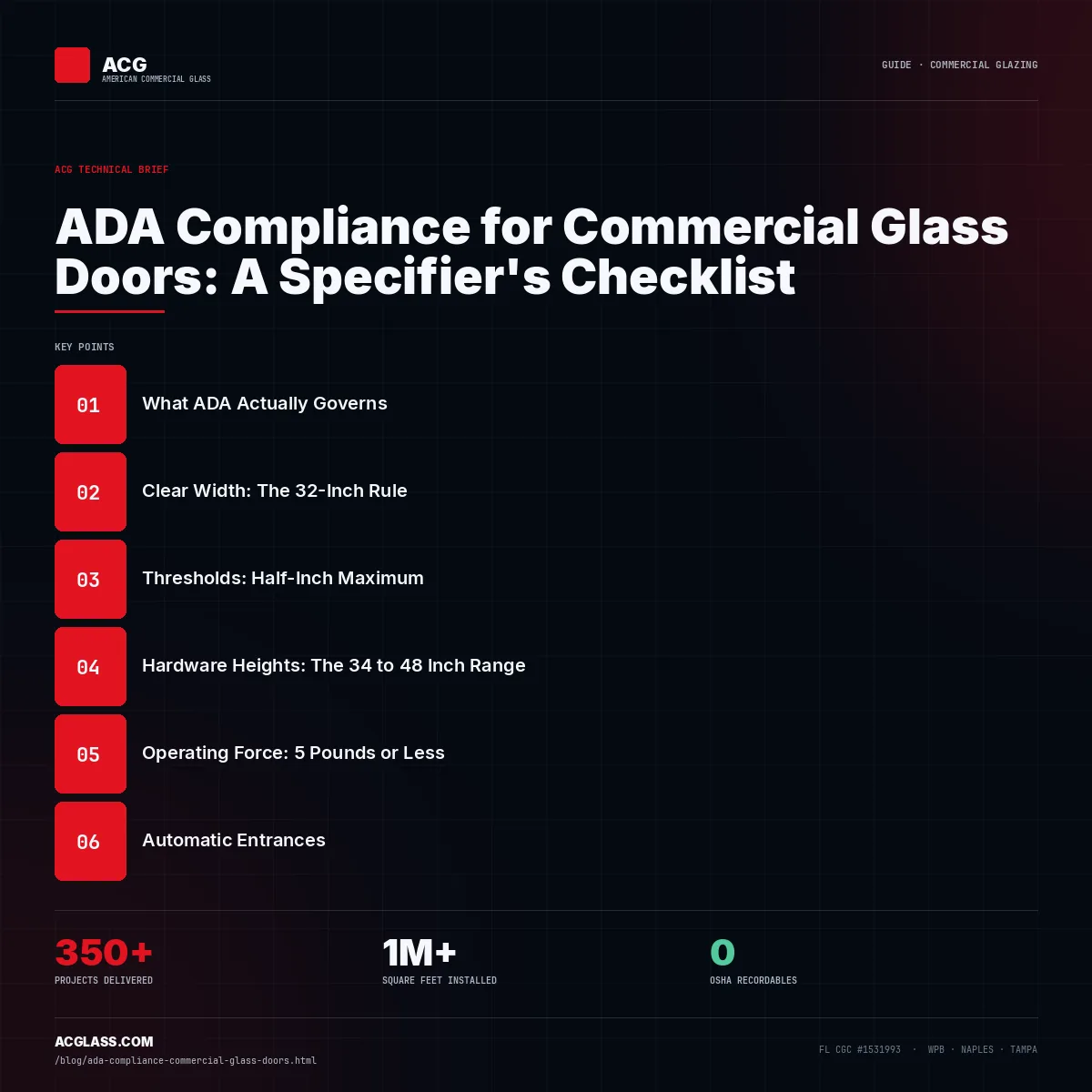
What ADA Actually Governs
The 2010 ADA Standards for Accessible Design apply to commercial buildings through Title III of the Americans with Disabilities Act. The Florida Building Code incorporates accessibility requirements aligned with the federal standard, so a door that meets the 2010 ADA Standards generally meets Florida accessibility code as well. The governing provisions for glass doors are primarily in Section 404, Doors, Doorways, and Gates, with related requirements in Section 308 on reach ranges and Section 309 on operable parts.
ADA applies to every public-facing accessible entrance, every interior door on an accessible route, and every employee door where full access is required. Back-of-house service doors are sometimes exempt, but the safe default on commercial work is to assume every door is accessible until the code consultant carves out exceptions.
Clear Width: The 32-Inch Rule
ADA requires a minimum 32-inch clear width at the door opening, measured between the face of the door, open 90 degrees, and the opposite stop. That measurement is after the door stop, hinge, and any hardware that projects into the opening. On a glass storefront door, this translates to a finished opening that is typically 36 inches wide with a 3-foot leaf, because the door thickness, stop detail, and offset pivot hardware eat into the clear dimension.
How to Spec It
- Single leaf on an accessible route: 3-foot door minimum, measured 36 inches nominal, yielding roughly 32 inches clear
- Paired doors: each leaf minimum 32 inches clear if both are used, or one leaf 32 inches clear if the other is a fixed or inactive leaf
- Offset pivot hardware: confirm clear width with the manufacturer, offset pivots steal roughly half an inch
- Continuous hinges: confirm projection into the opening, most continuous hinges are neutral to clear width
Florida storefront work often uses a 3-foot-0-inch nominal opening as the default, but on narrower openings or where frame details reduce clear width, a 3-foot-6-inch opening may be needed to make the 32-inch clear dimension.
Thresholds: Half-Inch Maximum
ADA caps threshold height at half an inch maximum, with the top quarter-inch required to be beveled at 1:2 slope. Any threshold taller than half an inch is non-compliant regardless of how well-finished it is. This rule is the single most commonly violated ADA door requirement on commercial construction, usually because the threshold was selected without coordinating with flooring heights on either side.
On storefront work in Florida, the code additionally requires that exterior thresholds maintain water resistance, so the threshold often includes a dam that must still fit under the half-inch total height budget. Pre-cast concrete thresholds, aluminum channel thresholds, and offset saddle thresholds are all available in compliant profiles, but the specifier has to confirm the product data sheet, not assume.
Hardware Heights: The 34 to 48 Inch Range
Operable hardware on accessible doors, including pulls, push bars, latch hardware, and lock release mechanisms, must be between 34 and 48 inches above the finished floor. That range is the overall reach zone established in Section 309 for operable parts.
Commercial glass doors typically use push-pull hardware at 42 inches, which splits the range and works for both seated and standing users. Mortise locks, panic hardware, and automatic door activators all need to sit in this zone. A panic bar mounted at 30 inches fails, as does a lever handle at 50 inches.
Lever vs Knob
ADA requires hardware that is operable with one hand and does not require tight grasping, pinching, or twisting. That rules out round knobs on accessible doors. Lever handles, push-pull hardware, loop handles, and panic bars all comply. On commercial glass doors, push-pull and panic hardware dominate because the aesthetic suits the application.
Operating Force: 5 Pounds or Less
Interior doors on an accessible route must open with no more than 5 pounds of force applied in the direction of swing. Exterior doors and fire doors have no specific ADA operating force limit, but fire doors still must close and latch, and exterior doors must overcome wind loads. That tension is solved in commercial construction by specifying automatic operators on the exterior entrance and manual swing doors on the interior accessible route.
Measuring operating force in the field uses a door pressure gauge. An aluminum storefront door with a high-quality closer and no binding typically measures 4 to 8 pounds in the field; exceeding 5 on an interior accessible door is a finding that the closer needs adjustment or replacement.
Automatic Entrances
ADA does not require automatic doors on every accessible entrance, but the 2010 Standards strongly favor them for high-traffic commercial applications. When automatic doors are used, they fall under Section 404.3, which covers swing, sliding, and folding automatic door types.
Power-Operated Door Requirements
- Activation device placed within the reach range, typically 34 to 48 inches for push plates
- Clear floor space in front of push plate to allow wheelchair approach
- Opening time and closing time compliant with ANSI A156.10 (automatic doors) or A156.19 (low energy operators)
- Safety sensors to prevent closing on occupants in the threshold
- Breakout function on sliding and folding doors for emergency egress
Low-energy operators under A156.19 are the common specification on office, medical, and retail applications. Full automatic operators under A156.10 are used on high-traffic entries where continuous hands-free operation is required. Both comply with ADA when specified correctly. See automatic entrance ADA compliance for additional detail on activator placement and clear floor space.
Safety Glazing: Where ADA and Building Code Overlap
ADA itself does not prescribe safety glazing, but the Florida Building Code Section 2406 requires safety glazing in hazardous locations, which include every door, sidelights within 24 inches of a door, and glazing in wet areas. Safety glazing means tempered to ANSI Z97.1 or laminated to CPSC 16 CFR 1201 Category II for openings larger than 9 square feet.
On commercial glass doors, tempered glass is the default, typically 1/2-inch monolithic tempered on interior doors and 1/4-inch tempered laminated or 5/16-inch laminated on exterior storefront doors where impact rating is required. Mislabeled or unlabeled safety glass is a field finding that requires replacement, even when the glass is in fact tempered, because the permanent identifying mark required by code must be visible.
Visibility Marking on All-Glass Doors
All-glass doors, meaning frameless or minimally framed doors where the glazing is the door leaf, require visual indicators to prevent walk-through accidents. The 2010 ADA Standards do not explicitly mandate visibility marks, but ANSI A117.1 and Florida Building Code require visual contrast markings on glass doors and full-height glass adjacent to doors.
The Standard
Markings must be placed at two heights: a band between 34 and 38 inches above the finished floor, and a second band between 58 and 80 inches. The marking must contrast visually with the background when viewed from either side. Frit dots, etched lines, or applied vinyl films all work. The common commercial detail is a 1-inch-wide horizontal band in white frit or etched finish at roughly 36 and 60 inches.
On storefronts where the door is framed but adjacent fixed glass reads as a continuous wall, the same visibility marking rule applies to the adjacent fixed glass within 24 inches of the door edge. This is often missed on aesthetic-driven retail storefronts, and it is a common post-occupancy finding.
Maneuvering Clearance at Doors
ADA Section 404.2.4 requires maneuvering clearance on both sides of accessible doors. The specific clearance depends on the approach direction and whether the door is push or pull side, with the pull side requiring more clear space because the user has to maneuver around the opening door. On tight commercial vestibules, failing to provide pull-side clearance is a frequent issue that requires either resizing the vestibule or converting to automatic operation.
Typical Maneuvering Clearances
| Approach and Side | Latch-Side Clearance | Depth |
|---|---|---|
| Front approach, pull side | 18 inches minimum | 60 inches |
| Front approach, push side | 0 inches (with closer/latch, 12 inches) | 48 inches |
| Hinge approach, pull side | 36 inches | 60 inches |
| Hinge approach, push side | 22 inches | 48 inches |
| Latch approach, pull side | 24 inches | 54 inches |
| Latch approach, push side | 24 inches | 42 inches |
Pre-Installation ADA Checklist
For GCs and specifiers coordinating commercial glass doors on Florida projects, a pre-install checklist catches the common issues before they become permit or punch-list problems:
- Door schedule shows accessible doors flagged and clear widths calculated after hardware projections
- Threshold elevations coordinate with both-side flooring to stay under half an inch
- Hardware specification sits in the 34 to 48 inch operable range
- Closers specified at 5 pounds or lower on interior accessible doors
- Automatic operators specified on exterior entrances where wind loads or volume demand it
- Safety glazing Category II specified on doors and sidelights, with permanent marking
- Visibility marking shown on all-glass doors and adjacent full-height glass
- Maneuvering clearance confirmed at every accessible door in the plan
How ACG Handles ADA on Commercial Glazing
On every commercial storefront and entrance project, ACG reviews the door schedule against ADA clear width, threshold, hardware, and safety glazing requirements during shop drawings. Where plans are silent or conflicting, we flag it in the submittal with the code section cited. For ground-up retail, mixed-use, and medical office work across Miami-Dade, Broward, Palm Beach, and the Tampa Bay market, this review is part of standard scope. Call (772) 486-7711 or send plans to contact for an ADA-aware submittal review on your next project. CGC1531993, delivering commercial glazing across Florida since 2021, headquartered in West Palm Beach.