
Tampa Bay's commercial construction pipeline has GCs running hard. Between the ongoing development in downtown Tampa, Westshore, and downtown St. Petersburg, and the suburban commercial growth pushing through Wesley Chapel, Riverview, and Brandon, reliable Division 08 subcontractors are in genuine short supply. If you're bidding work in Hillsborough, Pinellas, or Pasco and your glazing list is thin, this is what you need to know about sourcing and evaluating commercial glazing in Tampa in 2026.

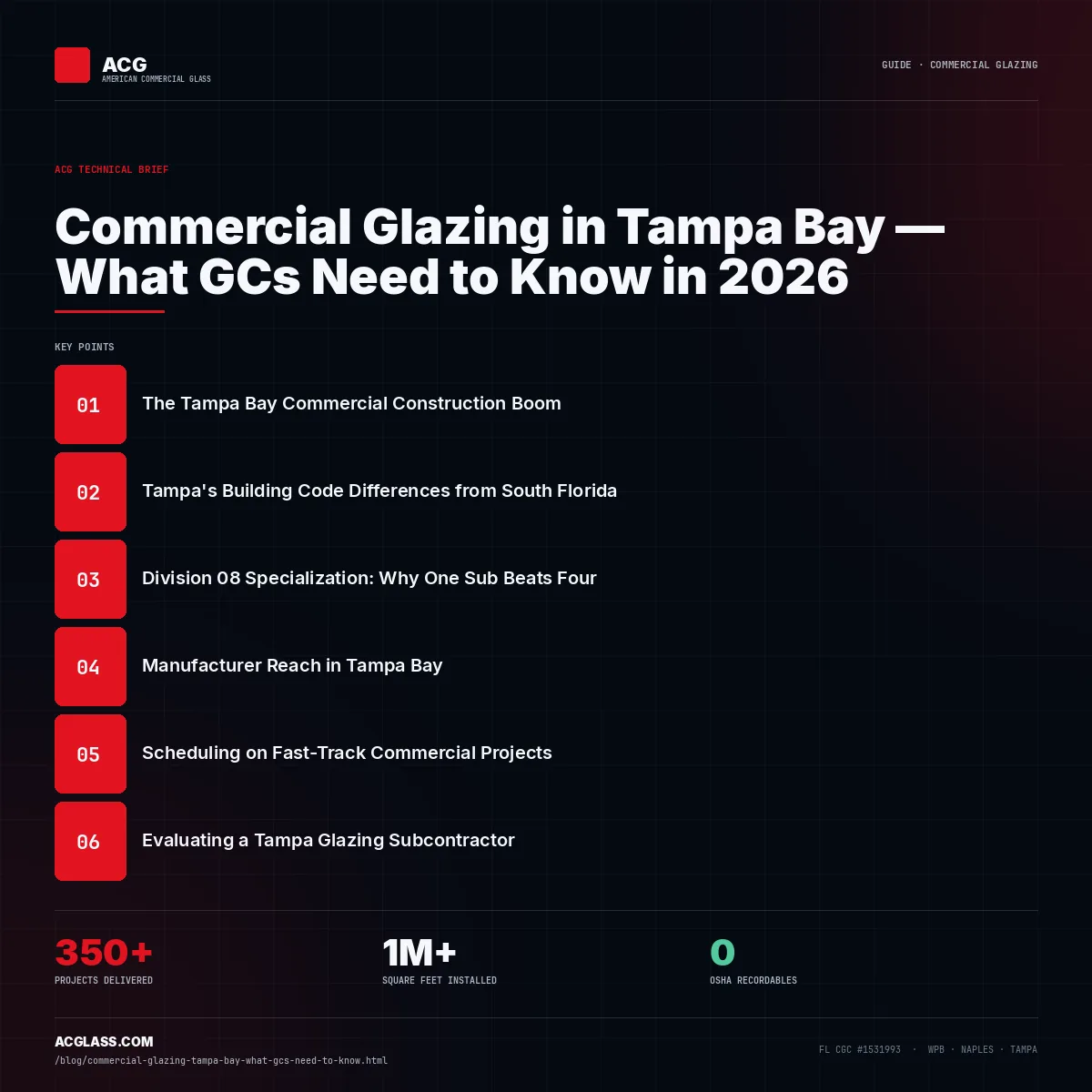
The Tampa Bay Commercial Construction Boom
The numbers behind Tampa Bay's commercial construction activity aren't speculative - they're visible from a project tracking standpoint. Water Street Tampa, the 56-acre mixed-use development anchored by Cascade Investment and Strategic Property Partners, has reshaped the Eastern waterfront with office towers, hotels, residential, and retail at a scale the city hasn't seen in decades. Westshore remains one of Florida's most active commercial office submarkets. The Riverwalk area continues to attract hospitality and mixed-use development. Across the bay, downtown St. Pete is seeing its own sustained wave of hotel, multifamily, and retail construction.
The downstream effect for GCs is a supply-demand imbalance in qualified trade contractors. Electricians, mechanical subs, and glazing contractors who have the commercial infrastructure to handle fast-track, documentation-heavy scopes are genuinely stretched. Subs who were adequate for a slower market are now showing their limits on complex projects. Knowing how to identify and retain the right Division 08 partner before bidding season is a competitive advantage, not just a procurement function.
Tampa's Building Code Differences from South Florida
This distinction matters and regularly catches GCs off guard when they work both markets: Tampa is not in the High Velocity Hurricane Zone (HVHZ). The HVHZ encompasses Miami-Dade and Broward counties only. That means the Miami-Dade Notice of Acceptance (NOA) approval pathway - the product testing and listing standard required in the HVHZ - does not apply to Tampa Bay projects in the same way it applies in South Florida.
What does apply in Tampa is Florida Product Approval (the FL number system), administered by the Florida Building Commission. Every glazing product used on a permitted commercial project in Florida must carry a valid FL number demonstrating it meets the applicable wind load and, where required, impact resistance standards. That FL number must correspond to the specific installation method and substrate in your structural drawings.
That said, impact-rated glazing is frequently specified on Tampa Bay commercial projects even though the HVHZ mandate doesn't apply. Here's why: Hillsborough County sits in a Florida wind zone that requires design wind speeds of 150 mph and above for many locations. Architects and structural engineers specifying for that wind environment often default to impact-rated products because the combination of wind pressure performance and debris protection is cleaner than designing around non-impact glazing with an opening protection system. Impact-rated products are also increasingly the market standard for Class A commercial, regardless of code mandate.
The practical result: if your Tampa project specs call for impact-rated glazing, you need a glazing sub who understands the FL number system and the corresponding installation requirements - even though the HVHZ NOA framework isn't in play. Those are different documentation sets and different compliance pathways.
Division 08 Specialization: Why One Sub Beats Four
On a typical mid-rise commercial project in Tampa Bay, the Division 08 scope might include aluminum storefront at the ground floor retail or lobby, a curtainwall or window wall system on the tower floors, automatic sliding or swinging entrances, and interior glass partition walls or office fronts. Some project teams try to split that scope across multiple specialty subs - one for storefront, one for curtainwall, one for entrances. That approach introduces coordination risk that experienced GCs increasingly want to avoid.
When the storefront sub and the curtainwall sub have different lead times, different submittal schedules, and different installation crews working the same floor at the same time, the coordination burden lands on your project manager. Shop drawing conflicts between systems, anchor interference at transitions, thermal and air barrier continuity at the interfaces - these are real field problems that require a single point of accountability to resolve cleanly.
A glazing sub who handles the full Division 08 scope produces a single submittal package, coordinates a single installation sequence, and owns the performance of the entire glazed envelope. For GCs on fast-track commercial projects, that consolidation is operationally significant. Our Division 08 services cover the full scope - storefront, curtainwall, window wall, entrance systems, and interior glazing - under one contract.
Manufacturer Reach in Tampa Bay
The major Florida commercial glazing manufacturers - ESWindows, Eurowall, and PGT Commercial (MITER Brands) - all service the Tampa Bay market, but lead time and logistics differ from South Florida. Most of these manufacturers have fabrication or distribution facilities concentrated in South Florida, Central Florida, or out of state, and the freight dynamics into Tampa can add days to the schedule when subs are ordering from facilities optimized for the Miami-Fort Lauderdale corridor.
A glazing sub with a Tampa-area office and established manufacturer relationships in the region has a structural advantage on lead time management that an out-of-market sub cannot replicate. When a project goes on a compressed schedule - which Tampa Bay fast-track projects frequently do - the difference between a sub who is already holding product at a local staging location and one who is shipping from a Miami warehouse can be a week or more on your schedule. ACG's Tampa office sources directly within the region and manages manufacturer relationships that reflect current Tampa Bay lead time realities, not South Florida ones.
Scheduling on Fast-Track Commercial Projects
Tampa Bay's commercial pipeline has pushed many projects into fast-track delivery modes - design-build, CM at risk, or accelerated design-bid-build with construction starting before drawings are complete. In that environment, Division 08 scheduling becomes a coordination challenge that goes beyond "when does the glass show up."
Glazing typically cannot start until the structural frame is in place, exterior sheathing or backup wall is complete, and the anchor substrate is ready for inspection. On a multi-story building, that means glazing crews are chasing the frame up the building while the lower floors are still awaiting inspections. Managing crew deployment, material staging, and lift scheduling across that vertical sequence requires project management discipline that not every glazing sub has built into their operations.
ACG uses systematic scheduling tools to model crew deployment against the structural release schedule on multi-floor commercial projects. That approach allows us to identify schedule conflicts before they become field problems and to give GC project managers real visibility into when glazing milestones will be met - not just a start date and a finish date. On Tampa Bay projects where the GC is coordinating eight or ten active trades simultaneously, that level of schedule transparency is a meaningful operational advantage.
Evaluating a Tampa Glazing Subcontractor
Before you add a glazing sub to your Tampa Bay bid list, there are three questions worth asking directly:
How many commercial projects have you completed in Tampa Bay in the last 12 months? This isn't a trick question - it's a market familiarity question. A sub who is active in the Tampa Bay market knows the local building departments, the local inspection culture, and the specific schedule demands of the Hillsborough and Pinellas plan review process. One who is stretching into Tampa from another market is learning those things on your project.
Who are your active GC partners in Tampa Bay? Ask for names. Then call them. A sub who is genuinely active in the market can produce two or three GC project managers who will take your call without hesitation. One who hesitates on this question probably doesn't have those relationships yet.
What is your bid-to-award ratio on Tampa Bay commercial work? This question surfaces whether a sub is pricing to win work or just covering their overhead on bids. Subs with strong bid-to-award ratios are competitive on price and trusted by the GCs who award to them. Subs with weak ratios either aren't competitive or aren't reliable enough to get repeat invitations. Review our portfolio for examples of Tampa Bay and statewide commercial glazing work.
The Value of 48-Hour Bid Turnaround in Hot Markets
When a GC is bidding five to ten commercial projects per month, the glazing subs who consistently deliver complete, organized bids within 48 hours of receiving drawings are the ones who stay on the active bid list. The ones who take two weeks - or worse, miss due dates - get removed. It's not personal; it's operational necessity.
A 48-hour turnaround on a commercial glazing scope isn't a marketing claim - it's an infrastructure requirement. It requires an estimating team with current pricing relationships with manufacturers and suppliers, a scope template that can be adapted to a specific project quickly, and a decision-making process that doesn't require three layers of internal approval before a number goes out. Subs who have built that infrastructure are fundamentally different businesses than those who are still running estimating out of a spreadsheet and a distributor price list.
If you're bidding Tampa Bay commercial work and your current glazing list isn't delivering on turnaround time, it's worth evaluating whether the issue is the individual sub or the category. In a market this active, slow turnaround from a glazing sub is a structural problem - not a one-time miss.
Working with ACG on Tampa Bay Commercial Projects
ACG's Tampa office handles Division 08 scopes throughout Hillsborough, Pinellas, Pasco, and surrounding counties. We're a statewide commercial glazing subcontractor headquartered in West Palm Beach - which means our West Palm Beach office and our Florida-wide logistics network back up every Tampa Bay project. Over five-plus years of Florida commercial work, we've built the estimating infrastructure, the manufacturer relationships, and the project management systems that Tampa Bay's commercial construction pace requires.
Our standard bid turnaround is 48 hours. Our scopes cover the full Division 08 envelope. And our team knows Florida Product Approval documentation, Hillsborough and Pinellas building department submittal requirements, and the manufacturer lead time realities specific to this market.
Send your Tampa Bay drawings to our team at acglass.com/contact.html or call (772) 486-7711. We'll have a complete scope back to you in 48 hours.