
Most GCs and building owners think a commercial glazing project comes with a warranty - singular. In reality, every completed scope carries at least three distinct warranties, often four, and each one covers a different failure mode. The confusion matters because when something fails at year five - a fogged IGU, a leaking perimeter sealant, a failed hardware closer, a delaminated Kynar finish - the right path forward depends on which warranty applies. This article breaks down the three warranties on every commercial glazing job, what each one actually covers, what is routinely excluded, and what Florida GCs and owners should verify before specifying a system. Statewide code path and office map: Florida commercial glazing hub. Send Us Plans for a 48-hour bid.

The Three Warranties on Every Commercial Glazing Project
A standard Division 08 scope on a Florida commercial project generates warranty documentation from three parties - and in some cases a fourth. Each warranty has a different duration, a different claim process, and a different scope of covered defects.
| Warranty Type | Typical Duration | Covers |
|---|---|---|
| Manufacturer product warranty | 5-10 years | Material defects in framing, glass coatings, and hardware |
| Installer workmanship warranty | 1-3 years | Installation defects - perimeter sealant, shimming, anchor execution |
| IGU seal warranty | 10-20 years | Insulated glass unit edge seal failure (fogging, moisture intrusion) |
| Applied film / coating warranty | 5-10 years | Low-E or solar film integrity, where a separate third-party film is applied |
Manufacturer Product Warranty
The manufacturer warranty is the base document and the one most GCs actually receive at closeout. It covers defects in materials - extrusion finish failure, hardware operation failure, glass coating delamination, factory-fabricated unit failure. Length varies by system class:
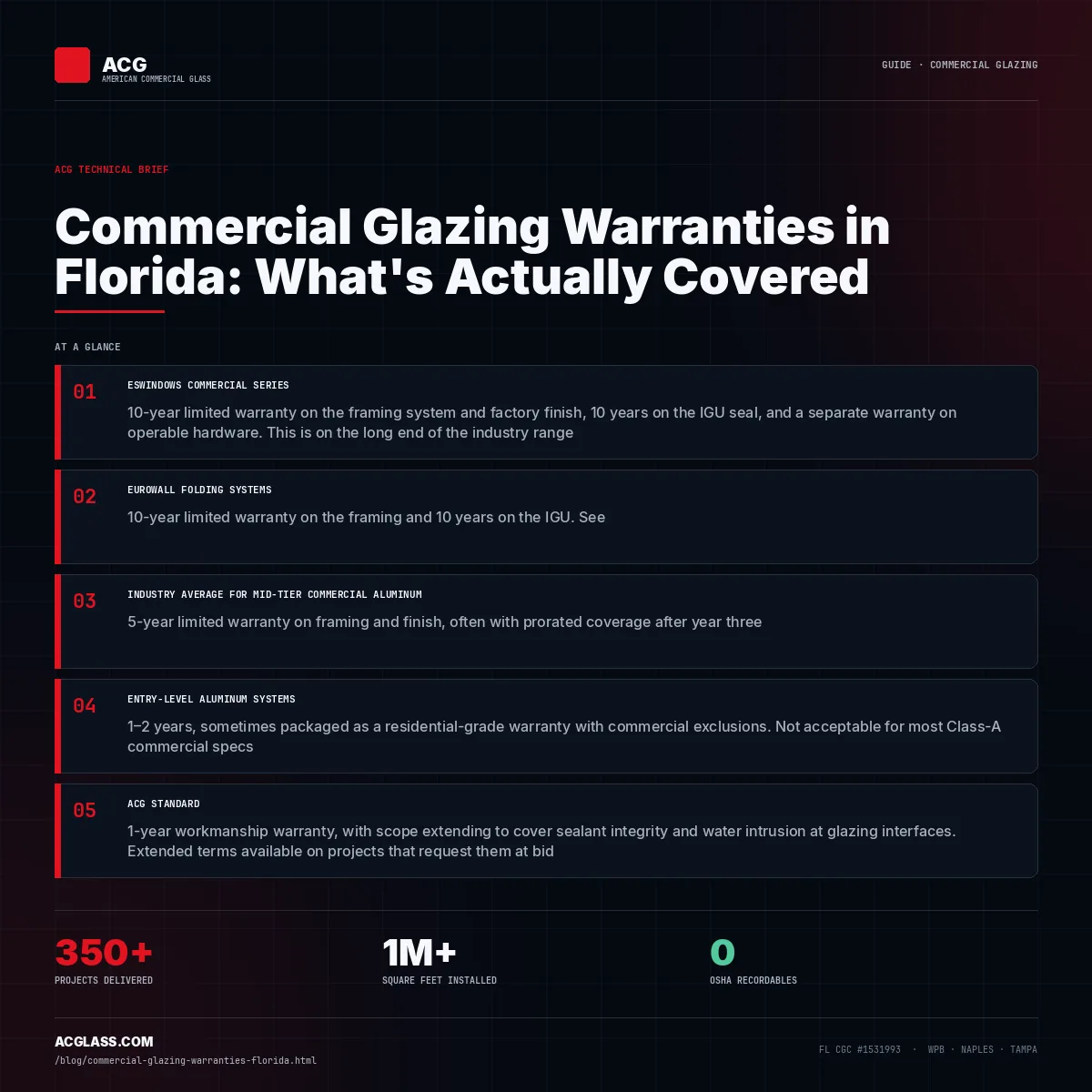
- ESWindows commercial series: 10-year limited warranty on the framing system and factory finish, 10 years on the IGU seal, and a separate warranty on operable hardware. This is on the long end of the industry range.
- Eurowall folding systems: 10-year limited warranty on the framing and 10 years on the IGU. See Eurowall for system details.
- Industry average for mid-tier commercial aluminum: 5-year limited warranty on framing and finish, often with prorated coverage after year three.
- Entry-level aluminum systems: 1-2 years, sometimes packaged as a residential-grade warranty with commercial exclusions. Not acceptable for most Class-A commercial specs.
Duration matters, but so does the exclusion list. Most manufacturer warranties specifically exclude coastal corrosion on non-specified finishes, UV-related interlayer yellowing beyond a defined tolerance, damage from improper cleaning products, and any failure attributable to installation rather than manufacturing.
What Kynar AAMA 2605 Does for Warranty
Kynar 500-based fluoropolymer finishes tested to AAMA 2605 - the premium architectural finish standard - carry meaningfully longer finish warranties than AAMA 2604 or standard anodized. On coastal Florida projects, AAMA 2605 is effectively required for any 10-year finish warranty because salt exposure at non-AAMA 2605 finishes is almost always called out as an exclusion.
Installer Workmanship Warranty
This is the warranty most often misunderstood. The installer covers execution - how the system was installed, not whether the parts were good. It includes perimeter sealant performance, anchor installation, shimming and plumb, proper gasketing, and hardware adjustment at closeout. Industry practice in Florida commercial glazing:
- ACG standard: 1-year workmanship warranty, with scope extending to cover sealant integrity and water intrusion at glazing interfaces. Extended terms available on projects that request them at bid.
- Typical commercial glazing sub: 0-2 years, often capped at the same duration as the GC's general workmanship warranty to the owner.
- Lowball / residential-leaning contractors: Sometimes no written workmanship warranty at all, or a verbal "we'll come back if there's a problem" without documentation.
The pre-glazed storefront approach has a workmanship implication worth noting. Because the glazing itself is executed in factory conditions - controlled humidity, controlled temperature, cure-time managed - the field work reduces to setting finished units and sealing perimeters. The installation variables that most often cause field-glazed workmanship failures are removed from the field.
IGU Seal Warranty
The insulated glass unit warranty is issued by the glass fabricator, which is usually different from the framing manufacturer. It covers edge-seal failure - moisture migrating past the primary and secondary seals into the airspace, causing visible fogging or condensation between panes. Standard durations:
- Cardinal Glass: 10-year limited
- Guardian Glass: 10-year limited on commercial IGUs, with SunGuard low-E coating included in the same warranty
- Vitro Architectural Glass: 10-year limited
- ESWindows in-house IGU fabrication: 10-year limited, matching the system framing warranty
- Some premium IGUs with butyl primary + structural silicone secondary seals: 20-year limited, typically on high-rise and specification-driven curtainwall
IGU seal failure is one of the most common long-term warranty claims on any commercial glazing job, and Florida's humidity accelerates it. When the primary seal breaks down, desiccant in the spacer bar absorbs moisture until it saturates, and at that point the interior surface of the glass begins to fog under temperature differential. Once an IGU fogs, it cannot be repaired - it must be replaced. See the companion article on why commercial glass fogs up for the diagnostic detail.
What's Not Covered - On Any Warranty
Exclusions are where warranty claims go to die. Across manufacturer, installer, and IGU warranties, these items appear on almost every exclusion list:
- Improper maintenance. Ammonia-based cleaners, abrasive cleaners, and pressure-washer contact with gaskets all void warranty coverage.
- UV degradation of interlayer. Laminated glass interlayers yellow slowly over time. Most warranties exclude this as inherent to the material.
- Coastal corrosion on non-specified finishes. If the project spec did not call out AAMA 2605 Kynar or 316 stainless hardware at the coast, the manufacturer is not going to cover corrosion at year four.
- Thermal stress cracks from field modifications. Applied films installed after glazing, painted frames, and window treatments that retain heat against the glass can cause thermal stress failures that the IGU warranty specifically excludes.
- Acts of God and Force Majeure. Hurricane-caused glass failure is addressed through insurance, not the product warranty, even on impact-rated assemblies. Impact rating is a structural performance requirement, not a guarantee against every possible strike.
- Owner modifications. Post-install penetrations, alarm contact installations, and any third-party work that disturbs the glazing system typically voids manufacturer coverage at that opening.
What to Verify Before Specifying
Before the bid is awarded, GCs and owners should ask four specific questions:
- What is the finish warranty period on the specified finish? If it's less than 10 years and the project is on the coast, the finish spec needs to be upgraded.
- What is the IGU seal warranty duration and is it prorated? A 10-year non-prorated warranty is worth more than a 15-year prorated warranty where the manufacturer contribution drops 10% per year after year five.
- What is the installer's workmanship warranty duration and scope? Ask for the written document, not a verbal commitment. Verify whether water intrusion at perimeter sealants is specifically covered.
- Who handles closeout documentation? The best warranties in the world are worthless if the documentation is lost before the owner receives it. ACG submits bound warranty packages at turnover on every project, with manufacturer warranty cards, IGU certificates, and our own workmanship warranty included.
How This Plays on a Real Project
A 45,000 SF mixed-use commercial project might have an ESWindows ES-8000 pre-glazed storefront (10-year framing + 10-year IGU), a GW-7000 unitized curtainwall (10-year + 10-year), impact windows in the residential units (10-year + 10-year), and Eurowall folding systems at the restaurant tenant (10-year). All of that is stacked on top of ACG's 1-year workmanship warranty. The bound closeout binder - one per owner, one for the GC's file - references all of it in a single index.
For project reference, see how warranty documentation was handled at Wave Food Hall Cocoa Beach or in the portfolio.
Getting This Right on Your Next Project
Warranty language is worth a second read on every commercial glazing bid. ACG's bids include manufacturer warranty references and our own workmanship warranty language in the proposal text, not as a post-award surprise. Send plans through our bid portal for a line-item proposal that includes warranty scope on each system. GCs working West Palm Beach and Tampa commercial projects can have pricing and warranty detail inside 48 hours, and new construction scopes are covered under the new construction glazing workflow.
ACG is a CGC-licensed Florida commercial glazing subcontractor (CGC1531993) headquartered in West Palm Beach, working as factory-installer for ESWindows, Eurowall, ESWindows, and other commercial manufacturers. Contact (772) 486-7711 to discuss warranty terms on a specific scope.