
Every commercial glazing bid looks serviceable on paper. The numbers are in range, the cover letter is professional, the scope reads like it covers the work. The difference between a glazing sub who delivers on the bid and one who doesn't almost never shows up in the proposal itself - it shows up in the answers to specific questions about license, infrastructure, manufacturer relationships, and operational capacity. What follows is a ten-question filter for vetting a commercial glazing subcontractor before award. For each question, there's a "good answer" profile and a "red flag" profile. Any contractor who can answer all ten cleanly is worth awarding. A contractor who stumbles on three or more is worth passing on.

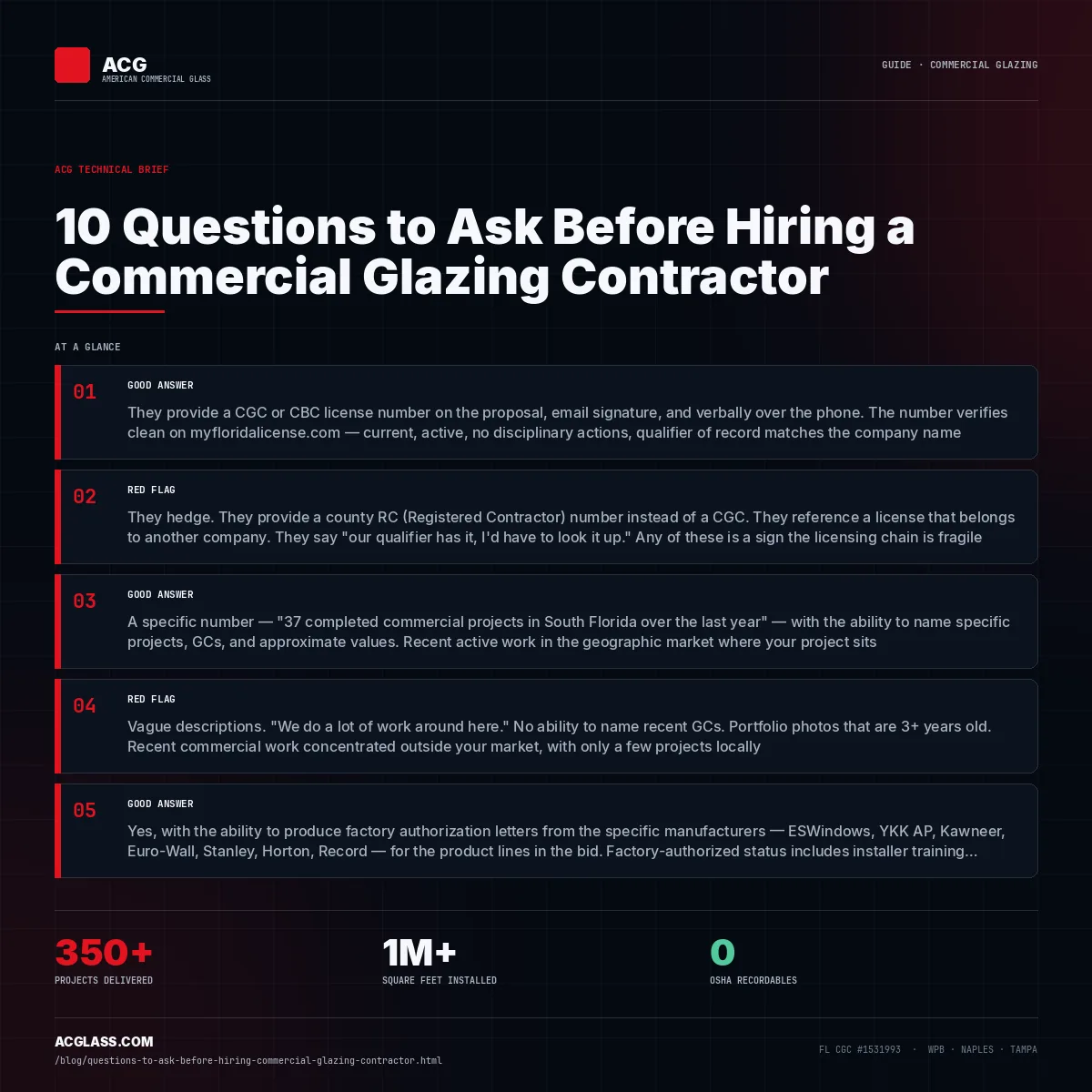
Question 1: What is your Florida CGC license number?
Good answer: They provide a CGC or CBC license number on the proposal, email signature, and verbally over the phone. The number verifies clean on myfloridalicense.com - current, active, no disciplinary actions, qualifier of record matches the company name.
Red flag: They hedge. They provide a county RC (Registered Contractor) number instead of a CGC. They reference a license that belongs to another company. They say "our qualifier has it, I'd have to look it up." Any of these is a sign the licensing chain is fragile.
ACG holds CGC1531993, which appears on every proposal and every piece of correspondence. Verification takes 30 seconds.
Question 2: How many commercial projects have you completed in the last 12 months in this market?
Good answer: A specific number - "37 completed commercial projects in South Florida over the last year" - with the ability to name specific projects, GCs, and approximate values. Recent active work in the geographic market where your project sits.
Red flag: Vague descriptions. "We do a lot of work around here." No ability to name recent GCs. Portfolio photos that are 3+ years old. Recent commercial work concentrated outside your market, with only a few projects locally.
Question 3: Are you factory-authorized for the products you're proposing?
Good answer: Current manufacturer documentation for the specified systems, not a directory bio. Ask for project-specific paperwork. Do not assume a letter exists for every brand.
Red flag: "We're authorized to buy their products." That's not the same thing. Any contractor with a dealer account can purchase manufacturer products; factory authorization means the manufacturer has documented the installer's training, inspected their work, and signed off on their qualification to install the products to NOA and warranty standards.
Review ACG's manufacturer partnerships for reference.
Question 4: Can you handle a full Division 08 scope, or only portions of it?
Good answer: Full Division 08 - storefront, curtainwall, impact windows, commercial entrance doors (including automatic entrances), fire-rated glazing, interior glass partitions, mirror and shower enclosure. Or clear scope boundaries stated upfront: "we do sections 08 41 through 08 54; we sub out fire-rated glazing to our partner."
Red flag: Scope confusion. The sub says yes to everything but can't articulate specific section responsibilities, doesn't understand fire-rated ratings, or has never bid an automatic entrance door. Missing scope becomes missing work, which becomes change orders and schedule delay.
Question 5: What's your bid turnaround time commitment?
Good answer: A specific commitment - "48 hours from receipt of plans" or "5 business days for projects over X size" - backed by estimating infrastructure. The sub can describe their workflow: takeoff, pricing database, review, delivery.
Red flag: "It depends." "When we can get to it." "Our estimator is really busy right now." A sub who can't commit to a turnaround has no estimating infrastructure and is working bid-to-bid out of someone's head.
ACG commits to 48-hour bid turnaround as a standard. The Scope Engine intake process is what enables it.
Question 6: Do you install pre-glazed or stick-built storefront?
This is a question most GCs don't know to ask, but it matters. Pre-glazed storefront systems arrive at the jobsite as complete, factory-assembled units with glass already set. Stick-built systems arrive as extrusion lengths that are cut, assembled, and glazed on site. Pre-glazed field install is roughly 50% faster because crews set finished units rather than building and glazing them, and the factory environment controls humidity, temperature, and seal quality far better than any jobsite.
Good answer: "We install pre-glazed storefront as our default - ES-8000 and equivalent systems ship from the factory with glass already set. Field crews set the units; we don't glaze in the field."
Red flag: "We stick-build everything." That's a schedule risk and a quality risk, especially in Florida's humidity.
Question 7: What's your shop drawing and submittal process?
Good answer: Specific timing and workflow. "First-submit shop drawings in 10 business days from award. Standard MasterFormat organization. Electronic submittal through Procore or Newforma. Submittal log maintained in a shared directory. Engineering affidavits stamped by Florida PE."
Red flag: "Our drafter handles that." Silence on architect revision cycles. No clear timeline commitment. Submittals treated as an afterthought. On commercial work, submittals are 30% of the job - a sub who doesn't have them dialed in will bog down the project.
Question 8: What's your general liability and workers comp coverage?
Red flag: Hesitation on specifics. No workers comp ("we use 1099 guys"). No ability to name GC and owner as additional insureds. Glazing injuries are frequent and expensive; this is not the place for thin coverage.
Question 9: Are you bondable, and what's your current surety capacity?
A sub who has never carried a performance bond often can't, which limits their eligibility for many commercial scopes.
Question 10: Can you provide three GC references from projects completed in the last 24 months?
Good answer: Three named GC project managers, with phone numbers and project details, delivered within 24 hours of the request. References are willing to take a call and speak to quality, schedule, and closeout performance.
Red flag: "We don't typically give out references." Slow response. References that don't pick up. References who, when reached, give tepid feedback ("Yeah, they finished the job"). Legitimate commercial subs have active GC relationships and are not reluctant to share them.
Bonus Question: What's your coordination process with other trades?
This isn't on the numbered list because most GCs already know to ask it, but it's the single most important operational question. How does the glazing sub coordinate rough opening preparation with framers, flashing interface with waterproofing, power conduit with electricians for automatic operators, and final punch with the painter?
Good answer: They attend weekly OAC meetings, respond to RFIs within 48 hours, maintain a superintendent on site during active install, and participate in 3-week look-ahead scheduling. Their field super can be reached directly.
Red flag: Owner-operator installer who is both estimator and field super, with no backup. They don't attend OAC meetings. They don't have a superintendent. RFIs sit for a week.
How ACG Answers These Questions
- License: CGC1531993, current and active statewide
- Recent commercial projects: 5+ years of continuous commercial operation across Florida
- Manufacturer relationships: ESWindows and Euro-Wall installers; PGT, Allegion, TGP, Slimpact, and Aldora installed and coordinated to spec when specified. See facts and manufacturers.
- Full Division 08 scope: Storefront, curtainwall, impact windows, entrance systems, automatic entrances, fire-rated, interior glass, mirror, shower
- Bid turnaround: 48 hours from plans receipt, enforced by our Scope Engine process
- Storefront construction: Pre-glazed ES-8000 as standard; stick-built only when the spec requires it
- Submittals: First submit in 10 business days, electronic through Procore or Newforma, Florida PE-stamped engineering
- Insurance: $2M GL / $5M umbrella / workers comp statutory, additional insured certs within 24 hours
- Bondable: Yes, Travelers surety with meaningful per-project and aggregate capacity
- References: Active GC relationships across West Palm Beach, Tampa, Naples, and statewide - full list on request
Review recent work at HCA Cape Coral Emergency and Atlantic Fields Performance Center for examples of coordinated commercial Division 08 delivery.
Ready to get started?
Put us through the ten questions. Then send plans. We return a detailed, scoped, priced proposal inside 48 hours - and we answer RFIs for the life of the project.