
Many commercial property owners ask whether a permit is actually needed for their specific window replacement project - often with the implicit hope that the answer might be no. In most Florida commercial contexts, the answer is a clear yes, and the permit workflow is a meaningful part of the project timeline. Skipping the permit creates legal, insurance, and resale liability that can far exceed the cost of doing the work correctly. This article walks through when Florida requires a commercial window permit, what the documentation package looks like, and how the submittal and inspection process actually works across the state's major AHJs.

When Florida Requires a Permit for Commercial Window Replacement
The Florida Building Code (FBC) 8th Edition, together with local jurisdictional amendments, governs when a commercial window replacement requires a permit. The short answer: almost always. The longer answer depends on the scope and the specific Authority Having Jurisdiction (AHJ). Here are the scenarios where a permit is unambiguously required.
Any Structural Opening Change
Enlarging or reducing a rough opening, adding a new opening, or removing an opening in an existing exterior wall triggers structural review and permit requirements in every Florida jurisdiction. The work involves load-path implications for the building, which is why it always requires engineering review and building department approval.
Any Impact-Rated Glazing Installation
The FBC requires permits for all installations of impact-rated glazing in the Wind-Borne Debris Region (which covers effectively the entire Florida peninsula south of a line roughly through Ocala). Impact-rated installations must be documented with manufacturer Notice of Acceptance (NOA) or Florida Product Approval (FL) numbers matched to the specific building's design wind pressure. The permit submission includes these documents along with shop drawings and installer license verification.
Any Exterior Envelope Modification
The FBC Chapter 14 (Exterior Walls) and related sections govern modifications to the exterior envelope. Essentially any change to the building's exterior wall assembly, including window or storefront replacement that changes product type, size, or performance rating, requires a permit. This is the most common category driving permit requirements on commercial glazing projects.
Like-for-Like Replacement: The Gray Area
Some jurisdictions allow like-for-like replacement of non-impact-rated commercial windows without a permit when:
- The rough opening is not modified in any way
- The replacement product matches the original in size, material, and performance rating
- The installation does not affect the exterior cladding system
- The building is outside the Wind-Borne Debris Region
In practice, very few Florida commercial buildings fall into this category. Any commercial project in the Wind-Borne Debris Region (which is essentially all of coastal Florida and much of the interior) requires impact-rated replacement product, which requires a permit regardless of whether the opening is modified. And commercial windows installed before the 2001 FBC often need performance upgrades to meet current code, which further triggers permit review.
The defensible approach: assume a permit is required, verify with the local AHJ before starting, and never undertake commercial glazing replacement without written confirmation from the building department that a permit is not required if that is the position the owner is taking.
The Permit Documentation Package
A compliant commercial glazing permit application in Florida typically includes:
1. Product Approval (NOA or FL)
Every impact-rated product sold for use in Florida carries either a Miami-Dade County Notice of Acceptance (NOA) or a Florida Product Approval (FL) number. The approval document specifies:
- Tested design wind pressures (positive and negative, in PSF)
- Maximum opening size for the rating to apply
- Required anchor type, size, and spacing
- Required substrate conditions
- Installation detail drawings
The NOA or FL number must be submitted with the permit and the installed product must be demonstrably the same product covered by that approval. See our Florida Product Approval guide for a deeper walkthrough.
2. Installer License Number
Commercial glazing in Florida requires a Certified General Contractor (CGC) or Certified Glass and Glazing Contractor (CGG) license. The permit application requires the license number of the installer of record. Unlicensed glazing work on commercial buildings is illegal, invalidates insurance, and can result in the building being flagged for non-compliance during sale or audit.
ACG's license number is CGC1531993. Any licensed commercial glazier can provide theirs on request - if they cannot or will not, walk away.
3. Shop Drawings (Scope-Dependent)
Projects that modify structural openings, introduce new curtainwall or storefront systems, or otherwise exceed straightforward like-for-like replacement require engineered shop drawings. These drawings:
- Show the full glazing layout with dimensions and elevations
- Detail anchor and mullion connections to structural substrate
- Include wind load calculations per FBC Chapter 16 or ASCE 7
- Are signed and sealed by a Florida-licensed structural engineer (PE)
Shop drawings are typically produced by the glazing subcontractor and submitted through the GC or owner to the building department. Turnaround on AHJ review varies by jurisdiction - Miami-Dade is typically 3-6 weeks, Palm Beach County 2-4 weeks, Hillsborough 2-4 weeks. Some jurisdictions have express review programs for additional fee.
4. Inspection Schedule
Commercial glazing permits require scheduled inspections during and after installation. Typical inspection points:
- Substrate inspection (before window installation begins)
- Rough opening inspection
- Fastener and anchor inspection
- Final inspection
Each inspection must be scheduled with the AHJ and passed before work proceeds. Failed inspections trigger re-work and re-inspection, delays which push project schedule. Coordinating inspections is typically the GC's responsibility, with the glazing sub present for their scope.
Jurisdictional Variations
Florida's 67 counties and several hundred municipalities all have some discretion in how they implement the FBC. Key variations for commercial glazing permits:
| Jurisdiction | Review Time | Special Requirements |
|---|---|---|
| Miami-Dade County (HVHZ) | 3-6 weeks | Miami-Dade NOA required, not FL approval |
| Broward County (HVHZ) | 2-5 weeks | Miami-Dade NOA required, not FL approval |
| Palm Beach County | 2-4 weeks | FL approval acceptable outside HVHZ zones |
| Hillsborough County (Tampa) | 2-4 weeks | Wind-borne debris per FBC Fig. 1609 |
| Orange County (Orlando) | 2-3 weeks | Some inland areas not in WBDR |
| Collier County (Naples) | 3-5 weeks | Wind-borne debris per FBC |
For Miami-Dade and Broward (the HVHZ zone), only products with current Miami-Dade NOA are acceptable - Florida Product Approval alone is not sufficient. Outside HVHZ, products with either Miami-Dade NOA or FL approval work. Many products carry both.
The Risks of Skipping the Permit
Commercial glazing work performed without a required permit creates multiple liabilities:
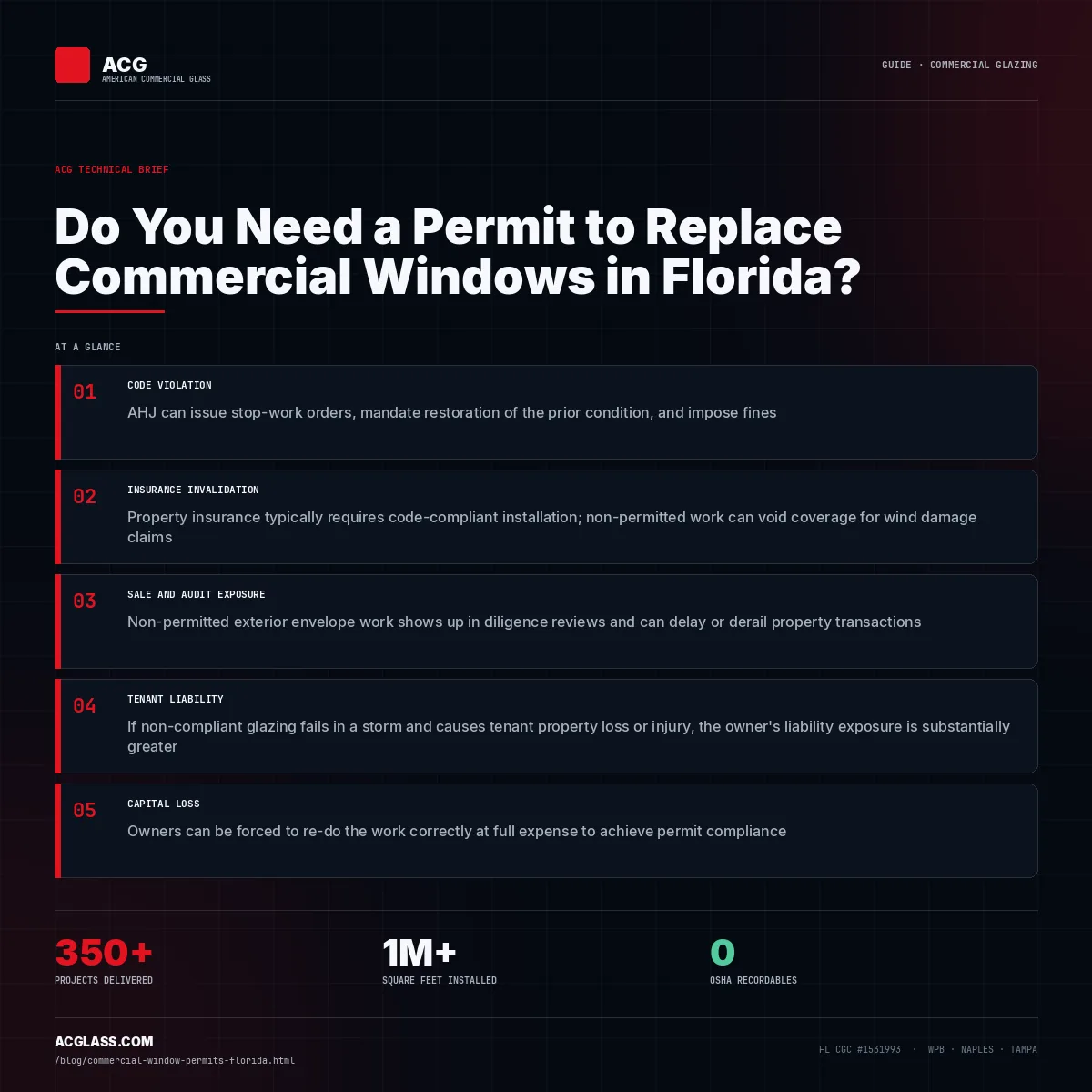
- Code violation: AHJ can issue stop-work orders, mandate restoration of the prior condition, and impose fines
- Insurance invalidation: Property insurance typically requires code-compliant installation; non-permitted work can void coverage for wind damage claims
- Sale and audit exposure: Non-permitted exterior envelope work shows up in diligence reviews and can delay or derail property transactions
- Tenant liability: If non-compliant glazing fails in a storm and causes tenant property loss or injury, the owner's liability exposure is substantially greater
- Capital loss: Owners can be forced to re-do the work correctly at full expense to achieve permit compliance
How ACG Handles the Permit Workflow
On commercial glazing projects, ACG typically handles the full permit and NOA documentation workflow as part of our scope. That includes:
- Identifying the appropriate NOA or FL approved product for the project's wind zone
- Preparing shop drawings for engineer review and seal
- Submitting the permit application with the GC or owner
- Coordinating all required inspections during installation
- Closing out the permit with the AHJ after final inspection
For GCs, this turns a frequently problematic subcontractor deliverable into a handed-off scope. For owners acting as their own GC on renovation work, our permit workflow support keeps the project code-compliant from day one.
On projects like Lake Park Innovation Center and Baron Shoppes of Tradition, the permit and NOA workflow is a core part of how we deliver. See our hurricane code compliance page and the FBC commercial glazing guide for deeper code context.
Ready to get started?
ACG is a CGC-licensed Florida commercial glazing subcontractor (CGC1531993) headquartered in West Palm Beach. Commercial Division 08 scope, statewide. Send plans and we return a detailed scope with system recommendations and 2026 pricing inside 48 hours.