
The question "how long do commercial windows last" has a lazy answer - roughly 25 years - and a useful one. The useful answer is that a commercial window is five or six different components aging on different clocks. The IGU seal fails on one timeline, the Kynar finish on another, the hardware on another, and the structural aluminum on a fourth. A facility manager who understands those timelines can plan capital replacement in stages and avoid the two common mistakes: replacing too early (and throwing away decades of remaining structural life) or replacing too late (and dealing with emergency IGU replacements and sealant failures that should have been planned 5 years out). Here's how the real service life numbers break down for Florida commercial glazing in 2026.
What Commercial Window Lifespan Actually Means
A commercial window isn't one product - it's an assembly of at least five distinct components, each with a different service life. Talking about "how long a window lasts" without breaking it down that way leads to bad asset planning decisions. Some components may need attention at year 12 while others are still performing at year 40. Here's how those components age in Florida.
| Component | Typical Florida Service Life | Failure Mode |
|---|---|---|
| IGU perimeter seal | 15 - 20 years | Fogging between panes, argon loss |
| Laminated glass interlayer | 30+ years | Edge delamination (rare) |
| Aluminum extrusions | 40 - 60 years | Corrosion if finish fails first |
| Kynar AAMA 2605 finish | 25 - 35 years | Chalking, fading (< 30 years) |
| Anodized finish | 20 - 30 years | Chalking, pitting near coast |
| Low-grade painted finish | 8 - 15 years | Flaking, chalking, corrosion bleed |
| Door hardware (closers, pivots) | 10 - 15 years | Wear, seal breakdown |
| Perimeter sealants | 10 - 15 years | UV degradation, adhesion loss |
| Gaskets / weatherstripping | 10 - 15 years | UV, compression set |
Notice what isn't in that table: the glass itself. Monolithic annealed or tempered glass, barring breakage, lasts essentially forever. The laminated PVB or SGP interlayer in impact glass can haze slightly at the edges after 30+ years but the glass body stays clear. What ages is everything around the glass - seals, finishes, hardware, gaskets.
Factors That Accelerate Aging in Florida
Florida is harder on commercial fenestration than almost any other climate in the U.S. Four environmental factors compress the service life numbers in the table above.
Salt Air (Coastal Exposure)
Within 1,500 feet of the Atlantic or Gulf coastline, salt-laden air accelerates finish and fastener corrosion. Anodized aluminum can pit within 15 to 20 years in heavy coastal exposure. Kynar AAMA 2605 still holds up, but stainless or powder-coated fasteners are essential. On projects like Eau Palm Beach Resort & Spa - directly oceanfront - we specify 300-series stainless fasteners and AAMA 2605 finish as baseline.
Humidity
Florida's average relative humidity sits at 73 to 78 percent year-round. That moisture is what drives IGU seal degradation. A dual-seal IGU (butyl primary + silicone/polyurethane secondary) with a warm-edge spacer has measurably longer seal life in humid climates than a single-seal unit. Specifying dual-seal IGU construction adds a few dollars per SF and pays back in service life.
UV Radiation
Florida receives roughly 20 percent more UV annually than the national average. Sealants, gaskets, and non-laminated plastics all degrade under UV. Structural silicone used on 4-sided structural glazed curtainwall has a tested service life of 30+ years - but perimeter sealants at storefront transitions often need replacement at year 10 to 15.
Thermal Cycling
Daily cycling between overnight lows and midday highs creates expansion and contraction stress at every glass-to-frame interface. Over tens of thousands of cycles, this works gaskets loose, fatigues fastener connections, and accelerates sealant failure.
Why Kynar AAMA 2605 Matters
The finish on the aluminum frame is where service life is made or lost. AAMA 2605 is the highest-tier finish specification published by the American Architectural Manufacturers Association. A Kynar 500 or Hylar 5000 coating meeting AAMA 2605 carries a 10-year no-chalk, 10-year color-retention warranty and in practice holds up 25 to 35 years in Florida exposure.
AAMA 2604 is a mid-tier spec (typically good for 10 to 15 years in Florida). AAMA 2603 is the entry-level spec and should not be used on exterior commercial frames in this climate. When a low bid comes back specifying AAMA 2603 to save cost, that's a 10-year fenestration product being sold as a 30-year one.
The Pre-Glazed Quality Factor
Where the IGU gets set into the frame matters for the 20-year number. ACG installs ES-8000 storefront pre-glazed from the factory as our standard. In a pre-glazed unit, the IGU is installed into the frame under controlled humidity and temperature at the ESWindows plant before it ever reaches the site. In a stick-built or field-glazed unit, the same IGU is sealed into the frame on the jobsite, often in Florida humidity that runs over 80 percent during summer work. That humidity gets trapped inside the glazing pocket at the moment of seal. Over the next 10 to 15 years, the trapped moisture accelerates the IGU primary seal breakdown from inside. Field-glazed units in Florida humidity typically fog up 3 to 5 years earlier than their factory-glazed equivalents. That's the single biggest install-quality variable on service life that most specifications don't address.
When to Budget for Component Replacement
For asset planning on a commercial building, the usable planning intervals are:
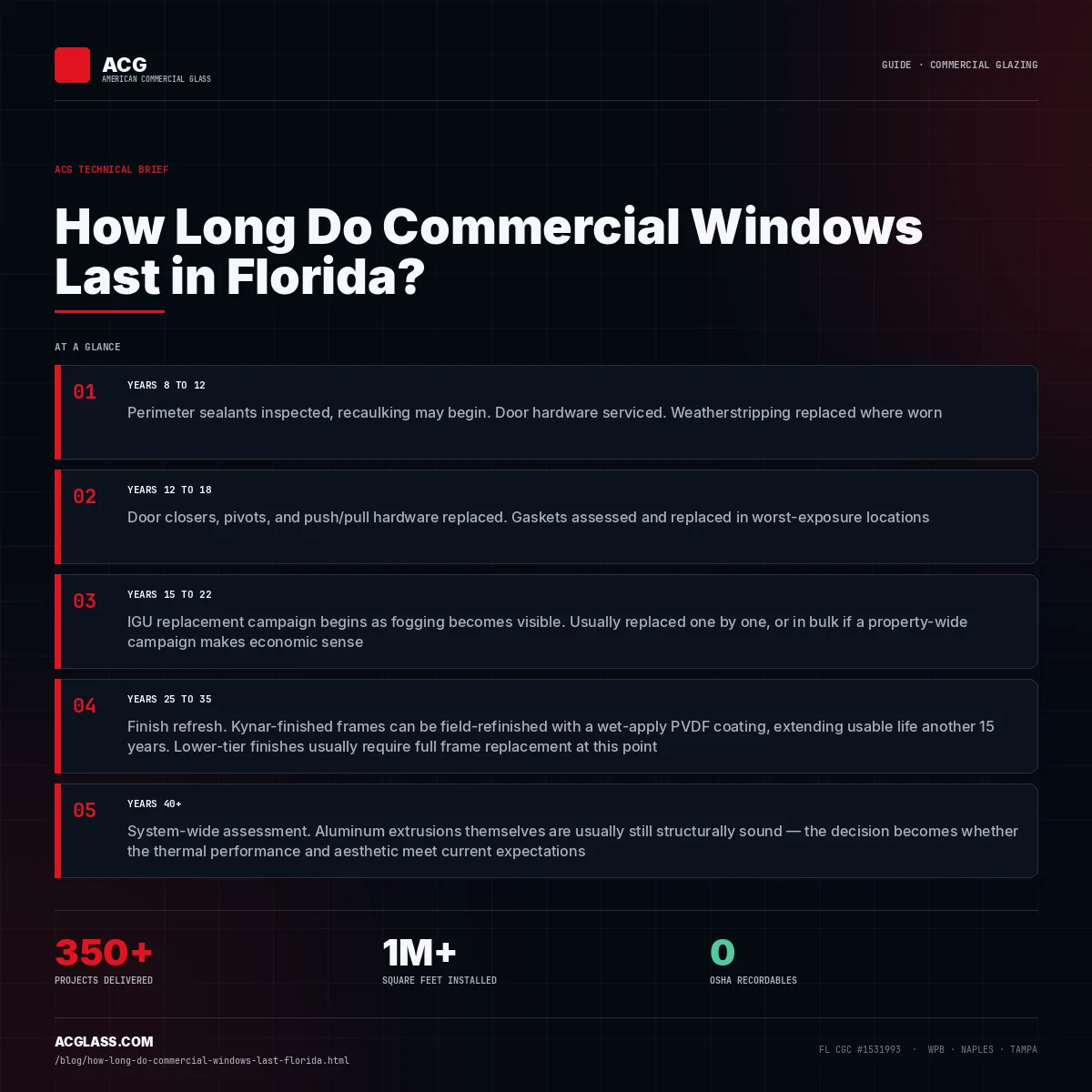
- Years 8 to 12: Perimeter sealants inspected, recaulking may begin. Door hardware serviced. Weatherstripping replaced where worn.
- Years 12 to 18: Door closers, pivots, and push/pull hardware replaced. Gaskets assessed and replaced in worst-exposure locations.
- Years 15 to 22: IGU replacement campaign begins as fogging becomes visible. Usually replaced one by one, or in bulk if a property-wide campaign makes economic sense.
- Years 25 to 35: Finish refresh. Kynar-finished frames can be field-refinished with a wet-apply PVDF coating, extending usable life another 15 years. Lower-tier finishes usually require full frame replacement at this point.
- Years 40+: System-wide assessment. Aluminum extrusions themselves are usually still structurally sound - the decision becomes whether the thermal performance and aesthetic meet current expectations.
Depreciation and Tax Planning
Commercial windows and storefront systems in the U.S. are generally depreciated over the building's structural life (39 years for nonresidential real property under MACRS) rather than as a separate asset class. IGU replacement as a repair can often be expensed in the year incurred rather than capitalized, depending on scope. For a property-wide IGU replacement campaign, the tax treatment can materially affect the economics of doing the work in one year versus spreading it. This is a conversation for the owner's CPA, not the glazing sub - but it's worth flagging at the planning stage.
What a 25-Year Assessment Looks Like
When an owner or facility manager brings ACG in for an assessment on an aging building, the scope usually covers: (1) walk the exterior and document finish condition, (2) sample-test sealants for adhesion and flexibility, (3) identify any IGUs showing fogging, (4) test door hardware under operation, (5) inspect anchor conditions at representative locations, and (6) deliver a prioritized phasing plan with pricing. That document becomes the capital plan for the next 5 to 10 years.
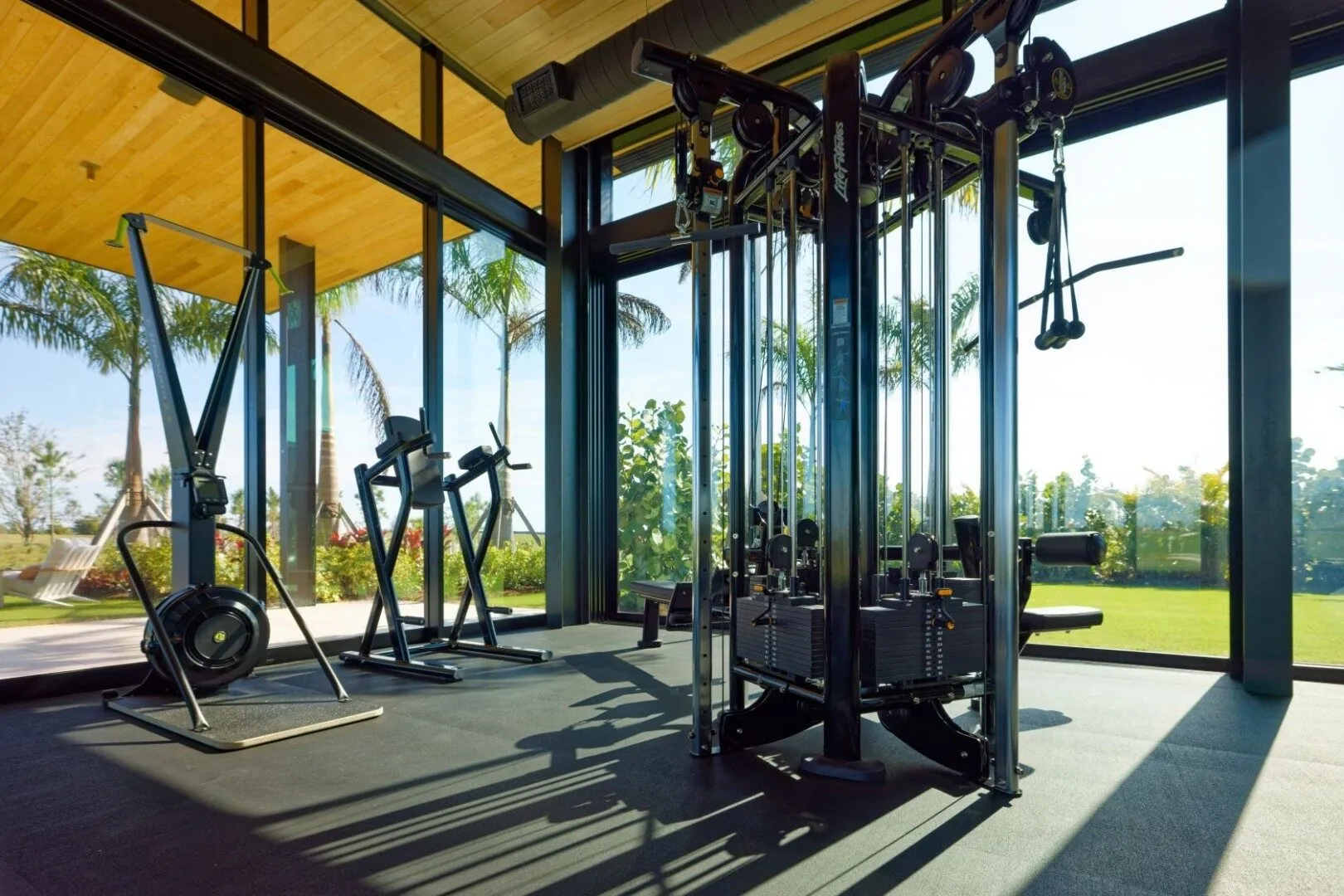
Specifications that last are easier to maintain. On Atlantic Fields Performance Center, we specified AAMA 2605 Kynar, pre-glazed ES-8000, and dual-seal laminated IGU. That package is engineered to hit 25 to 30 years before major intervention. For more on product selection, see ESWindows.
If you're a facility manager or owner in Tampa or elsewhere in Florida planning capital replacement for aging glazing, send building information via contact.html for a survey and phasing plan.
Ready to get started?
ACG is a CGC-licensed Florida commercial glazing subcontractor (CGC1531993) headquartered in West Palm Beach. We price commercial Division 08 scopes across the state and return competitive, itemized bids within 48 hours. Send your plans and we'll have a scope back to you fast.