
You've seen curtainwall hundreds of times. You just didn't know what it was called. Those glass towers downtown with floor-to-ceiling windows? Curtainwall. The glass wall wrapping an airport terminal? Curtainwall. The reflective skin on a modern office building? Almost certainly curtainwall.
Here's the simplest way to understand it: a curtainwall is a glass and aluminum wall that hangs on the outside of a building like a curtain. It doesn't hold the building up. The steel or concrete frame does that. The curtainwall's only job is to create the building's exterior skin.
The "Curtain" Metaphor
Imagine a stage curtain hanging from a rod. The rod holds the curtain. The curtain just covers the space below it. A curtainwall system works the same way.
The building's structural frame - steel columns and beams, or concrete - carries all the weight. The curtainwall frame connects to that structure at specific anchor points, usually at each floor. From those anchor points, the glass panels hang between the framing members.
This is called a non-load-bearing system. It doesn't carry structural loads. It only resists wind pressure and keeps out water and heat.
Where You See Curtainwall
Curtainwall shows up on buildings where large expanses of glass are needed across multiple floors:
- High-rise office buildings - the glass skin covering most modern towers
- Airport terminals - large glass walls letting in daylight and views of the tarmac
- Convention centers and stadiums - massive exterior glass facades
- Luxury hotels - full-height glass walls on upper floors
- Medical campuses - atrium walls and building connectors
- Corporate headquarters - signature glass facades for brand presence
If a building is more than three or four stories tall and has glass running continuously across multiple floors, it almost certainly uses curtainwall.
How a Curtainwall System Is Built
A curtainwall system has a few main parts. Understanding them makes the whole system clearer.
The Mullions
These are the vertical aluminum framing members. They're the main structural element of the curtainwall frame. Mullions anchor to the building structure above and below, then the horizontal members - called transoms - span between them.
The Glass Infill
Glass panels fill the openings between the mullions and transoms. In most curtainwall systems, the glass is held in place by pressure plates and cover caps - aluminum pieces that clamp the glass against a rubber gasket.
The glass itself is typically insulating glass units (IGU) - two or three panes of glass sealed together with a gas-filled space between them. This improves thermal performance.
The Anchors
The mullions connect to the building's floor structure at each level using steel anchor assemblies. These anchors are designed to allow for slight movement - buildings flex in wind and expand with heat - without cracking the glass.
The Perimeter Sealant
Where the curtainwall frame meets the building's edge, a waterproof sealant system keeps water out. This is one of the most critical details - a failed perimeter seal is the most common source of curtainwall leaks.
Stick-Built vs. Unitized Curtainwall
There are two main ways curtainwall gets assembled:
Stick-Built (or Knock-Down)
The framing pieces are shipped to the job site and assembled in place, piece by piece. This is more flexible and works well when site access is limited. Most mid-rise and low-rise curtainwall in Florida uses stick-built systems.
Unitized
Panels are pre-assembled in the factory and shipped to the site as complete units, then hoisted into place floor by floor. Unitized is faster to install on tall buildings and offers better quality control, but it requires more coordination and factory lead time. It's common on high-rises.
Curtainwall vs. Storefront vs. Window Wall
These three systems often get confused. Here's how they're different:
| System | Stories | Structure | Cost Range |
|---|---|---|---|
| Storefront | 1-2 stories | Floor-to-floor spans, supported at slab | By scope |
| Window Wall | Multi-story | Spans between floors, seat-set at slab edge | By scope |
| Curtainwall | Any height | Hangs from structure, spans multiple floors | By scope |
The key difference between curtainwall and window wall is how the system connects to the building. Window wall units sit on the floor slab at each level - they're more like individual window units stacked. Curtainwall spans continuously past floors and hangs from the structure.
For a deeper dive on this topic, see our guide on storefront vs. curtainwall - when to use which.
Why Curtainwall Costs More
Curtainwall costs significantly more than storefront or window wall. Here's why:
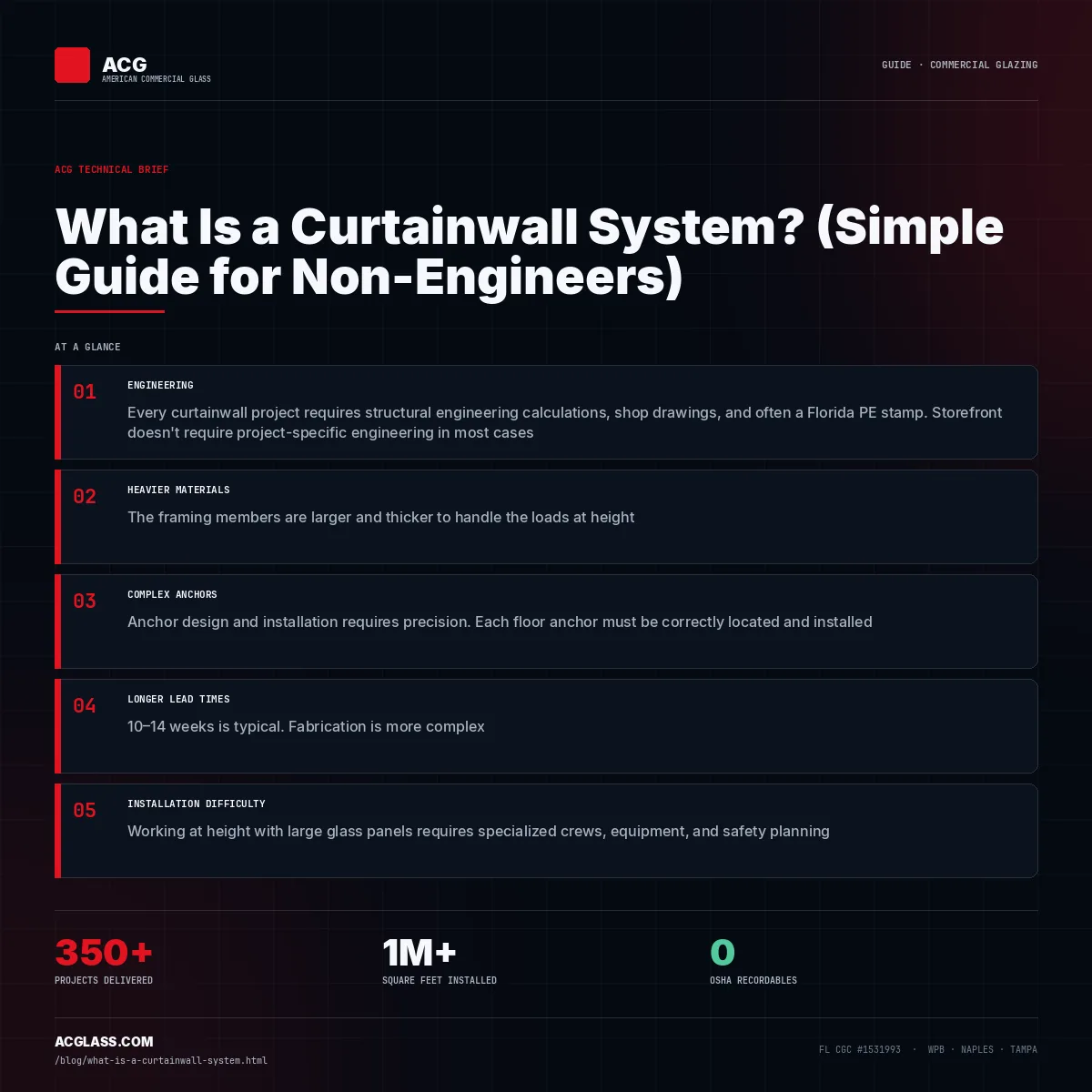
- Engineering: Every curtainwall project requires structural engineering calculations, shop drawings, and often a Florida PE stamp. Storefront doesn't require project-specific engineering in most cases.
- Heavier materials: The framing members are larger and thicker to handle the loads at height.
- Complex anchors: Anchor design and installation requires precision. Each floor anchor must be correctly located and installed.
- Longer lead times: 10-14 weeks is typical. Fabrication is more complex.
- Installation difficulty: Working at height with large glass panels requires specialized crews, equipment, and safety planning.
- Testing and certification: Curtainwall systems for Florida projects must carry Florida Product Approval documentation. Performance testing is conducted at the manufacturer level and costs are built into the system price.
If you're a property owner or developer deciding between curtainwall and other systems, the decision often comes down to building height, design intent, and budget. A curtainwall contractor in Florida can help you evaluate whether curtainwall is truly required for your project or if a less expensive system can meet your needs.
What a Curtainwall Looks Like (Without a Diagram)
Picture the side of a modern office building. You see a grid pattern of glass panels separated by thin aluminum lines. The vertical lines are the mullions. The horizontal lines are the transoms. The glass fills every panel between them.
From inside the building, you see floor-to-ceiling glass in each office. The aluminum frame is visible at the edges, but the view is mostly unobstructed glass.
At the floor level, you'd see the slab edge - but the curtainwall runs right past it, uninterrupted from the outside. That continuous exterior run is the defining visual characteristic of curtainwall versus window wall.
Do You Need Curtainwall?
Not every project does. Curtainwall makes sense when:
- The building is tall enough that standard storefront can't handle the wind loads
- The design requires a continuous glass facade across multiple floors
- The project demands the performance characteristics curtainwall provides (thermal, acoustic, structural)
- The budget supports the higher system cost
Many projects that specify curtainwall in early design can achieve the same visual result with window wall at a lower cost. See our storefront installation page and our commercial glazing services to understand the full range of options available.
ACG installs curtainwall, window wall, and storefront systems across Florida. If you're trying to determine the right system for your project, send us the plans and we'll give you a straight answer.
Frequently Asked Questions
What is a curtainwall system in simple terms?
A curtainwall is a non-structural glass and aluminum wall that hangs on the outside of a building. It does not hold up the building - the steel or concrete frame does that. The curtainwall's only job is to keep out wind, rain, and heat while letting in light. Think of it like a glass skin stretched over a building's skeleton.
What is the difference between curtainwall and storefront?
Storefront is a ground-floor glazing system designed for low-rise applications - typically one or two stories. It spans between floors and is supported by the building structure at each floor. Curtainwall spans multiple floors and hangs from the building's main frame. Curtainwall handles much higher wind loads, uses heavier framing, and requires more engineering. It also costs significantly more - typically 3 to 5 times the cost of storefront per square foot.