
A cracked commercial window is never just a cracked commercial window. It's a diagnostic signal pointing to one of five distinct root causes, and the correct path forward depends entirely on identifying which one. A thermal stress crack on a partially shaded lite will recur if the replacement glass has the same shading pattern. A nickel sulfide inclusion crack is rare but signals a potential batch issue in any same-lot glass elsewhere on the building. An installation-induced crack points to quality issues that should be documented and reviewed. Treating every crack as a simple replacement job misses the diagnostic information the failure is giving you. This article breaks down the five common causes of commercial glass cracks, how crack patterns reveal the cause, and prevention strategies for each failure mode on Florida commercial buildings.

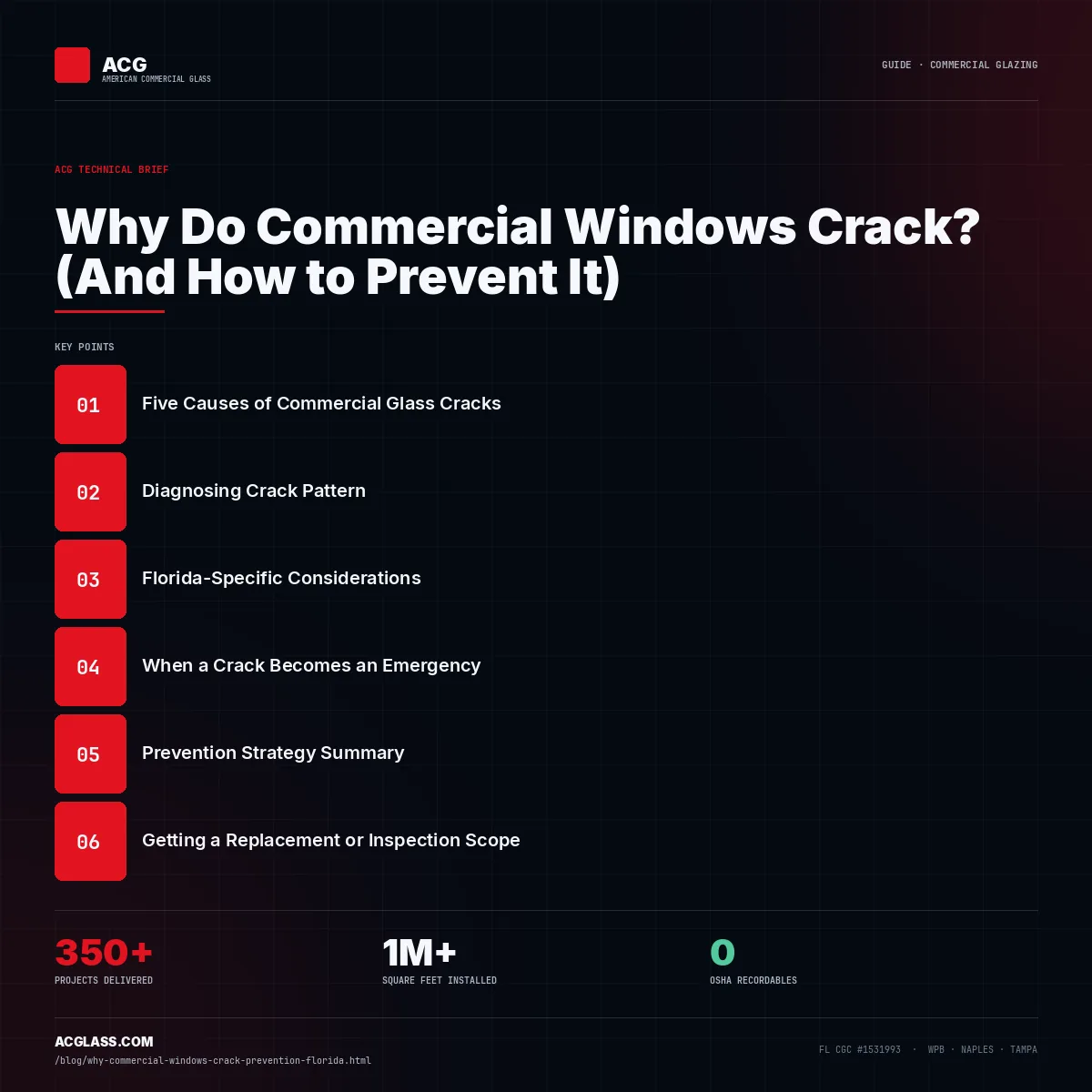
Five Causes of Commercial Glass Cracks
1. Thermal Stress (40%+ of Commercial Glass Cracks)
Thermal stress is the single most common cause of commercial glass failure and the one most often misdiagnosed. It happens when one area of a glass lite heats or cools faster than another, creating differential expansion that exceeds the tensile strength of the glass edge. The crack initiates at the edge of the lite and propagates toward the center, typically perpendicular to the edge at the initiation point.
Conditions that cause thermal stress in Florida commercial applications:
- Partially shaded lites where the shaded portion stays cool while the sun-exposed portion heats rapidly
- Interior window treatments (blinds, shades) that create heat traps between the treatment and the glass
- Applied films installed on glass not designed for that film (often voiding glass warranty)
- HVAC supply registers directed at the interior surface of the glass
- Dark colors painted on frames where the frame conducts heat unevenly into the glass edge
Prevention on new construction: heat-strengthened or fully tempered glass on any lite where shading, color change, or applied treatments are expected. Heat-strengthened glass has roughly twice the thermal stress tolerance of annealed float glass; tempered has roughly four times. On existing buildings with a thermal stress failure, replacement with heat-strengthened glass and a review of the shading or treatment condition typically ends the recurrence.
2. Impact (Debris, Vandalism, Vehicle)
Impact cracks have a distinctive pattern: a point of initiation where the impact occurred, radial cracks propagating outward, and sometimes concentric secondary cracks. The fracture pattern usually makes the diagnosis obvious - there's a chip or pit at the initiation point.
On Florida commercial buildings, common impact sources include: wind-borne debris during storms (where impact-rated glass is specifically engineered to survive and retain debris behind the interlayer), vandalism at ground-floor openings, vehicle strikes at parking-lot-adjacent storefront, and ballistic impact in rare security-related incidents. Impact-rated laminated glass is designed to crack under sufficient impact without the glass separating from the interlayer - the crack pattern on impact laminated often looks dramatic but the opening remains weatherproof until replacement.
Prevention: Large Missile Impact (LMI) rated glazing per ASTM E1886/E1996 or TAS 201/202/203 in HVHZ on any exterior opening where debris is a realistic threat, which is essentially all of coastal Florida. Bollards or other vehicle protection at parking-adjacent glass. Security laminated glass (thicker PVB or SGP interlayer) at ground-floor retail where vandalism risk is elevated.
3. Edge Defects from Fabrication
Glass is most vulnerable at its edges. Fabrication defects - chipped edges, vent (small surface scratches at the cut line), or improperly polished edges - create stress concentrations that cause cracks to initiate under normal wind load or thermal cycling. Edge defect cracks typically initiate at the defect location and propagate in a pattern that leads forensic investigators back to the origin.
Prevention: edge quality verification at delivery. Every lite received should be inspected for edge damage before installation. Glass with visible edge chips or vent marks greater than 1/16 inch deep should be rejected and replaced. On large projects, ESWindows and other quality fabricators run edge inspection as part of factory QC - which is one of the reasons their IGU warranty carries a 10-year duration. Lower-cost fabricators often have less rigorous edge QC and correspondingly higher field failure rates.
4. Installation Error (Squeezing the Frame)
A glass lite that is installed with inadequate clearance between the glass edge and the frame perimeter will crack as the building moves under thermal expansion or wind-induced deflection. Required clearance varies by system but is typically 1/8 inch to 1/4 inch of clearance between the glass edge and the inner face of the frame glazing bead. Installers who force glass into undersized frames, or who over-tighten glazing stops, create a stress condition that produces cracks within weeks or months of install.
Installation cracks often appear in multiple lites in a similar pattern, which is the diagnostic signal. If five openings on the same facade crack within six months of install, the issue is almost certainly installation-related rather than coincidental.
Prevention: pre-glazed storefront factory installation removes this failure mode because the glass is set in controlled conditions against specified clearances. Field-glazed installation requires installer training and glazing bead tension verification. See professional installation matters for the broader install-quality discussion.
5. Nickel Sulfide Inclusions (Rare, Spontaneous, Specific to Tempered Glass)
Nickel sulfide (NiS) inclusions are microscopic impurities in tempered glass that can expand over time and cause spontaneous fracture months or years after installation. NiS fracture is distinctive: a "butterfly" pattern with two origin points close together at the fracture center, often with no exterior cause. It's statistically rare - probably 1 in 10,000 tempered lites or lower in quality-controlled factories - but the consequences can be dramatic when it occurs at height on a commercial building.
Prevention: heat-soak testing of tempered glass used in critical applications. Heat-soak test per EN 14179-1 accelerates NiS expansion in the factory, causing flawed lites to fracture during testing rather than in service. The test is specified on government, high-rise curtainwall, and critical glazing applications where NiS failure consequence is high. For standard commercial storefront and non-critical applications, the cost-benefit of heat-soak testing usually doesn't justify - which is also a reason to specify laminated or annealed glass where tempered isn't strictly required.
Diagnosing Crack Pattern
| Pattern | Likely Cause | Next Step |
|---|---|---|
| Single crack perpendicular to edge, no impact point | Thermal stress | Review shading, treatments, HVAC; upgrade to heat-strengthened |
| Radial cracks from a chip or pit on exterior surface | Debris or vandalism impact | Replace; review impact rating adequacy |
| Crack initiating at visible edge defect | Fabrication edge damage | Replace; review QC at delivery going forward |
| Multiple similar cracks across same facade within months of install | Installation error | Engage installer; review glazing clearance on all openings |
| Butterfly pattern with two interior origin points, no edge initiation | Nickel sulfide inclusion | Replace with heat-soaked tempered; investigate same-lot lites |
| Laminated glass with crack but no separation | Impact, functioning as designed | Replace; debris protection worked |
Florida-Specific Considerations
Hurricane Cycling
Florida buildings experience wind pressure cycles during named storms that can accelerate edge defect failures on glass that would have lasted years in a milder climate. The 2024 and 2025 seasons both produced named storms with sustained winds that put design-pressure-level cycling on Florida commercial glazing. Post-storm inspection of commercial glass for hairline edge cracks is a reasonable facility-management practice.
Thermal Cycling in the Sun Belt
Florida glass sees larger diurnal temperature swings than glass in northern markets because the summer sun on a west-facing lite can push surface temperatures to 140°F while interior AC keeps the inboard surface at 72°F. That 68°F differential across a single IGU is a thermal stress condition. Heat-strengthened glass is increasingly specified on exposures where this condition is chronic.
Salt Air and Edge Corrosion
Coastal exposure can cause edge corrosion on IGU spacer bars, which over time creates micro-stress at the glass edge and can initiate thermal cracks. Warm-edge spacers (stainless or composite) outperform aluminum spacers in coastal exposure, and on oceanfront or near-oceanfront projects they're typically specified for that reason.
When a Crack Becomes an Emergency
Some cracks need immediate response; others can wait for scheduled replacement. Emergency criteria:
- Laminated glass crack with visible interlayer bubbling or separation - compromised impact rating, replace immediately
- Any crack on a ground-floor opening where secured access is a concern - board up and schedule replacement
- Crack during hurricane season forecast - expedited replacement before next storm event
- Multiple cracks on same facade - full facade inspection before further failure
For emergency response, see emergency commercial glass replacement for the immediate-action protocol.
Prevention Strategy Summary
- Spec heat-strengthened glass on any exposure with partial shading, applied treatments, or HVAC proximity
- Spec Large Missile Impact glazing on all exterior openings within the wind-borne debris region (most of coastal Florida)
- Verify edge quality on every lite at delivery, reject damaged lites
- Use pre-glazed factory-installed storefront to eliminate field installation clearance errors (ACG standard on ES-8000)
- Specify heat-soak tested tempered on critical applications at height
- Conduct post-storm inspection of commercial glazing annually and after any named-storm impact
Getting a Replacement or Inspection Scope
ACG handles commercial glass crack diagnosis, replacement, and facade inspection across Florida. Send a photo of the crack pattern along with the opening location and a brief history of the failure for preliminary diagnostic guidance. Full replacement scopes go through the bid portal with 48-hour turnaround. GCs and owners in West Palm Beach, Tampa, and across Florida can get scope and pricing inside 48 hours through contact.html. ACG is CGC-licensed (CGC1531993) and installs ESWindows and other commercial systems. Call (772) 486-7711 for urgent replacement needs.