
Ask any envelope consultant or commercial glass failure investigator, and they will tell you the same thing: the glass almost never fails. The installation does. Water intrusion at the perimeter sealant, air infiltration at a bad shim, hardware binding from a frame that went in out of square, anchor pullout under design wind load - these are the failure modes that show up two, three, five years after occupancy, and they trace back to the day the crew was on site, not to the factory that made the units. On a Florida commercial project where the Florida Building Code demands engineered performance at every opening, installation quality is the single biggest lever between a building that performs for 25 years and one that leaks at year three. This article breaks down what a quality commercial glazing install actually looks like, the four most common failure modes from bad execution, and why installer certification and licensing matter more than product brand.

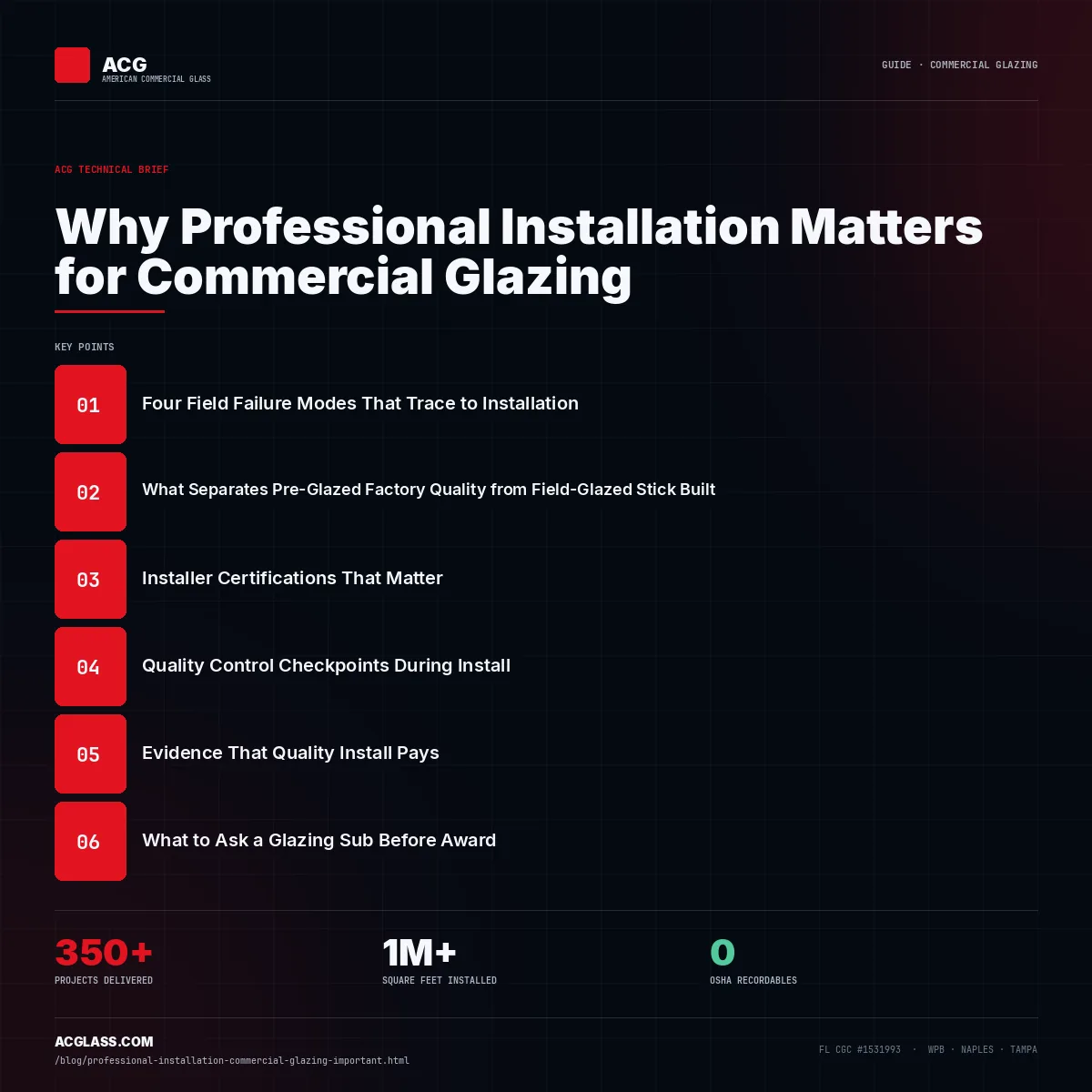
Four Field Failure Modes That Trace to Installation
1. Improper Flashing Integration
The perimeter of every commercial window or storefront unit sits inside a rough opening that has been prepped by the GC's framer and waterproofer. The sequence of flashings - sill pan first, then side flashings lapped over the sill, then head flashing lapped over the sides, all integrated with the air and water barrier on the wall - is the single most important water management detail in the building envelope. A window installed over flashings that lap wrong will leak. Not might - will, under any sustained wind-driven rain event.
The failure typically shows up 6-24 months after install, during a significant weather event, usually at the sill corners.
2. Sealant Misapplication
Perimeter sealant at the glazing frame-to-wall transition is the primary air and water seal on most commercial openings. The sealant bead must be correctly sized (typically 3/8 to 1/2 inch wide), applied to clean dry substrate, tooled to create a slight hourglass profile, and backed with a closed-cell foam backer rod that prevents three-sided adhesion. A sealant bead that was applied to dusty substrate, tooled flat instead of concave, or installed without backer rod will fail in tension when the building moves under thermal expansion.
The failure shows up as hairline cracks in the sealant within 18-36 months, followed by air infiltration complaints from the tenant and eventually water intrusion. Replacement cost in occupied buildings runs 2-4x the cost of doing it right the first time, because now it's also a disruption event.
3. Shimming and Leveling Errors
Aluminum framing systems are fabricated to tolerances of 1/16 inch. Rough openings are framed to tolerances of 1/4 inch. The installer bridges that gap with shims - usually composite plastic wedges - set at specific points around the perimeter to hold the frame plumb, level, and square while perimeter sealant and anchors are installed. A frame that goes in racked by even 1/4 inch over a 10-foot run will have hardware binding issues on day one and seal failures within a year.
Hardware binding is the tenant-facing symptom: a storefront door that drags on the threshold, a sliding glass door that won't close fully, a casement window that won't lock. Once the frame is locked in with sealant and anchors, fixing a racked install usually means removing and resetting the unit - a 3x cost and downtime event.
4. Wrong Fastener Spacing or Wrong Fastener Type
Florida Product Approval and Miami-Dade NOA documents specify exact anchor schedules: fastener type (typically 1/4 inch self-drilling TEK screws or 3/8 inch Tapcon for concrete), embedment depth, and spacing around the perimeter (typically 8-16 inches on center depending on system). An installer who substitutes a shorter fastener, reduces density, or uses the wrong type to save time is creating a wind load failure mode.
The scary part of this failure is that it doesn't show up in normal conditions. Under every typical wind event the building sees, the reduced anchor schedule performs fine. The failure shows up in the one event the system was specifically tested for: a rated hurricane or tornado. At that moment, the owner discovers that the product approval certification was invalidated by field execution, insurance coverage may be compromised, and structural damage propagates from the opening.
What Separates Pre-Glazed Factory Quality from Field-Glazed Stick Built
Factory-glazed units - where the glass is set into the frame in a controlled shop environment before shipping - remove many of the installation variables that cause field failures. Shop conditions control humidity (so structural silicone cures correctly), temperature (so gasketing seats correctly), and process discipline (so every unit is inspected before shipping). The installer's field work reduces to setting the factory-finished unit, anchoring to the spec schedule, and applying the perimeter sealant.
Stick-built storefront, by contrast, arrives on site as cut extrusion lengths and individual glass lites. The installer assembles the frame in the field, glazes the glass with field-applied sealant or structural silicone, and completes the perimeter seal - all under site conditions that include wind, rain risk, dust, and temperature swings outside ideal cure ranges. The opportunity for execution errors is meaningfully higher.
ACG installs ESWindows ES-8000 and similar platforms pre-glazed as standard. Field install rate runs roughly 1,000 SF per day per crew versus roughly 500 SF per day for stick-built - and the quality outcome is more consistent because fewer critical variables are left to field judgment. See ESWindows systems for pre-glazed platform detail.
Installer Certifications That Matter
Factory-Installer Programs
Most major commercial manufacturers run factory-installer programs. Installation crews complete product-specific training, pass shop drawing and field execution reviews, and earn authorization to install the manufacturer's warranted products. On an ESWindows, or Eurowall project, the manufacturer warranty applies only if the installer is authorized for that system. An un-authorized install can void product warranty coverage entirely, leaving the owner without manufacturer backup for 10 years.
AAMA InstallationMasters Certification
The American Architectural Manufacturers Association's InstallationMasters program is the national certification for fenestration installation. It covers flashing integration, sealant application, anchor execution, and quality control. Certification is individual to the installer, not the company.
Florida CGC License
In Florida, commercial glazing subcontractors operate under a Certified General Contractor (CGC) or Certified Residential Contractor (CRC) license through the DBPR. CGC is the commercial credential. It requires 4 years of documented experience, passing the CGC examination, and continuing education - and it exposes the license holder to financial responsibility for project outcomes. Verifying a glazing sub's CGC number before award is the single most important pre-qualification step a GC can take. See why hire a licensed commercial glazier for the full license discussion.
OSHA 30-Hour / Construction Safety Training
On commercial jobsites, all field crew should have at minimum OSHA 10 and foremen should have OSHA 30. Fall protection at elevation is specifically important for glazing because so much work happens at height.
Quality Control Checkpoints During Install
A professional commercial glazing install includes documented QC at specific checkpoints, not just at closeout:
- Rough opening inspection. Frame tolerances verified against shop drawings. Out-of-tolerance openings flagged to GC before install proceeds.
- Sub-sill pan installation. Water management detail verified before frame goes in. Photos archived.
- Frame set and shimming. Frame plumb, level, and square verified with a digital level. Shim locations documented.
- Anchor inspection. Fastener type, embedment depth, and spacing verified against NOA or product approval schedule.
- Glazing. On pre-glazed systems, shop QC records reviewed. On field-glazed systems, sealant cure window and tool profile verified.
- Perimeter sealant. Bead width, backer rod placement, and tool profile verified.
- Hardware adjustment. Door closers, weatherstripping, and hardware operation verified before tenant occupancy.
- Water test (on selected projects). ASTM E1105 field water test on a mockup or sample opening. Not standard on every project but specified on large curtainwall scopes.
Evidence That Quality Install Pays
Reference projects across ACG's active book demonstrate what quality install looks like in the field. Bobcat of the Treasure Coast used pre-glazed ESWindows storefront with full perimeter sealant documentation and an installer crew. Lake Park Innovation Center completed ESWindows ES-8000 storefront with standard QC checkpoints. Baron Shoppes of Tradition ran the same QC sequence across multiple tenant fronts.
What to Ask a Glazing Sub Before Award
- Is your firm a factory-installer for the specified system? Can I see the authorization letter?
- What is your CGC license number? (Verify it at myfloridalicense.com.)
- Who is the superintendent for my project and what is his or her experience with this specific system?
- What is your QC checklist and at what install stages do you document?
- Do you pre-glaze or field-glaze the storefront/curtainwall on this scope?
- What is your workmanship warranty duration and what specifically is covered?
The answers separate commercial-only glazing subs from firms that are learning commercial on your project. See questions to ask before hiring a glazing contractor for a full pre-award checklist.
Getting This Right on Your Next Project
ACG is a CGC-licensed commercial glazing subcontractor in Florida (CGC1531993), an installer for ESWindows and Euro-Wall. Other systems on the manufacturers page are installed to spec. 5+ years of active commercial-only work. Pre-glazed storefront is standard install on storefront scopes. New construction projects flow through the new construction glazing workflow with full QC documentation. Send plans via bid.html or contact.html for a line-item proposal with installer qualifications spelled out. GCs in West Palm Beach and Tampa can have scope and pricing inside 48 hours. Call (772) 486-7711 to discuss installer qualification on a specific project.