
When a GC or owner asks how long a commercial glazing project takes, the honest answer is "12 to 20 weeks for most scopes, with meaningful variables at each phase." The phases themselves are predictable. Shop drawings take a specific amount of time. Manufacturer fabrication windows are what they are. Field install production rates are knowable. What drives timeline variance is which products are specified, how clean the plans are at bid time, and whether the glazing sub's internal processes can compress or expand each phase. Here's the full phase-by-phase breakdown of a typical Florida commercial glazing project in 2026, with the variables that move each phase faster or slower. Statewide code path and office map: Florida commercial glazing hub. Send Us Plans for a 48-hour bid.
The Seven Phases of a Commercial Glazing Project
A commercial glazing scope, from first plans review to final punch, moves through seven discrete phases. Each has its own typical duration and its own set of factors that push it longer or shorter.
| Phase | Typical Duration | Range |
|---|---|---|
| 1. Plans review + takeoff | 1-2 weeks | 48 hours to 3 weeks |
| 2. Bid review / award | 1-2 weeks | 3 days to 6 weeks |
| 3. Shop drawings | 2-3 weeks | 1 week to 6 weeks |
| 4. Engineering / submittals / NOA | 1-2 weeks | 1 week to 4 weeks |
| 5. Manufacturer fabrication | 4-8 weeks | 3 weeks to 16 weeks |
| 6. Delivery / logistics | 1-2 weeks | 1 week to 3 weeks |
| 7. Field install | Scope-dependent | Days to months |
The total project duration from "plans in hand" to "installed and punched" runs 12 to 20 weeks for a typical mid-sized commercial scope. Large complex curtainwall projects can run 24 to 36 weeks. Small storefront retrofits can run 6 to 10 weeks. The phases compound, but they also overlap - submittals can start while shop drawings are still in review, for example.
Phase 1: Plans Review + Takeoff (1-2 weeks, or 48 hours)
When plans arrive, the glazing estimator reviews elevations, schedules, sections, and the Division 08 specification. They build a quantity takeoff - square footage by system type, door counts, hardware counts, glass buildups - and price it against current material and labor rates. This phase is entirely within the sub's control.
An estimating department with takeoff software, a current pricing database, and clear workflow produces a bid in 48 to 72 hours. A sub without that infrastructure takes one to three weeks. ACG's standard commitment is 48 hours from plans receipt to delivered bid, which reflects the efficiency of our Scope Engine intake process.
Phase 2: Bid Review + Award (1-2 weeks)
After the glazing sub submits a bid, the GC reviews bids, aligns scope, and issues letter of intent or contract. This phase is driven by the GC's bidding schedule and the owner's decision cycle, not by the glazing sub. Typical duration is 1 to 2 weeks; aggressive pursuits run 3 days, slow decision cycles run 6 weeks.
Phase 3: Shop Drawings (2-3 weeks)
Once awarded, the glazing sub produces shop drawings - elevation drawings, plan details, section cuts, anchor conditions, and hardware schedules - that show exactly how the specified system will be built on this specific building. The shop drawings go through a submit/review/resubmit cycle with the architect of record.
Speed here depends on:
- Clarity and completeness of the original architectural drawings
- The sub's in-house drafting capacity vs outsourced
- How quickly the architect responds to submittal reviews
- Whether the project uses standard manufacturer systems (faster) or custom details (slower)
Standard systems with clean plans: 1 week to first submit, 1 week for architect review, often approved on first or second submit. Custom curtainwall with significant architectural complexity: 3 to 4 weeks to first submit, 2 to 3 review cycles.
Phase 4: Engineering + Submittals + NOA (1-2 weeks)
Running in parallel with shop drawings, the engineering package is assembled: structural calculations for anchorage, wind load analyses, Florida Product Approval (FL) number documentation or Miami-Dade NOA packages for HVHZ projects. Engineering is typically performed by the manufacturer's in-house engineer or a contracted PE. On HVHZ projects in Miami-Dade and Broward counties, the NOA documentation package requires specific formats and cross-references that the building department will review at permit submission.
ACG delivers the full NOA package as a standard bid deliverable, not an upgrade. The engineering fee is built into the unit pricing.
Phase 5: Manufacturer Fabrication (4-8 weeks)
This phase is the single largest driver of project schedule, and it's where ACG's product selection becomes a real schedule variable. Typical 2026 fabrication lead times by system:
- ESWindows ES-8000 storefront (pre-glazed): 4-6 weeks
- ESWindows impact windows (standard sizes): 4-6 weeks
- ESWindows GW-7000 curtainwall: 6-10 weeks
- ESWindows commercial systems: 6-8 weeks
- Euro-Wall folding systems: 8-12 weeks
- Custom finishes (non-standard Kynar colors): add 2-4 weeks
- Custom glass (tints, ceramic frit, low-iron): add 2-6 weeks
Projects that use pre-approved NOA products from the manufacturer's standard catalog fabricate fastest. Projects with custom finishes, oversized glass, or unique hardware run longer. Clear communication about spec choices during bid review is the single biggest tool for managing fabrication lead time.
Phase 6: Delivery + Logistics (1-2 weeks)
Once fabricated, product ships from the manufacturer's facility. ESWindows ships from Miami; ESWindows from Dublin, Georgia; Euro-Wall from out of state. Delivery to a Florida jobsite runs 3 to 10 days depending on origin. Staging, unloading, and storage on site take another 2 to 5 days for a typical scope.
Phase 7: Field Install (Scope-Dependent)
Install production rates are where ACG's pre-glazed storefront approach pays off. Pre-glazed storefront systems arrive at the jobsite as complete, factory-assembled units with glass already set - no field glazing required. Field crews set pre-assembled units directly into prepared openings. This cuts install time roughly in half compared to stick-built systems where frames are assembled on site, glazed in place, and sealed under field conditions.
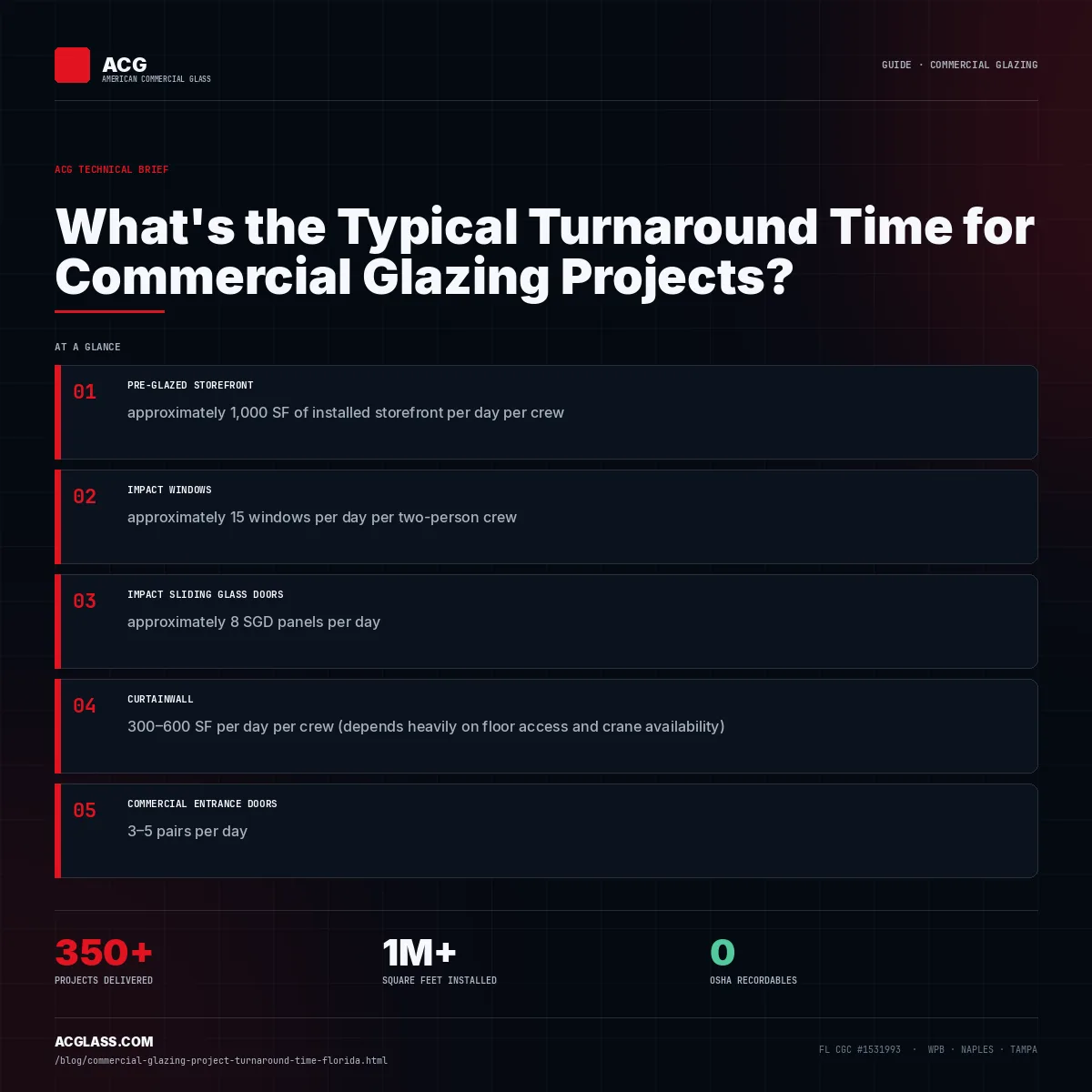
Real 2026 production rates for ACG field crews:
- Pre-glazed storefront: approximately 1,000 SF of installed storefront per day per crew
- Impact windows: approximately 15 windows per day per two-person crew
- Impact sliding glass doors: approximately 8 SGD panels per day
- Curtainwall: 300-600 SF per day per crew (depends heavily on floor access and crane availability)
- Commercial entrance doors: 3-5 pairs per day
A 4,000 SF storefront install, with one crew working pre-glazed units, completes in 4 to 5 working days. A 15,000 SF curtainwall on a three-story building, with crane picks, runs 4 to 6 weeks.
The 48-Hour Bid Commitment
The single phase under a glazing sub's direct control is the bid turnaround. ACG commits to 48 hours from plans receipt to delivered scope - a commitment built on estimating infrastructure, current unit-cost calibration across recent projects, and established manufacturer pricing relationships. That commitment matters because a GC bidding a project on a 30-day owner deadline needs glazing numbers 5 to 10 days before bid day to integrate them into the GC's total proposal. A two-week bid turnaround from a glazing sub is a bid that doesn't make it into the GC's package.
What Makes a Project Finish Early
Three factors consistently compress project timelines:
- Standard products from the manufacturer's catalog. No custom finishes, no oversized glass, no one-off hardware.
- Clean architectural drawings. Complete elevations, clear schedules, section cuts that show anchor conditions. Ambiguity in the drawings becomes RFIs, which become delays.
- Early submittal review by the architect. When an architect turns shop drawings in 5 business days rather than 15, the project picks up two full weeks.
What Makes a Project Run Late
And three factors consistently extend timelines:
- Design changes during fabrication. Once the manufacturer has cut material, changes are expensive and slow. A change during fabrication adds 4 to 8 weeks.
- Permit review delays. Miami-Dade, Broward, and some coastal Tampa-area building departments can take 3 to 6 weeks on permit review in busy cycles. This delays install regardless of whether the glazing is ready.
- Substrate issues. If the rough openings aren't ready, plumb, or dimensionally correct when the glazing shows up, install stalls. This is usually a framing/rough carpentry issue, not a glazing issue - but the glazing timeline absorbs the delay.
Example: 20-Week Project Timeline
A 12,000 SF mixed-use commercial project in Tampa, typical spec:
- Week 1: Plans issued to bidders. ACG submits bid within 48 hours.
- Weeks 2-3: GC reviews bids, contract issued.
- Weeks 4-5: Shop drawings first submit.
- Week 6: Architect review, minor revisions.
- Week 7: Shop drawings approved. Engineering/NOA package submitted.
- Weeks 8-13: Manufacturer fabrication.
- Week 14: Delivery to site, staging.
- Weeks 15-19: Field install (approximately 3-4 weeks of crew time for 12,000 SF).
- Week 20: Punch, final clean, close-out submittals.
Total: 20 weeks. Variations run from 14 weeks (standard products, no revisions) to 26 weeks (custom finishes, revision cycles).
Recent project delivery examples include work where a complex multi-system glazing scope was delivered on a tight GC master schedule through the phases described above.
Ready to get started?
Send plans and ACG returns a priced, scoped, and scheduled proposal inside 48 hours. That turnaround is the first phase compression on the project - it buys the GC extra days on every downstream phase.