
For architects, developers, and general contractors working on Florida commercial projects, the phrase "hurricane sliding glass door" covers a wide range of products - from basic residential-grade sliders to engineered multi-slide systems designed for full wall-to-wall openings in luxury hospitality. The performance gap between these categories is substantial, and so is the cost gap. This guide lays out what separates a true hurricane impact sliding door from a standard slider, which products are appropriate for commercial use in Florida, how the HVHZ approval process works, and what installed pricing looks like across common commercial configurations in 2026.

What Makes a Sliding Door 'Hurricane Impact' (vs Regular)
A standard sliding glass door uses a single- or double-pane glass unit, a basic aluminum frame, and hardware selected for interior comfort rather than structural performance. It carries no wind pressure rating beyond what the frame dimensions can incidentally handle, and it has never been subjected to impact or cyclic pressure testing. In Florida, installing a non-impact sliding door on any exterior opening where impact protection is required by the Florida Building Code is a code violation - and a liability exposure that extends from the permit stage through the life of the structure.
A hurricane impact sliding door is a tested assembly. The distinction is not in the glass alone - it is in the entire system: glass makeup, frame extrusion dimensions, glazing bite, interlayer type, hardware, fastener schedule, and anchor pattern. All of those elements must have been tested together as an assembly and must perform as tested when installed in the field. The key characteristics that define hurricane impact classification:
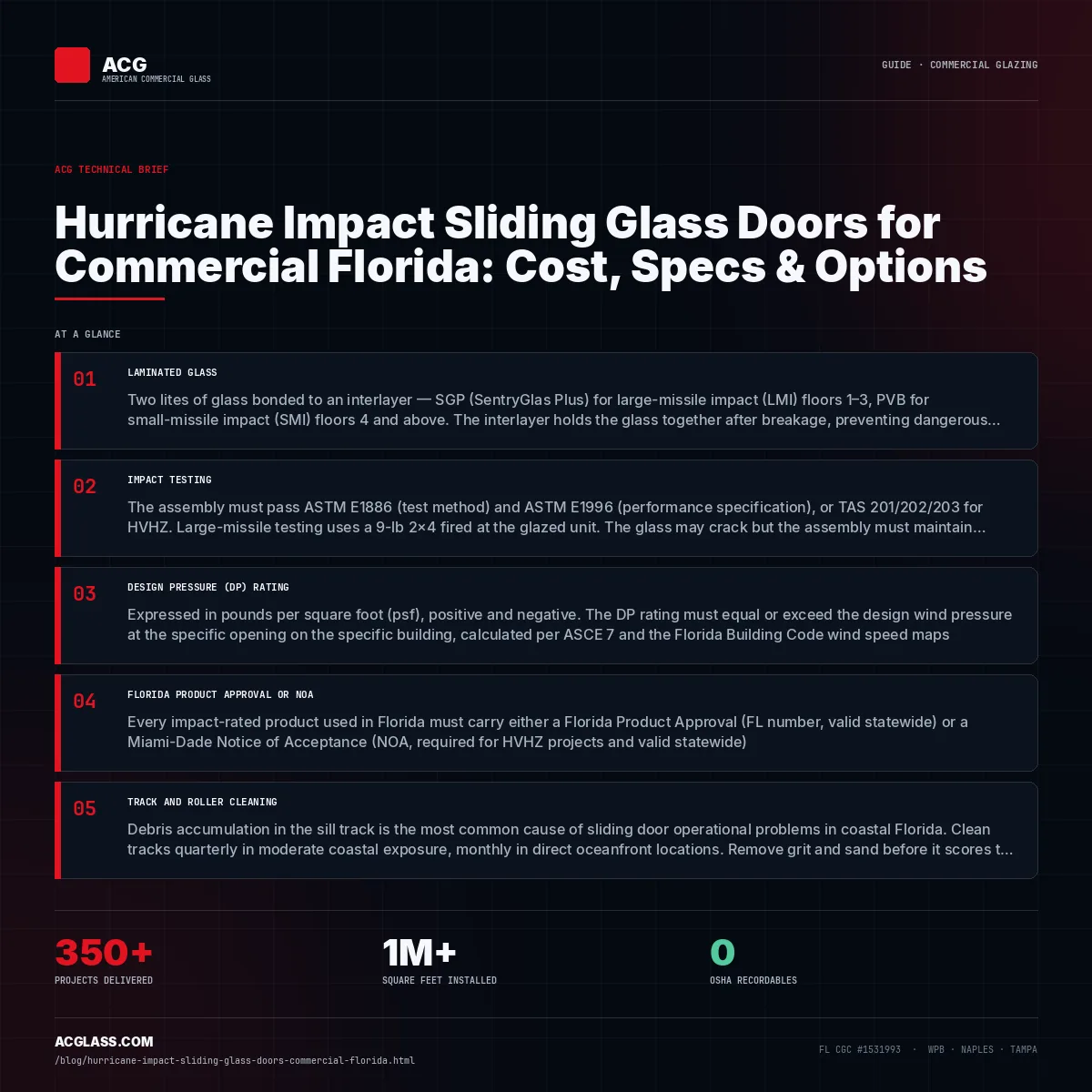
- Laminated glass: Two lites of glass bonded to an interlayer - SGP (SentryGlas Plus) for large-missile impact (LMI) floors 1-3, PVB for small-missile impact (SMI) floors 4 and above. The interlayer holds the glass together after breakage, preventing dangerous fragments and maintaining the weather envelope.
- Impact testing: The assembly must pass ASTM E1886 (test method) and ASTM E1996 (performance specification), or TAS 201/202/203 for HVHZ. Large-missile testing uses a 9-lb 2x4 fired at the glazed unit. The glass may crack but the assembly must maintain integrity and pass subsequent pressure cycling.
- Design Pressure (DP) rating: Expressed in pounds per square foot (psf), positive and negative. The DP rating must equal or exceed the design wind pressure at the specific opening on the specific building, calculated per ASCE 7 and the Florida Building Code wind speed maps.
- Florida Product Approval or NOA: Every impact-rated product used in Florida must carry either a Florida Product Approval (FL number, valid statewide) or a Miami-Dade Notice of Acceptance (NOA, required for HVHZ projects and valid statewide).
A product with laminated glass but no tested assembly and no FL approval is not hurricane impact. The tested assembly and the approval document are what matter.
Where Hurricane Sliding Glass Doors Fit in Commercial Projects
In residential construction, impact sliding doors are primarily balcony doors in high-rise condominiums. The commercial application set is broader and more varied, and each application type places different demands on the door system.
Clubhouses and Amenity Spaces
The most common commercial application ACG encounters is the multifamily amenity building - clubhouses, pool pavilions, and fitness centers where the design intent is to dissolve the boundary between interior and exterior. These buildings are often one or two stories, located in coastal or near-coastal Florida communities, and designed with large glass openings facing pool decks or landscaped courtyards. The structural requirements for these openings depend on the county and wind speed zone, but most fall into the DP50-80+ range for the first floor. The design intent typically calls for a clean, minimal sightline - making the ESWindows SGD-2020 or a premium multi-slide system the appropriate specification depending on budget.
Rooftop Bars and Restaurant Patios
Rooftop and elevated restaurant patios face some of the highest wind pressure demands on a commercial structure. Exposure category, building height, and the absence of surrounding shelter all drive up the design pressure requirement. These openings also face the full range of weather - direct sun, wind-driven rain, and potential debris - in a high-traffic hospitality environment where aesthetics matter as much as performance. Multi-slide systems that pocket completely into wall framing are often specified here to allow full indoor-outdoor operation during favorable conditions.
Hospitality Lanai and Indoor-Outdoor Dining
Florida hospitality - hotels, resorts, and upscale food and beverage - has driven strong demand for large-panel sliding systems that open dining rooms onto terraces. High-visibility hospitality dining-to-terrace transitions use a Euro-Wall multi-slide system, a configuration that prioritizes maximum glass area and minimal frame intrusion.
Mixed-Use Ground Floor Retail and Food Hall
Ground-floor retail and food hall spaces benefit from large operable openings that activate street presence and improve ventilation. ACG installed ESWindows SGD systems at Wave Food Hall in Cocoa Beach and Baron Shoppes Tradition in Port St. Lucie - both projects where the sliding door system needed to balance commercial performance, code compliance, and the active operational demands of a food and beverage environment.
Key Specs: Impact Rating, Pressure, Glass Makeup
Understanding what the specification numbers mean is necessary for evaluating product submittals and for catching mismatches between what the design documents require and what a supplier is proposing.
DP Rating
Design Pressure (DP) is the wind pressure, expressed in pounds per square foot (psf), that the assembly has been tested to withstand. It is stated as positive (inward) and negative (outward) - for example, +90/-150 psf. The negative (suction) load is typically the governing value for most Florida commercial facades. The required DP at each opening is calculated by the structural engineer of record using ASCE 7 wind speed tables, the building's mean roof height, the exposure category, and the location of the opening (corner vs. field condition). For a typical first-floor commercial opening in a coastal non-HVHZ county, DP50-70 is a common minimum. HVHZ projects and tall buildings push requirements higher.
Large vs. Small Missile Impact
Florida building code distinguishes between large-missile impact (LMI) and small-missile impact (SMI) based on floor level. Floors 1-3 (up to 30 feet above grade) require large-missile impact testing - a 9-lb 2x4 at 34 mph. Floors 4 and above are permitted to use small-missile impact testing - 10 ball bearings at 80 mph. The practical difference for glazing is the interlayer: LMI assemblies use SGP interlayer with structural silicone glazing because SGP provides substantially higher post-breakage resistance than PVB. SMI assemblies typically use PVB. Most commercial building specifications default to LMI through all floors for uniformity and reduced submittal complexity.
Laminated Glass Makeup
A typical commercial hurricane impact sliding door glass makeup for an LMI assembly: 5/16" annealed outer lite + 0.090" SGP interlayer + 5/16" annealed inner lite, or an insulating laminated unit (ILU) that adds an air or argon space between the outer laminated lite and an inner lite for thermal performance. The ESWindows SGD-2020 is available with an insulating laminated option; the reference U-value for one configuration is 0.51 (3/16" SB70XL Gray + 3/8" AS + 3/16" Clear + 0.090" PVB + 1/4" EAD Low-E). Glass makeup must remain within the tested and approved configurations - substituting glass thickness or interlayer type outside the NOA scope invalidates the approval.
ASTM E1886 / E1996 Testing
ASTM E1886 is the test method for measuring the structural performance of fenestration products subject to wind and windborne debris. ASTM E1996 is the standard specification that defines what missiles are used and what performance levels are required. For HVHZ, the equivalent testing standards are TAS 201 (impact), TAS 202 (uniform static air pressure), and TAS 203 (cyclic static air pressure) - Miami-Dade's own protocols, which are generally considered more stringent than the ASTM equivalent for the same wind speed exposure.
Top Commercial Hurricane Sliding Door Products
ESWindows SGD-2020 (ES-SGD2020)
The ES-SGD2020 ProSlide is ESWindows' primary commercial impact sliding door in the Prestige line. It is the workhorse specification for Florida commercial amenity and retail applications where budget, performance, and a clean aesthetic all need to be balanced. Key specs: DP +90/-150 psf, LMI and SMI rated, Florida Product Approval FL22267 (tested to FBC 6th and 7th Edition). Panel size up to 60" wide by 144" tall. Frame depths of 4-3/8" (2-track), 6-7/16" (3-track), and 8-1/2" (4-track). Sill height 1-7/8". Available in 2-panel through multi-panel configurations including pocket. Corner configurations at 90° and 135° are available. Hardware is needle bearing acetal roller with 2-point locking. The ES-FX2020 fixed window is designed to match the SGD-2020 frame profile for clean transitions between operable and fixed panels. ACG specifies the SGD-2020 on projects including Wave Food Hall (Cocoa Beach) and Baron Shoppes Tradition (Port St. Lucie). For more detail on the full ESWindows product lineup, see the ESWindows product page.
Euro-Wall Multi-Slide and Folding Systems
Euro-Wall is a Florida-based manufacturer of premium sliding and folding door systems used in high-end commercial hospitality and amenity applications. Their multi-slide and Wall Vista Fold systems are impact-rated and used where the design calls for maximum glass area, near-zero sightlines, and architectural statement. Euro-Wall systems are appropriate for high-end clubhouses, resort lobbies, rooftop bars, and fine dining venues where the opening is a design centerpiece - projects such as Fort Lauderdale and . They carry a substantial price premium over standard commercial impact sliders and require experienced installation crews. See the Euro-Wall product page for system specifications and availability.
PGT WinGuard Sliding
PGT WinGuard is a Florida-manufactured impact sliding door line widely specified in residential and low-rise residential construction. It is worth understanding for commercial teams primarily as a comparison point: PGT WinGuard is a residential-grade product, not a commercial system. Frame profiles, DP ratings, and maximum panel sizes are appropriate for single-family and low-rise residential. On a commercial project, a glazing contractor proposing PGT WinGuard where a commercial impact slider is specified should be asked to demonstrate compliance - particularly for maximum size, DP, and commercial-grade hardware requirements. For commercial applications, the ESWindows SGD-2020 or a comparable commercial system is the correct specification.
Hurricane Impact Sliding Glass Doors Cost (2026)
Pricing for commercial hurricane impact sliding door systems in Florida ranges substantially based on panel count, opening size, system type, zone (HVHZ vs. non-HVHZ), and site conditions. The table below reflects ACG's 2026 installed pricing for typical commercial configurations, inclusive of material, labor, substrate prep, sealant, and standard hardware. It excludes structural framing modifications, custom finishes, special glass specifications, and permit costs.
| System | Door Size | Configuration | Installed $/Door |
|---|---|---|---|
| Impact sliding (2-panel) | 8' x 8' | OX | By scope |
| Impact sliding (3-panel) | 12' x 8' | OXO | By scope |
| Impact bi-parting (4-panel) | 16' x 8' | OXXO | By scope |
| Euro-Wall multi-slide (3-panel) | 12' x 8' | Pocketed | By scope |
| Euro-Wall folding (4-panel) | 16' x 8' | Bi-fold | By scope |
That premium is driven by the glass makeup (laminated vs. standard IGU), the reinforced frame extrusions, the tested hardware, and the approval documentation required for permitting.
For a broader view of impact glazing costs across commercial project types, see the impact windows and doors overview and the 2026 impact-rated glass requirements guide.
Standard Sliding vs. Hurricane Impact: A Spec Comparison
| Factor | Standard Sliding | Hurricane Impact Sliding |
|---|---|---|
| Glass | Standard 1/4" or IGU | Laminated IGU with SGP/PVB interlayer |
| Frame | Basic aluminum | Reinforced aluminum, impact-rated |
| Testing | None required | ASTM E1886/E1996 |
| HVHZ approval | No | Yes (Miami-Dade NOA) |
| DP rating | Low (DP25-40) | Higher (DP50-80+) |
HVHZ vs. Non-HVHZ: What Changes
The High Velocity Hurricane Zone (HVHZ) covers Miami-Dade and Broward Counties. In HVHZ, every exterior glazing product must carry an active Miami-Dade Notice of Acceptance (NOA) - a product-specific approval issued after testing at an approved laboratory using TAS protocols. The NOA specifies the tested product, the tested sizes, the tested glass makeup, and the tested installation conditions. Installation outside those parameters requires a new test or engineering analysis.
Outside HVHZ - Palm Beach County, Collier, Sarasota, Pinellas, Hillsborough, and all other Florida counties - a Florida Product Approval (FL number from floridabuilding.org) is the required credential. FL Product Approvals use ASTM test standards rather than TAS. Most commercial impact sliding doors carry both an FL Product Approval and a Miami-Dade NOA, which simplifies specification across project geographies.
The practical differences for a commercial project in HVHZ:
- Product submittals must include the active NOA, not just an FL Product Approval.
- The NOA scope must cover the specific door size, configuration, and glass makeup specified on the project drawings.
- Installation must follow the NOA's installation instructions exactly - anchor type, anchor spacing, buck dimensions, and sealant specification.
- Third-party special inspection is typically required by the building department for impact glazing in HVHZ. Budget for inspector coordination and any rework required by inspection findings.
- Product substitutions that look equivalent may not be HVHZ-compliant. Verify NOA scope before accepting alternates.
The ESWindows SGD-2020 carries FL Product Approval FL22267. For HVHZ projects, confirm current NOA status with the manufacturer before specifying, as NOA expiration and scope updates can affect project eligibility.
For a detailed breakdown of HVHZ requirements as they apply to commercial glazing, see the hurricane impact windows vs. shutters guide.
Operation: Single, Bi-Parting, Pocket, Stacking
The operating configuration determines how the opening functions, how much clear opening width is achieved, and what the wall framing must accommodate. Commercial impact sliding doors are available in the following primary configurations:
OX / XO (2-Panel Single Slide)
One fixed panel (X) and one operable panel (O). The operable panel slides behind the fixed panel on a parallel track. Clear opening width equals approximately one panel width. The most cost-efficient configuration for smaller openings - 6' to 10' nominal width. Common on individual unit egress openings, smaller amenity access points, and service areas.
OXO (3-Panel)
One central fixed panel flanked by two operable panels that slide to each side. Clear opening on each side equals one panel width. Total opening width typically 12'-18'. Common for pool deck access from clubhouse interiors where a center fixed panel is acceptable architecturally.
OXXO (4-Panel Bi-Parting)
Two operable panels that meet at center and slide to opposite sides, each behind a fixed end panel. Clear opening equals approximately two panel widths - the most open configuration for a standard sliding system. Common for large clubhouse-to-pool transitions and restaurant terrace openings where maximum clear width is the priority.
Pocket Configuration
Operable panels slide into a wall pocket rather than stacking in front of a fixed panel, eliminating visible glass in the open position. Requires sufficient wall depth and structural framing to accommodate the pocket. The ESWindows SGD-2020 supports pocket configurations. Pocket systems significantly improve the indoor-outdoor experience but add framing complexity and cost.
Multi-Track Stacking
Premium multi-slide systems like Euro-Wall stack multiple panels on parallel tracks, allowing nearly full wall-width openings. Panels are typically pocketed or stacked at one or both ends. This configuration is the highest-performing for indoor-outdoor architectural applications - and the most expensive per linear foot of opening.
Installation Considerations for Florida
Correct installation is as important as correct product selection for hurricane impact compliance. The tested assembly is only as strong as its connection to the building structure, and installation defects are a common source of permit failures and warranty voids.
Substrate and Buck Conditions
Impact sliding doors in Florida commercial construction are typically installed into concrete masonry unit (CMU) or reinforced concrete openings using code-compliant anchors at the tested spacing. Wood-framed openings require a pressure-treated wood buck of sufficient dimension to transfer loads to the structural framing. The NOA or FL Product Approval installation instructions specify the required buck dimensions, anchor type, and anchor spacing - deviation from those specs is a code violation and can void the approval.
Sill and Threshold Conditions
Florida's water management requirements for impact sliding doors are more demanding than in most other states because of the frequency and intensity of wind-driven rain events. Sill height, weep slot design, and the relationship between the door threshold and the adjacent floor must be coordinated carefully. A 2" sill height is standard for most systems; low-rise threshold options (under 1-1/2") are available on select products for ADA accessibility but require careful water management detailing.
Structural Framing Above Large Openings
Commercial openings wider than approximately 12' typically require a structural header - a reinforced concrete bond beam, structural steel, or engineered lumber header - capable of carrying the load from the wall above. The glazing subcontractor's scope is the door and frame; the structural framing above is typically GC or structural subcontractor scope. Coordination between these scopes before rough-in is essential - framing errors that result in inadequate bearing or incorrect rough opening dimensions are expensive to correct after the fact.
Sequencing with Other Trades
Impact sliding doors in commercial amenity spaces are typically installed after the structural shell is complete and dry, but before flooring, millwork, and finish painting. The sequence matters because large door frames are difficult to maneuver through finished spaces, and sealant and caulk application requires clean surfaces. Coordinate with the GC's schedule to confirm rough opening inspections are complete before ordering custom-fabricated units, and to schedule installation before trades that will work adjacent to the openings.
Maintenance in a Coastal Environment
Hurricane impact sliding doors in Florida's coastal environment require more active maintenance than their inland counterparts. Salt air, UV exposure, sand abrasion on tracks, and humidity cycling all accelerate wear on components that are straightforward to maintain but easy to neglect.
- Track and roller cleaning: Debris accumulation in the sill track is the most common cause of sliding door operational problems in coastal Florida. Clean tracks quarterly in moderate coastal exposure, monthly in direct oceanfront locations. Remove grit and sand before it scores the track or roller surfaces.
- Roller adjustment and replacement: Roller height is adjustable on most commercial systems. Properly adjusted rollers allow effortless panel operation; worn or misadjusted rollers create operational difficulty and accelerate frame wear. Roller replacement is a routine maintenance item at 7-12 year intervals in high-use commercial settings.
- Sealant inspection: Perimeter sealant at the frame-to-substrate interface is the primary weather barrier. Inspect annually for cracking, adhesion loss, or joint movement. Reseal as needed - sealant failure is the most common source of water infiltration around impact sliding doors.
- Frame and hardware finish: Salt air attacks aluminum finishes over time. PVDF (Kynar) finishes have the best long-term performance in coastal exposure; standard painted finishes require more frequent inspection and touch-up. Anodized finishes perform well but can show streaking from hard water and mineral deposits without regular cleaning.
- Weep system: Verify weep slots at the sill are clear and draining freely. Blocked weeps cause sill water accumulation that can damage flooring, framing, and hardware over time.
How to Spec Hurricane Sliding Glass Doors on Your Project
Specifying impact sliding doors correctly on a Florida commercial project requires coordination across the structural, architectural, and glazing scopes. The steps that produce a clean submittal and a compliant installation:
1. Establish the Design Pressure Requirement
The structural engineer of record (EOR) must provide the design wind pressure for each glazed opening, or the glazing contractor must calculate it from the EOR's wind speed and exposure parameters. Do not rely on product DP ratings without confirming they exceed the calculated design pressure at the specific opening location, including corner zone multipliers.
2. Confirm HVHZ or Non-HVHZ Zone
The project county determines the approval credential required. Miami-Dade and Broward require NOA; all other Florida counties require FL Product Approval. If the project is in HVHZ, confirm that the specific product model, size range, and glass makeup specified fall within the current NOA scope before finalizing the specification.
3. Select Configuration and Size
Define the clear opening width required for the design intent and the panel configuration that achieves it within the structural framing. Confirm panel maximums against the product's tested scope - panels exceeding the tested size require engineering analysis or a different product.
4. Specify Glass Makeup
Specify the glass makeup in the project documents - not just "impact laminated" but the specific configuration (e.g., insulating laminated unit, 3/16" low-E outer + 3/8" AS + 3/16" clear + 0.090" PVB + 1/4" EAD Low-E). This prevents substitution of lower-performing assemblies and ensures the thermal performance specified on the energy model is actually delivered. Verify the specified makeup is within the tested and approved scope for the selected product.
5. Coordinate Structural Framing and Rough Opening
Provide the structural framing requirements for large openings to the GC and structural engineer before the framing package is issued. Rough opening dimensions, header requirements, and buck specifications must be reflected in the structural drawings.
ACG works with commercial teams at the specification stage - reviewing product options, confirming approval scope, and flagging coordination issues before they become field problems. ACG operates from West Palm Beach headquarters. If you are working through a commercial glazing scope in Florida, see our frameless glass doors guide and the 2026 impact-rated glass requirements overview for related context.
For project-specific guidance on system selection, sizing, and 2026 pricing, send plans to ACG and we return a detailed scope inside 48 hours.