
Hurricane season in Florida runs June 1 through November 30, and for commercial property owners the preparation window starts in March. Pre-season inspection of impact-rated glazing, understanding which systems are installed and what they are rated for, deciding whether backup shutters are worthwhile on older non-impact openings, running a maintenance pass on weatherstripping and gaskets, and having a post-storm inspection protocol ready to go-each step has a window when it is low-end to do and a window when it becomes a scramble. This guide walks through the pre-season commercial impact glass preparation workflow for Florida owners, property managers, and facility teams.
Know What You Have Installed
The most overlooked step in hurricane preparation is confirming what is actually installed on the building. Impact glazing is not a binary; the rating depends on HVHZ versus non-HVHZ jurisdiction, missile test level, design pressure, and the specific approval number. A building with impact glazing approved for a coastal Palm Beach County application is not automatically approved for HVHZ Miami-Dade or for the wind speeds of an intensifying Category 5 event.
Pull the Original Submittals
For buildings built in 2010 or later, the original construction submittal package typically includes the glazing product approvals (Miami-Dade NOA or Florida Product Approval FL numbers), shop drawings with design pressures, and closeout documentation with the as-installed configuration. This documentation belongs in the owner's permanent facility file and in the property insurance file. If it is missing, the general contractor of record, the glazing sub, or the building department's digital permit record can usually recover it.
HVHZ vs Non-HVHZ Ratings
Florida Building Code defines two relevant wind regimes for commercial glazing:
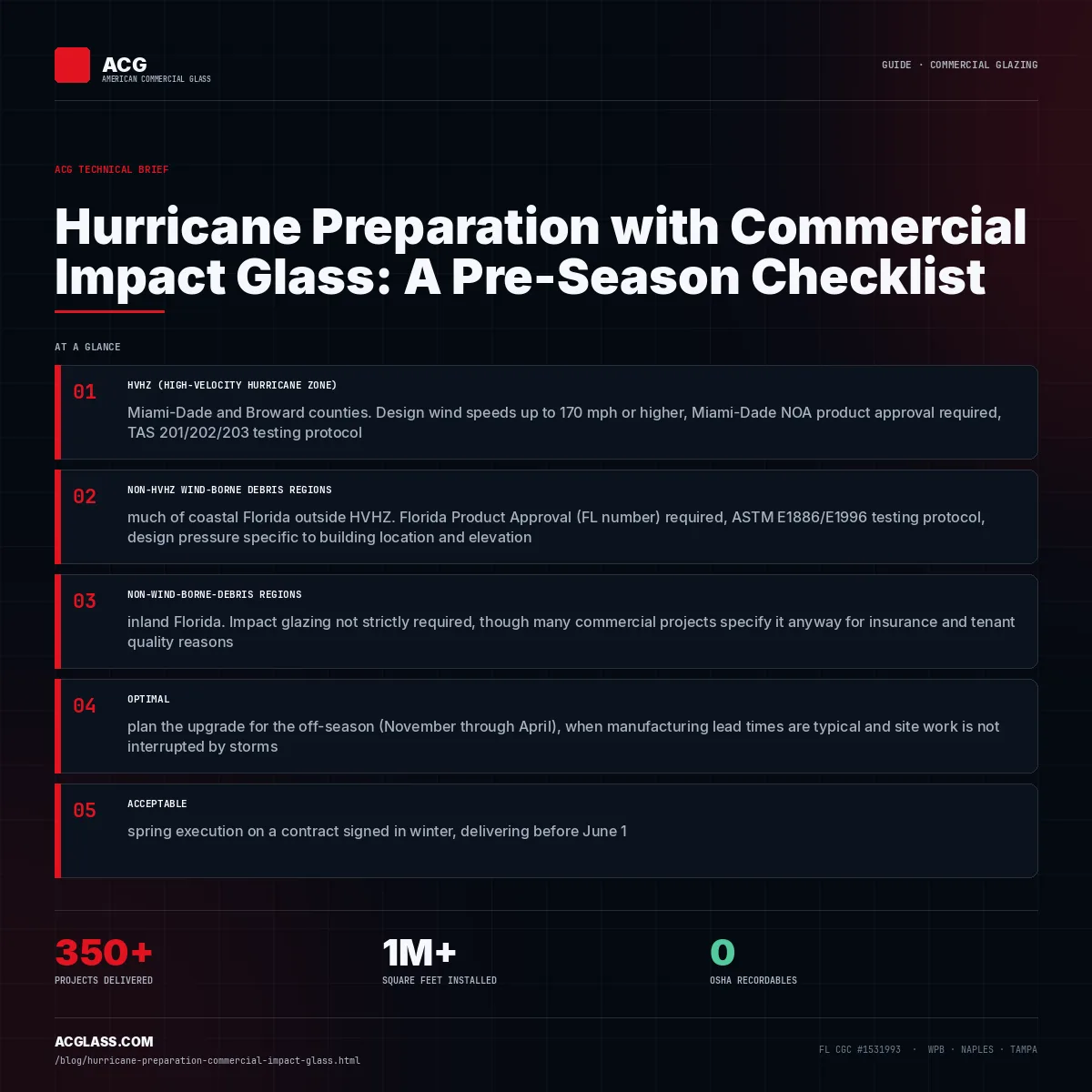
- HVHZ (High-Velocity Hurricane Zone): Miami-Dade and Broward counties. Design wind speeds up to 170 mph or higher, Miami-Dade NOA product approval required, TAS 201/202/203 testing protocol.
- Non-HVHZ Wind-Borne Debris Regions: much of coastal Florida outside HVHZ. Florida Product Approval (FL number) required, ASTM E1886/E1996 testing protocol, design pressure specific to building location and elevation.
- Non-Wind-Borne-Debris Regions: inland Florida. Impact glazing not strictly required, though many commercial projects specify it anyway for insurance and tenant quality reasons.
A building in Miami that was permitted under HVHZ rules has stricter glazing than the same building would have inland. Know your jurisdiction.
Missile Test Levels and Design Pressure
Impact-rated glazing is tested to one of several missile test levels:
| Missile Level | Test Projectile | Typical Application |
|---|---|---|
| Small Missile | Steel balls at specified velocity | Glazing above 30 feet elevation |
| Large Missile Level C | 4.5-lb 2x4 at 40 ft/sec | Lower-risk applications |
| Large Missile Level D | 9-lb 2x4 at 50 ft/sec | Most commercial HVHZ applications |
| Large Missile Level E | 9-lb 2x4 at 80 ft/sec | Essential facilities, hospitals, EOCs |
Design pressure (DP rating) quantifies the wind load the assembly can resist without failure. A DP+60/-65 assembly handles 60 psf positive and 65 psf negative pressure. On coastal Florida buildings, DP requirements range from +/-50 psf on low-elevation mid-rise to +/-100 psf or more on high-rise corners and coastal ocean-facing elevations.
Pre-Season Inspection Workflow
Run a systematic pre-season inspection in March or April. The checklist:
Exterior Inspection
- Walk every exterior elevation and photograph every glazing system, noting location, size, and any visible damage
- Check for cracked, chipped, or compromised glass, even hairline fractures in laminated assemblies
- Inspect perimeter sealant for cracking, peeling, or separation from glass or frame
- Look for corroded or damaged frame fasteners, anchors, and perimeter attachments
- Verify weep holes are clear and functioning
- Confirm all operable windows close and lock properly, with gaskets intact
Interior Inspection
- Check for water staining on sills, jambs, or drywall near glass openings
- Confirm interior gaskets and glazing stops are present and not damaged
- Look for IGU seal failures (fogging between panes)
- Verify any automatic operators on entrance doors are functioning
Documentation
Produce a written report with photographs, location-tagged findings, and recommended repairs. This report becomes the pre-storm baseline that a post-storm inspection compares against, and it also feeds the insurance file if a claim becomes necessary.
Maintenance Before Hurricane Season
Deferred maintenance is where impact glazing fails prematurely in an event. Common pre-season maintenance items:
Sealant Renewal
Perimeter sealant on commercial glazing typically lasts 15 to 20 years before it needs replacement. Signs of sealant failure include cracking, discoloration, peeling, separation from substrate, and visible gaps. Renewing sealant before hurricane season (or on a scheduled 15-year cycle, whichever comes first) prevents the wind-driven rain infiltration that ruins ceilings and flooring during tropical storms.
Gasket and Weatherstripping Replacement
EPDM and silicone gaskets compress, dry out, and develop permanent set after a decade of service. Replacing worn gaskets is a labor-intensive job but a meaningful contributor to airtightness during a storm. On operable windows and entrance doors, this is the maintenance most often deferred and most frequently regretted.
Fastener and Anchor Verification
On buildings 15 years or older, pulling a representative sample of fasteners and checking for corrosion is appropriate. Coastal Florida salt air corrodes carbon steel rapidly; stainless steel fasteners are the spec, but substitutions and field modifications can leave weak points. Corroded anchors cause sudden perimeter failure in high wind.
Shutter Backup Decisions
For buildings with non-impact or mixed glazing, deploying storm shutters is the backup plan. The decision hinges on a few factors:
- Impact rated throughout: no shutters needed. Impact glazing is the engineered solution.
- Non-impact on limited openings: accordion, roll-down, or panel shutters on those specific openings are the practical solution.
- Non-impact throughout in a modern coastal commercial building: the long-term play is upgrading to impact glazing. Shutters are the stopgap.
See impact windows vs shutters commercial for detailed comparison.
Deploying Shutters
Accordion and roll-down shutters deploy in minutes. Panel shutters require installation labor that takes hours to days depending on building size and must be done before the weather window closes. Property managers with panel shutters should pre-position panels and hardware in March and run a deployment drill with the maintenance team.
Post-Storm Inspection Protocol
After any named storm affects the property, a systematic post-storm inspection documents damage and starts the insurance claim process on a strong footing.
Immediate Post-Storm (24 to 48 Hours)
- Secure any compromised openings with emergency board-up
- Walk every exterior elevation and photograph damage with timestamps and geotags
- Document interior damage from any water intrusion
- Notify the property insurance carrier within the policy notification window
- Do not remove debris or permanently repair damage until the adjuster has inspected
Scheduled Glazing Inspection
Within 7 to 14 days, have a commercial glazing contractor walk the building with the property manager and document findings in writing. The glazier looks for damage the casual observer misses: hairline cracks propagating from impact points, frame distortion, anchor displacement, IGU seal compromise from impact shock. See our commercial glass insurance claims guide for claim documentation detail.
Upgrade Timing for Non-Impact Buildings
On commercial buildings with non-impact glazing that are candidates for upgrade, timing matters:
- Optimal: plan the upgrade for the off-season (November through April), when manufacturing lead times are typical and site work is not interrupted by storms
- Acceptable: spring execution on a contract signed in winter, delivering before June 1
- Suboptimal: triggering an upgrade after a near-miss storm in August, when lead times are stretched and the next named storm is already forming
Factory lead times on custom HVHZ-approved commercial glazing run 10 to 20 weeks depending on system and fabricator. Planning backwards from the delivery date determines when the contract has to be signed.
Pre-Season Glazing Assessment
For Florida commercial property owners and managers who want a pre-season glazing condition assessment with a written report, documented product approvals, and recommended maintenance actions, ACG offers a structured inspection service. The output is a stabilization plan heading into hurricane season and, where applicable, an upgrade scope with 2026 pricing. Call (772) 486-7711 or send the building address to contact. CGC1531993, 5+ years of Florida commercial glazing. Covering West Palm Beach, Naples, and Tampa Bay with our three offices.