
When you're building or renovating a commercial property in Florida, you need hurricane protection on your glazing. Florida Building Code gives you two main options: impact-rated glass or approved storm shutters. Here's the honest comparison most articles won't give you.
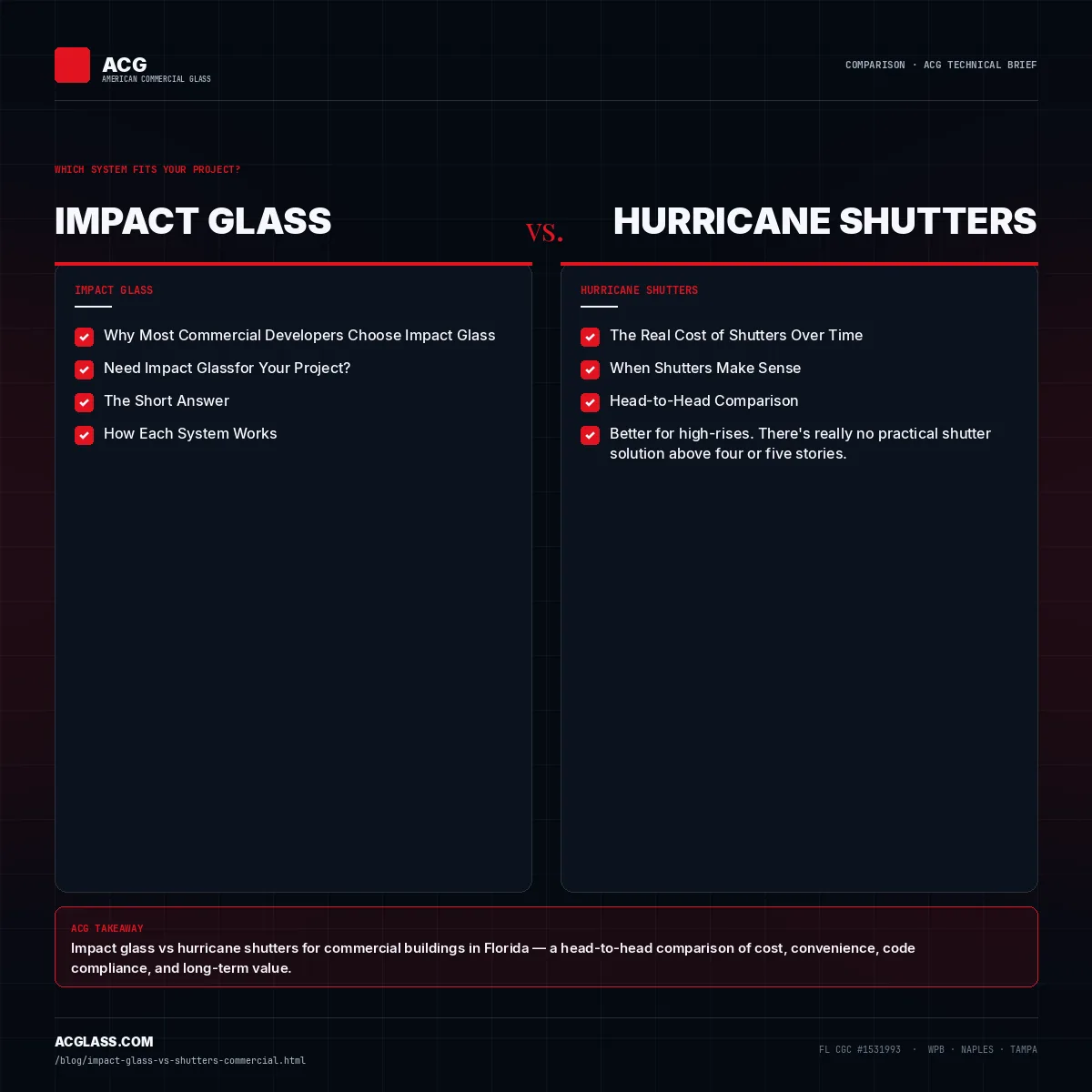
The Short Answer
For most commercial buildings - especially occupied ones - impact glass is the better choice. It's always on. It requires no deployment. It looks better. And over the life of the building, it often costs less than managing a shutter system.
Shutters have a place. Certain building types and budget constraints make them a reasonable choice. But on a commercial property where people show up every day, shutters create a serious operational burden every time a storm threatens.
How Each System Works
Impact Glass
Impact-rated glass uses a laminated construction. Two or more panes of glass are bonded to a tough plastic interlayer - usually PVB (polyvinyl butyral) or SGP (SentryGlas Plus). When the glass breaks under impact or pressure, the interlayer holds the broken pieces in place. The opening stays protected.
Impact glass is always in its protective state. There's nothing to deploy, activate, or store. It looks like normal glass from every angle.
In Florida, impact glass must carry a Florida Product Approval (FL PA) number or a Miami-Dade NOA to be used in permitted construction. The product is tested for both large-missile impact (a 9-pound 2x4 fired at 50 feet per second) and cyclic pressure loading.
Hurricane Shutters
Commercial hurricane shutters typically come in two forms:
- Roll-down shutters - metal or polycarbonate panels that roll down from a housing above the opening. Can be motorized for easier operation.
- Accordion shutters - hinged panels that fold flat beside the opening when not in use and unfold to cover the glass during a storm.
- Panel systems - removable metal or polycarbonate panels stored on-site and fastened over openings before a storm. Less common on commercial buildings.
The underlying glass can be standard non-impact glass when shutters are used. The shutter system carries the code-required protection. But the shutters must be deployed before every storm event - and Florida code requires deployment before a storm warning is issued.
Head-to-Head Comparison
| Factor | Impact Glass | Hurricane Shutters |
|---|---|---|
| Upfront cost | Higher than non-impact | By scope |
| Deployment required | None - always protected | Yes - before every storm warning |
| Labor cost per storm | $0 | By scope |
| Appearance | Normal glass, always visible | Shutters visible when deployed - often unattractive |
| Business impact during storm | None - building can remain open until evacuation order | Closes when shutters are deployed (no daylight) |
| Maintenance | Minimal - inspect sealants periodically | Regular maintenance of motors, tracks, hinges |
| High-rise use | Practical at any height | Extremely difficult above 3-4 stories |
| HVHZ compliance | Yes (with FL PA or NOA) | Yes (with NOA), but glass also needs separate approval |
| Long-term value | Higher property value, lower OpEx | Lower upfront, higher ongoing costs |
The Real Cost of Shutters Over Time
Shutters look lower-priced on paper. But the ongoing costs add up fast.
Florida averages six named storms per season. Not all require full deployment, but a typical coastal commercial building in Florida should expect to deploy shutters two to four times per hurricane season in active years.
Each deployment costs labor. On a small strip retail building with 20 openings, manual accordion shutter deployment might take a maintenance crew two to three hours. At a larger commercial property, it's a full-day job.
Roll-down shutters with motors are faster, but the motors need maintenance. They fail at the worst time - right before a storm. An active storm season in Florida means multiple service calls.
Why Most Commercial Developers Choose Impact Glass
When developers run the full cost analysis - upfront, operational, maintenance, and business impact - impact glass wins for most commercial applications.
The reasons are simple:
- No operational burden. Your property manager doesn't need to worry about storm warnings, calling crews, or whether the shutter motors work.
- Better for tenants. Commercial tenants don't lose daylight or have to work around shutter deployment schedules.
- Better for high-rises. There's really no practical shutter solution above four or five stories.
- Better insurance terms. Many insurers provide premium reductions for impact-rated openings - which partially offsets the higher upfront cost.
- Higher resale value. A building with impact glass throughout is worth more than one with shutters. Buyers understand that shutters mean ongoing operational headache.
ACG has installed impact glass on commercial buildings from fire stations to retail centers to multifamily developments across Florida. See our project at Cudjoe Key Fire Station for an example of impact glazing on a mission-critical public safety building. More on our commercial glass installation services in Florida.
When Shutters Make Sense
Shutters are not always the wrong choice. They make sense when:
- The building is vacant or seasonally occupied (no ongoing operational burden)
- Budget constraints are severe and the upfront delta matters more than long-term savings
- The glazing area is very small - a few openings on an accessory building
- The building is a warehouse or industrial facility with limited occupancy
For any occupied commercial building - retail, office, hospitality, healthcare, multifamily - impact glass is almost always the better long-term choice.
For a deeper look at impact glass options, see our guide on hurricane impact windows for commercial buildings in Florida and our storefront installation page.
Frequently Asked Questions
Is impact glass required for commercial buildings in Florida?
In Florida's High Velocity Hurricane Zone (HVHZ) - Miami-Dade and Broward counties - impact-rated glazing is required for all commercial buildings. Outside HVHZ, Florida Building Code allows either impact-rated glazing or an approved protection system (shutters). However, code requires that shutters be deployed before a storm warning is issued - which is impractical for occupied commercial buildings. Most code-compliant approaches for occupied commercial buildings use impact glass.
Can you use hurricane shutters on a high-rise commercial building?
Technically yes, but practically no. High-rise shutter systems require exterior deployment at every floor, which means mobilizing crews with rappelling equipment or lifts before every storm. For high-rise commercial buildings, impact-rated curtainwall or impact-rated window wall is the standard solution. Shutters are primarily practical on low-rise commercial buildings where ground-floor deployment is manageable.