
The aluminum vs vinyl windows question comes up often in online searches - and for good reason. The two materials dominate different segments of the window market, and the comparison genuinely matters when you are specifying or procuring windows for a Florida building. The practical answer for commercial projects, however, is shorter than most articles make it. This guide covers the full comparison honestly, with a commercial glazier's view of where each material belongs and why.
The Short Answer for Commercial
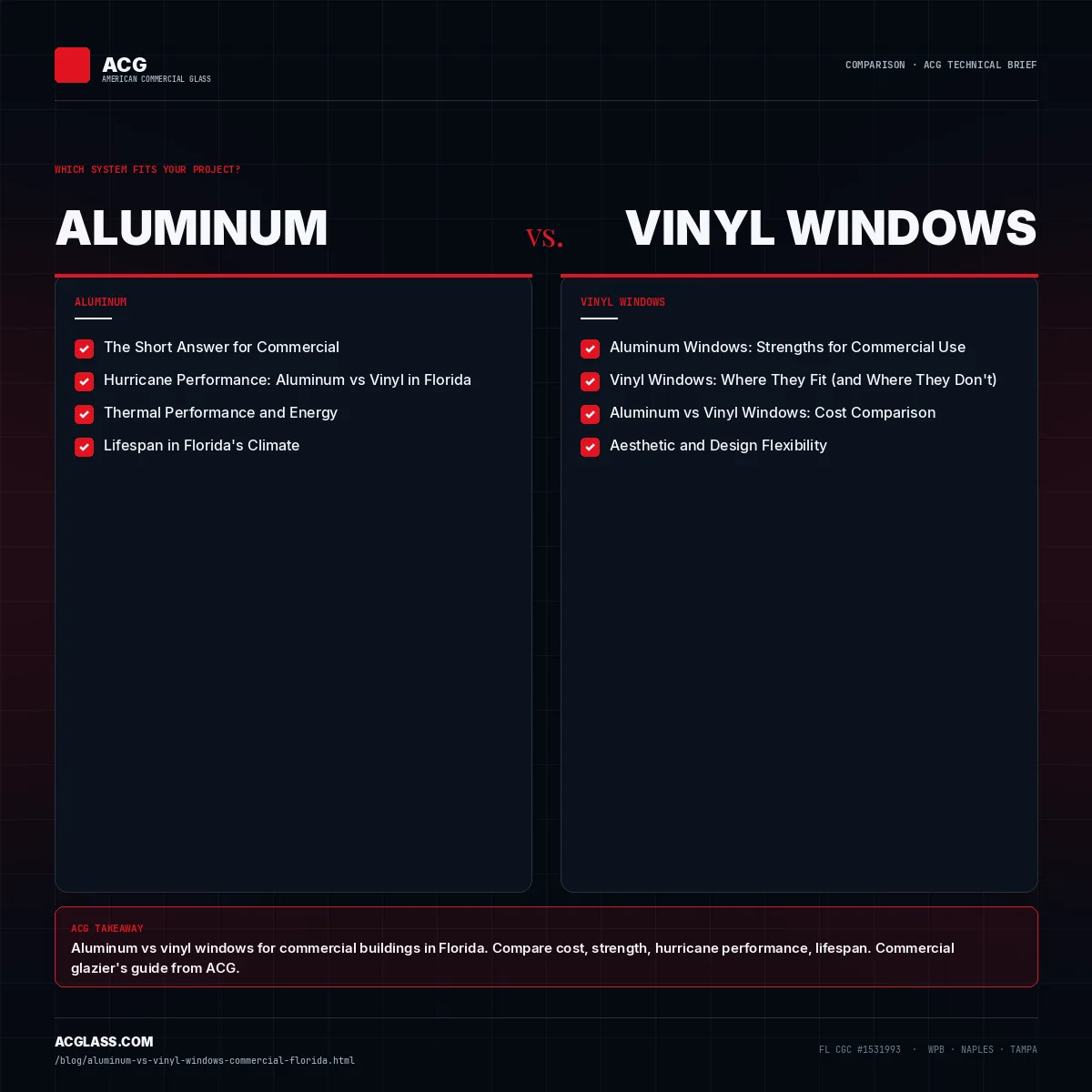
Commercial storefronts, window wall systems, and curtainwall are almost exclusively aluminum in Florida. This is not a preference - it is a function of structural physics, Florida Building Code requirements, and the product catalog of every major commercial glazing manufacturer. When a GC, developer, or architect specifies commercial glazing in Florida, the frame material is aluminum by default. The question is which aluminum system, what thermal break configuration, what glass specification, and what finish.
Vinyl windows exist primarily in the residential market and appear in very small commercial applications - a single-story office suite, a small medical office, or a landlord-supply replacement window in a low-rise apartment. As soon as opening sizes grow, wind loads increase, or the building type demands code-required structural performance, aluminum is the only viable choice.
That said, the aluminum vs vinyl comparison is worth understanding thoroughly. Property owners and developers who have looked at residential glazing pricing sometimes ask whether vinyl can be used commercially to reduce cost. Understanding exactly why the answer is no - and what governs that distinction - makes commercial glazing decisions clearer.
Aluminum Windows: Strengths for Commercial Use
Aluminum is the dominant commercial glazing frame material worldwide for reasons that are structural and practical, not simply conventional.
Structural Strength at Any Scale
Aluminum extrusions can be engineered to carry essentially any structural load. Commercial window systems - particularly those used in multi-story buildings, high-wind-load coastal zones, and large-span storefront applications - require frame sections that can resist positive and negative pressures without deflecting, warping, or failing. Aluminum delivers this across spans that would be impossible with vinyl.
Florida's High Velocity Hurricane Zone (HVHZ), which covers Miami-Dade and Broward counties, requires glazing systems to meet some of the most demanding structural performance standards in the country. These standards include testing per ASTM E1886 (missile impact), ASTM E1996 (specification for performance of exterior windows, curtain walls, doors, and impact protective systems), and the Florida-specific TAS 201, 202, and 203 test protocols. Commercial aluminum systems - including the ESWindows product lines ACG works with - are engineered and tested specifically to these standards. Vinyl is not a viable material at HVHZ structural performance levels.
Unlimited Opening Size
There is no practical upper limit on the opening sizes aluminum commercial systems can accommodate. Floor-to-ceiling storefront bays, multi-story curtainwall expanses, and large window wall panels are all standard aluminum applications. Vinyl, by contrast, tops out at roughly 4 feet by 6 feet per lite before frame deflection and structural limitations become prohibitive. That constraint alone rules out vinyl for almost every commercial application.
Thermal Break Technology
One of the common arguments for vinyl over aluminum is thermal performance - vinyl is inherently less conductive than aluminum, which means less heat transfer through the frame. This was a meaningful distinction in older aluminum systems. Modern thermally broken aluminum frames address it directly.
A thermally broken aluminum frame incorporates a polyamide (or similar non-conductive) strip between the interior and exterior aluminum sections, interrupting the conductive path through the frame. High-performance thermally broken systems can achieve frame U-values competitive with vinyl while retaining all of aluminum's structural advantages. For Florida commercial, where cooling load is the dominant energy concern, specifying a thermally broken aluminum system with a low-SHGC insulated glass unit (IGU) captures the energy performance benefit without the structural compromises of vinyl. See our article on best glass types for Florida's commercial climate for detail on low-E IGU specifications.
Finish Longevity in Florida's Environment
Florida's coastal environment - salt air, UV intensity, humidity, and thermal cycling - is demanding for any exterior material. Aluminum handles it well when finished correctly. Anodized aluminum creates an integral oxide layer that is highly resistant to corrosion and does not fade or chalk. Powder-coated aluminum provides a durable, color-stable finish rated to AAMA 2604 and AAMA 2605 specifications. PVDF (Kynar) coatings, the highest-grade option, are specified on high-end curtainwall and window wall projects where finish longevity over 30+ years is required.
ACG specifies finish systems and ESWindows aluminum products with these Florida-specific durability requirements in mind. The ESWindows commercial aluminum line ACG partners with is designed and tested for Florida coastal exposure.
Vinyl Windows: Where They Fit (and Where They Don't)
Vinyl is a legitimate window frame material in its appropriate applications. Understanding where it works helps clarify why it does not work commercially.
Residential Performance
In residential construction - single-family homes, townhomes, low-rise condominiums - vinyl windows perform well. They are cost-efficient for the application, provide good thermal performance from the frame material itself, require minimal maintenance, and carry impact ratings for residential-scale openings. Many Florida residential communities use vinyl impact windows with good long-term results for the size and load requirements involved.
Size and Structural Limitations
The structural limitations of vinyl become apparent quickly. A vinyl window frame section relies on the PVC extrusion itself for structural resistance - there is no equivalent to the custom-engineered aluminum extrusion profile that commercial systems use. When opening sizes exceed roughly 4 feet by 6 feet, or when wind loads are high (as they are throughout coastal Florida), vinyl frames cannot provide adequate structural performance without reinforcement strategies that largely eliminate the cost advantage over aluminum.
Appearance in Commercial Contexts
Vinyl frames are available in a limited palette - white, tan, and beige are the standard options, with a few wood-grain or bronze-look films available from some manufacturers. They are bulkier in profile than aluminum - typical vinyl frame widths run 3.5 to 5.5 inches compared to 2.5 to 5 inches for aluminum - which affects sightlines and the architectural appearance of a storefront or commercial facade. For commercial buildings where aesthetics are part of the tenant experience or brand positioning, vinyl's finish and profile limitations are a real constraint.
Long-Term Florida Exposure
Vinyl's behavior over time in Florida's climate is a documented concern. Prolonged UV exposure causes chalking and color fade. In salt-air coastal environments, some vinyl formulations lose flexibility and become brittle over the 20-to-30-year service life range. This is not a disqualifier in residential applications with shorter capital cycles, but it matters in commercial properties where envelope systems are expected to perform for 40 to 50 years without replacement.
Aluminum vs Vinyl Windows: Cost Comparison
The cost difference between aluminum and vinyl windows is real, and understanding what drives it helps put project economics in proper context.
The gap reflects several factors: aluminum commercial systems carry impact ratings and structural testing for larger openings and higher wind loads; aluminum systems require more precision in installation, sealant, and flashing to maintain warranty and code compliance; and aluminum systems are installed by licensed commercial glazing subcontractors operating under a commercial contractor license, not residential window replacement crews.
For commercial projects, the relevant cost comparison is not aluminum versus vinyl - it is which aluminum system is appropriate for the scope. Storefront systems run lower in cost per square foot than window wall, which runs lower than curtainwall. ACG works through that specification with developers and GCs at the project level. For a full breakdown of 2026 pricing, see our commercial glazing guide for Florida.
When property owners or developers ask whether vinyl can be substituted for aluminum to reduce cost on a commercial project, the structural and code constraints typically make that substitution impossible rather than simply inadvisable. The cost efficiency in commercial glazing comes from specifying the right aluminum system for the application - not from changing the frame material.
| Factor | Aluminum | Vinyl |
|---|---|---|
| Max opening size | Very large, unlimited | Limited (~4'×6') |
| Commercial use | Primary material | Rare in commercial |
| Hurricane rating | Strong, HVHZ-capable | Limited sizes available |
| Cost per SF (installed) | By scope | By scope |
| Lifespan in FL | 40-50 years | 20-30 years |
| Frame width | 2.5-5" (slimmer sightlines) | 3.5-5.5" (bulkier) |
| Salt air tolerance | Anodized/powder-coated: excellent | Can become chalky over time |
| Thermal break | Yes, available (polyamide) | Inherent (less conductive PVC) |
| Finish options | Anodized, powder-coat, PVDF | White, tan, beige |
| Recyclable | Yes, highly recyclable | Limited recyclability |
Hurricane Performance: Aluminum vs Vinyl in Florida
Florida's hurricane performance requirements for commercial glazing are among the most rigorous in the country, and understanding them clarifies why the aluminum vs vinyl question resolves quickly on commercial projects.
The Florida Building Code (FBC) 8th Edition establishes the baseline for commercial glazing performance statewide. Within the HVHZ - Miami-Dade and Broward counties - the requirements are more stringent still, with product approvals required under ASTM E1886 and ASTM E1996 (the standard specification for performance of exterior windows, curtain walls, doors, and impact protective systems impacted by windborne debris in hurricanes). Florida also maintains the TAS series of test protocols: TAS 201 (impact), TAS 202 (cyclic wind pressure loading), and TAS 203 (uniform static air pressure), which form the basis for Miami-Dade Notice of Acceptance (NOA) product approval.
Commercial aluminum systems - storefront, window wall, and curtainwall - are tested and certified to these standards in the opening sizes and wind load ranges required for commercial buildings. ESWindows aluminum commercial systems, which ACG specifies and installs across Florida, carry Miami-Dade NOA approvals for HVHZ applications. For more on impact-rated glazing performance, see our article on how impact windows protect Florida businesses and the comparison of impact windows versus shutters for commercial buildings.
Vinyl impact windows do exist and carry ratings for residential-scale use, but those ratings are at opening sizes and wind loads far below what commercial applications require. For any multi-story building, any opening larger than what a residential window accommodates, or any project in the HVHZ, vinyl is not a code-compliant option.
Thermal Performance and Energy
Florida commercial buildings spend significantly more on cooling than heating - the climate is heating-dominated only on a handful of winter days. The relevant thermal metrics for Florida commercial glazing are Solar Heat Gain Coefficient (SHGC), which governs how much solar energy passes through the glass, and U-value, which governs the rate of conductive and convective heat transfer through the assembly.
Vinyl's thermal advantage is in the frame: PVC is a poor conductor of heat, which means the frame section itself contributes less to overall U-value than a non-thermally-broken aluminum frame. In practice, for Florida commercial, this distinction has narrowed considerably. Thermally broken aluminum frames using polyamide isolators achieve frame U-values that compete directly with vinyl, while the glass unit itself - which constitutes the majority of the window area - determines most of the thermal performance regardless of frame material.
A properly specified Florida commercial aluminum window system - thermally broken frame, low-E insulated glass unit with SHGC in the 0.23-0.30 range, and appropriate low U-value - will meet or exceed ASHRAE 90.1 commercial energy code requirements and Florida Energy Code compliance thresholds. The frame material, aluminum vs vinyl, is not the primary driver of energy performance in a well-specified commercial system.
For large commercial buildings, the energy performance gain from moving to thermally broken aluminum with high-performance IGU over older aluminum single-pane or non-broken systems can reduce HVAC cooling loads by 20-35%, which translates to meaningful reductions in utility operating expense and NOI improvement at the property level.
Lifespan in Florida's Climate
Commercial capital planning depends on predictable service life from building envelope systems. The lifespan difference between aluminum and vinyl windows matters when a building owner is underwriting a 15- or 20-year hold.
Aluminum commercial windows, properly specified and maintained, routinely achieve 40 to 50 years of service life in Florida. The metal itself does not degrade under UV exposure. Anodized finishes are part of the aluminum surface and do not peel or fade. Powder-coat finishes rated to AAMA 2604 are warranted for 10 years and typically maintain appearance well beyond that. In ACG's experience across Florida commercial projects, properly specified aluminum systems from the 1970s and 1980s are often still structurally sound - they are replaced for aesthetic modernization and energy performance improvement, not because the frames have failed.
Vinyl windows in Florida's climate have a realistic service life of 20 to 30 years. UV degradation causes chalking and color fade over time. Thermal cycling - Florida's daily temperature swings - causes PVC to expand and contract, which can eventually compromise sealant integrity and frame dimensional stability. In high-humidity, salt-air coastal environments, some vinyl formulations show accelerated degradation. For commercial capital planning, replacing a window system at 20 to 25 years versus 45 to 50 years is a material difference in long-run cost efficiency.
Aesthetic and Design Flexibility
Commercial architecture in Florida increasingly demands facade systems that are visually distinctive, brand-consistent, and appropriate for the building's market position. Aluminum delivers on all of these dimensions in ways vinyl cannot.
Finish Range
Aluminum can be anodized in clear, bronze, champagne, dark bronze, and black; powder-coated in essentially any RAL or custom color; or finished in PVDF (Kynar) coatings for the highest durability and color consistency. This allows architects to match building color standards, coordinate with cladding systems, and achieve the dark frames and high-contrast sightlines that characterize contemporary commercial design. Vinyl is available in white, tan, and a narrow range of beige tones. A few manufacturers offer dark-frame vinyl, but the options are limited and the long-term color stability at Florida UV levels is less predictable than powder-coated aluminum.
Profile and Sightlines
Aluminum frame profiles can be engineered to be narrow, which maximizes glass area and gives storefronts and window wall systems the clean sightlines that read well on commercial facades. Vinyl frames, needing more material mass to achieve the same structural resistance, are inherently bulkier - a 5-inch-wide vinyl frame section versus a 2.5-inch aluminum section makes a visible difference in how a facade reads from the exterior. For retail storefronts, where visibility into the space and visual merchandising matter commercially, frame bulk is not a minor consideration.
Integration With Commercial Systems
Aluminum storefront systems integrate with aluminum entrance doors, framing anchors, perimeter trims, sill flashings, and sealant details in a coordinated system designed to work together. Commercial storefronts are typically pre-glazed at a shop facility and delivered to the jobsite ready for installation - a capability ACG offers that reduces field labor, improves quality control, and compresses schedule. There is no equivalent pre-glazed commercial storefront system in vinyl.
Which Should You Choose for Your Commercial Project?
For commercial construction in Florida - storefronts, window walls, curtainwall, mixed-use ground-floor retail, multifamily with commercial-grade systems, or any multi-story application - the answer is aluminum. This is not a close call. The structural requirements, Florida Building Code compliance path, opening size needs, service life expectations, and aesthetic demands of commercial buildings all resolve in favor of aluminum. The comparative question is which aluminum system is appropriate for the scope and budget.
For residential construction - single-family homes, small townhomes, low-rise condominiums - vinyl impact windows can be a cost-efficient and durable choice for the application. ACG focuses on commercial glazing, so residential vinyl replacement windows are outside our scope of work. But understanding where vinyl does perform well is part of giving accurate guidance.
For Storefronts
Aluminum storefront systems - typically 2-inch and 2.5-inch and 4-inch framing depths depending on wind load - are the standard specification. ESWindows ES-1000, ES-4500, and ES-8000 series are examples of the commercial storefront systems ACG works with regularly. Pre-glazed delivery allows field installation teams to set the system efficiently. Impact-rated configurations carry Miami-Dade NOA approval for HVHZ use. See our impact windows and doors service page for more on commercial impact-rated system options.
For Window Wall and Curtainwall
Multi-story commercial applications use aluminum window wall or curtainwall systems that are engineered for the specific building height, floor-to-floor dimension, wind load design pressure, and glass specification. These systems are categorized as commercial fenestration under the FBC 8th Edition and require commercial contractor licensing (ACG holds CGC #1531993) for design-assist and installation. Vinyl has no presence in window wall or curtainwall applications.
Replacing Existing Windows in a Mixed-Use or Multifamily Building
When replacing windows in an existing Florida commercial building - whether for code compliance, energy performance improvement, or aesthetic repositioning - the replacement system will be aluminum. This holds even if the original windows were a lower-grade aluminum; the replacement product will be a current-generation aluminum commercial system with appropriate impact rating and thermal performance for the building's location and use. ACG handles replacement scopes alongside new construction, working from GC-provided drawings or directly from owner plans. Our five-year track record across Florida's most demanding markets reflects that scope of work.
If you are specifying or pricing a commercial glazing project in Florida and want a direct comparison of aluminum system options for your opening schedule and wind load requirements, contact ACG at connor@acglass.com or (772) 486-7711. We return detailed scopes with system recommendations and current pricing within 48 hours of receiving plans.