
Commercial impact windows are not just storm protection - they are an engineered life-safety and asset-protection system that pays for itself several times over across a building's service life. Florida businesses that install commercial impact glazing see lower insurance premiums, continuous operation through hurricane season, reduced claims exposure, and measurably higher property valuations at refinance or sale. The engineering behind those outcomes is well-tested and well-documented. Here's how commercial impact windows actually work, what they're tested to, and the quantified business case for specifying them on any Florida commercial project.
The Engineering - How Impact Windows Actually Work
An impact-rated window is a laminated glass assembly. The laminate consists of two glass lites bonded with a polymer interlayer - typically polyvinyl butyral (PVB) or the higher-performance SentryGlas (SGP). The interlayer is what makes the glass "impact." When a wind-borne projectile strikes the outer lite during a hurricane, the glass fractures, but the interlayer holds the fragments in place and resists penetration of the opening.
That resistance is what protects the building envelope. A breached envelope - a broken window with the glass gone - allows internal pressurization of the building. Once pressurized, uplift forces on the roof multiply, often by 2x or 3x, frequently to the point of roof failure. A single failed window can lead to total roof loss. Keeping the envelope closed during the storm is the single most important structural decision a building owner makes, and impact glass is the primary mechanism for keeping it closed.
The Test Standards
Commercial impact windows in Florida must be tested to and certified under specific test protocols. The three that matter:
- ASTM E1886 / E1996 - The national standards for impact and cyclic pressure testing of windows, doors, and shutters. The "Large Missile Impact" test under these standards fires a 9-pound 2x4 lumber projectile at 34 miles per hour (50 feet per second) into three separate locations on the glazing. After impact, the assembly is subjected to 9,000 cycles of alternating positive and negative pressure simulating hurricane wind loads.
- TAS 201 / 202 / 203 - The Miami-Dade test standards that apply within Florida's High Velocity Hurricane Zone. TAS 201 is the impact test, TAS 202 is the uniform static air pressure test, and TAS 203 is the cyclic pressure test. These are stricter than the national ASTM standards and are the basis for Miami-Dade Notices of Acceptance (NOA).
- Florida Building Code Section 1609 - The code section that defines wind load design requirements, wind-borne debris regions, and the products permitted in each zone.
A commercial window with a current NOA or Florida Product Approval (FL) number has been tested to these standards by an accredited third-party lab, and the test report is publicly accessible. When a glazing sub bids a product, the test documentation chain - manufacturer, lab report, NOA or FL number, installation procedures - should be verifiable in under 10 minutes.
Business Case #1 - Insurance Premium Reduction
Florida insurers offer significant premium discounts on commercial property policies for buildings protected by impact-rated openings. The discount is documented through a Wind Mitigation Inspection under Form OIR-B1-1802, performed by a licensed inspector at the building. Key variables:
- Roof covering - type, age, and attachment
- Roof-to-wall connection - straps, clips, or toenails
- Opening protection - impact-rated glazing on all openings, or code-approved shutters
Citizens Property Insurance, Florida's residual market insurer, applies the same mitigation credits to the commercial policies it writes. Private-market commercial carriers - Travelers, Chubb, Zurich, AIG - apply similar or steeper discounts. On larger commercial portfolios, the present value of those savings over 10 years routinely exceeds the initial cost of the impact upgrade.
Business Case #2 - Continuous Operation
A hurricane that forces a business to close for 3-5 days creates revenue loss, payroll exposure, spoilage (for restaurants and grocery), and customer defection (for retail and hospitality). A business that loses its envelope during the storm may not reopen for 30-90 days, sometimes longer.
Commercial impact glazing allows a business to remain closed during the mandatory evacuation window and then reopen within hours of the storm passing. The building envelope is intact, interior systems are dry, and the work required to reopen is superficial - clearing debris from parking lots, checking power, reconnecting communications. A restaurant with impact-protected storefront does not lose its walk-in cooler contents. A retail tenant does not lose its inventory. A medical clinic does not lose its equipment. The business recovery curve is measured in hours, not weeks.
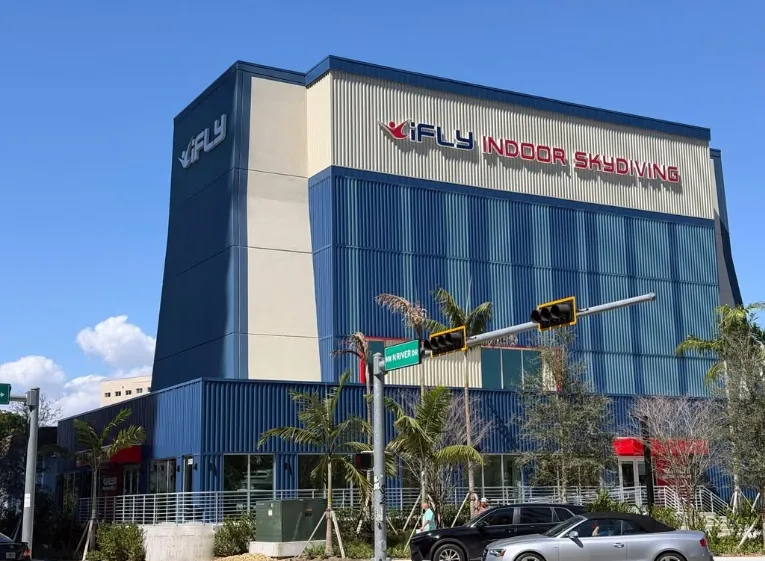
ACG installed impact-rated glazing at iFLY Miami, Wave Food Hall Cocoa Beach, and Villa L'Onz in Riviera Beach - three very different commercial businesses, all operating in wind-borne debris zones, all insured on the assumption that their envelopes will hold. That assumption is what makes the insurance math work.
Business Case #3 - Claims Avoidance
Commercial property insurance carries deductibles, and Florida hurricane deductibles are non-trivial - typically 2% to 5% of the insured value, structured as a percentage rather than a dollar amount.
A single major claim on a commercial property can also trigger non-renewal at the next renewal cycle, or a dramatic premium increase. A claim history also follows the building - it shows up in CLUE reports and underwriting questionnaires for years. Avoiding one claim over a building's service life is often worth the entire cost of impact glazing upgrade, before considering annual premium savings.
Business Case #4 - Property Valuation
Commercial appraisers increasingly price impact-rated envelope protection into market value. On a refinance, a building with full impact glazing typically supports a higher loan-to-value ratio because the lender's underwriter treats it as lower-risk. On a sale, institutional buyers and REITs specifically ask about envelope protection during due diligence - a building without impact glazing in a wind-borne debris zone is often priced lower, or the buyer negotiates a credit for the upgrade cost.
The quantified impact varies by market and asset class, but a credible range for Florida coastal commercial properties is 3-8% of appraised value differential between an impact-protected envelope and an unprotected one of equivalent size, condition, and location.
Why Commercial Doesn't Use Shutters
Florida code accepts hurricane shutters as an alternative to impact glazing for code compliance, but shutters rarely make operational sense for commercial buildings. Four reasons:
- Staff time. Deploying shutters on a 20,000 SF commercial building before a storm takes hours of staff labor, often at premium wage rates during an evacuation window. Doing it repeatedly each storm season is an operational burden.
- Storage. Removable shutters require dedicated storage space - square footage that a commercial building rarely has to spare. Fixed shutters (accordion, roll-down) are always visible and impact the building's aesthetic.
- Visibility and operations. A business with shutters down is closed. A business with impact glazing can potentially continue operating until mandatory evacuation, and reopen the moment the storm passes.
- Code nuances. Some commercial occupancies - healthcare, assisted living, certain educational uses - have code restrictions or AHJ preferences that make shutters problematic. Impact glazing has no equivalent restrictions.
Commercial impact glazing solves the storm protection requirement once, at construction, without ongoing operational cost.
What a Good Commercial Impact Spec Looks Like
For a typical Florida commercial building, a defensible impact glazing spec includes:
- Large Missile Impact (LMI) rated products tested to ASTM E1886/E1996 and/or TAS 201/202/203
- Current Florida Product Approval (FL) number for non-HVHZ locations, or current Miami-Dade NOA for HVHZ
- 9/16" laminated impact IGU with SGP interlayer on high-exposure or high-rise applications, PVB on standard applications
- Thermally broken aluminum framing with AAMA 2605 finish for coastal locations
- 304 or 316 stainless steel anchors per the NOA or FL product approval schedule
- Surface 2 low-E coating for solar heat gain control
- Manufacturer-backed 10-year seal warranty, 20-year finish warranty
This spec is what ACG installs as our default commercial impact package across Florida - HVHZ and non-HVHZ - from our West Palm Beach and Tampa offices. Review the ESWindows impact product line for the specific systems that meet this envelope.
Ready to get started?
ACG specifies and installs commercial impact glazing across Florida, with full NOA or FL documentation delivered as a standard bid package. Send plans and we'll price the impact scope inside 48 hours.