
Most commercial buildings in Florida already have security glass - it's called impact-rated laminated, and it is required by code. What most owners do not realize is that the baseline hurricane-rated glazing also provides a baseline level of forced-entry resistance. The question for a specific use case - cannabis dispensary, jewelry retailer, healthcare facility, government building, financial institution - is whether that baseline is sufficient, or whether the application calls for one of the three higher tiers of security glazing. This article walks through the real security glass hierarchy used in Florida commercial, with technical specifications, standard references, and honest pricing for each tier.

The Security Glass Hierarchy
Security glass is not a single product. It is a four-tier hierarchy, with each tier defeating a different level of threat and priced accordingly. The right specification depends on what you are actually protecting against - smash-and-grab retail theft is a different problem than an active-shooter scenario, and spending bullet-resistant money on a storefront that only needs forced-entry rating is waste. Here are the four tiers used in Florida commercial glazing, with the threat levels they defeat and the price points that come with them.
Tier 1: Impact-Laminated (Baseline)
Standard impact-rated laminated glass - the same product specified for hurricane compliance across Florida - provides baseline forced-entry resistance. Under ASTM E1886 and ASTM E1996 impact testing, the glass survives a 9-lb 2x4 traveling at 34 mph. Against a human attacker with hand tools, this translates to a first-layer deterrent. A rock, a brick, a hammer strike - the glass spiderwebs but holds in the frame, buying 30-90 seconds before the assembly can be breached. For retail, offices, and general commercial, this tier is the starting point and in many cases sufficient.
See our detailed walkthrough of commercial impact window requirements for the baseline hurricane code context.
Tier 2: Security-Laminated (Enhanced)
Tier 2 uses thicker PVB interlayers or upgraded SentryGlas (SGP) ionoplast interlayers. SentryGlas is roughly 100 times stiffer and five times stronger than standard PVB. The glass remains transparent and looks identical to standard laminated, but defeats sustained tool attack for 3-5 minutes instead of 30-90 seconds. Common builds are 5/16-inch tempered + 0.090-inch SGP + 5/16-inch tempered, or double-laminated constructions that push through 1 inch total thickness.
Use cases: jewelry, high-end retail, cannabis dispensaries (where Florida state and local law mandates security glazing at all perimeter openings), pharmacies handling controlled substances. See our Miami-Dade commercial glazing guide for jurisdiction-specific cannabis retail requirements.
Tier 3: Forced Entry Rated (UL 972)
UL 972 "Burglary Resisting Glazing Material" is a formal attack test - trained test technicians attempt to breach the assembly with prescribed tools for a prescribed duration. Passing glazing is rated for 5-minute, 15-minute, or 60-minute attack resistance. The assemblies typically combine laminated glass with bonded security film, reinforced framing, and tamper-resistant hardware.
Use cases: bank teller areas, cash-handling vestibules, government reception, pharmacy narcotics storage, cannabis dispensary back-of-house.
Tier 4: Ballistic Rated (UL 752)
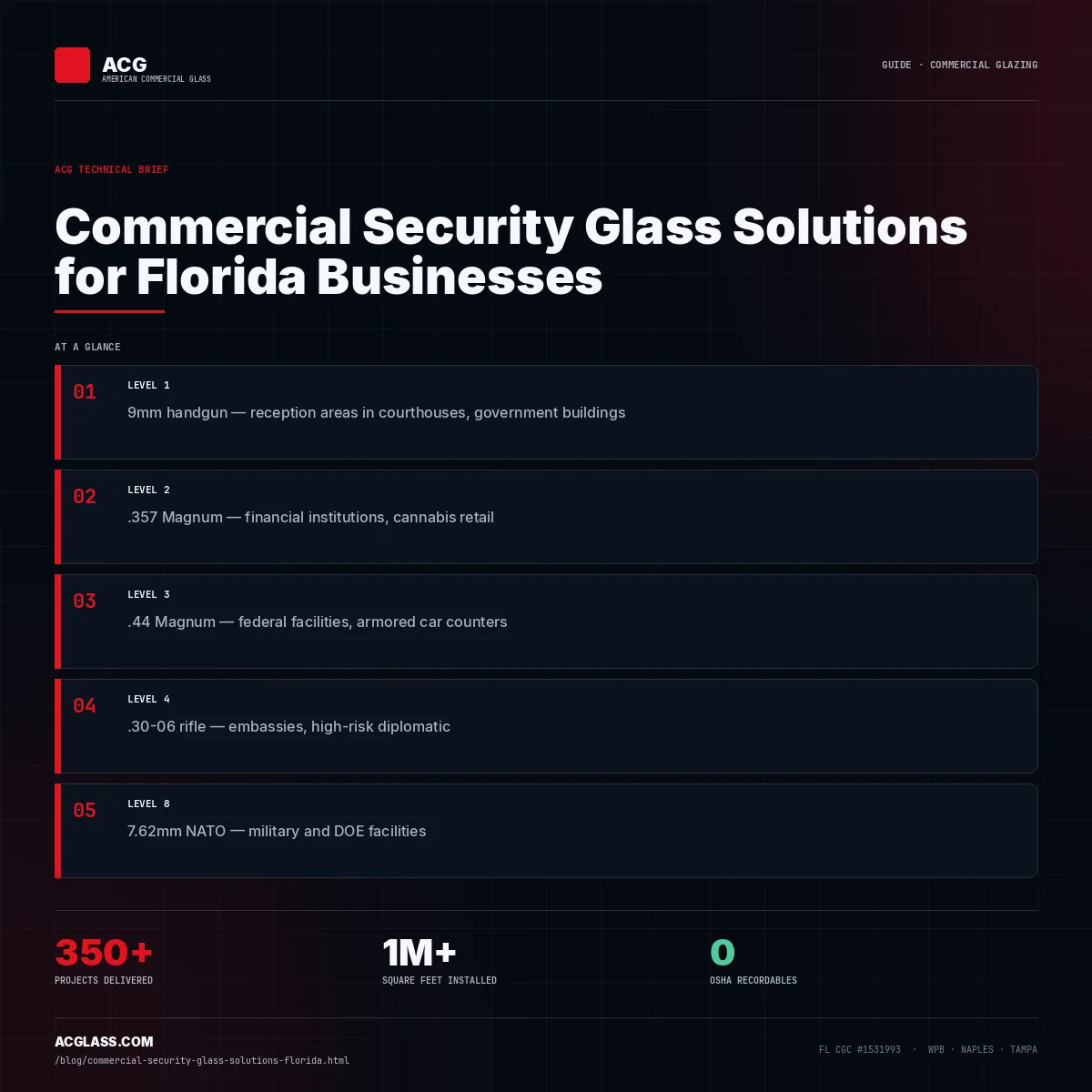
UL 752 "Bullet-Resisting Equipment" defines 8 levels of ballistic protection, from Level 1 (small handgun) to Level 8 (high-powered rifle). Common commercial ratings:
- Level 1: 9mm handgun - reception areas in courthouses, government buildings
- Level 2: .357 Magnum - financial institutions, cannabis retail
- Level 3: .44 Magnum - federal facilities, armored car counters
- Level 4: .30-06 rifle - embassies, high-risk diplomatic
- Level 8: 7.62mm NATO - military and DOE facilities
Ballistic glass is thick (1 to 2.5 inches), heavy (15-35 PSF), and requires completely different framing, anchorage, and structural substrate reinforcement. The frames must defeat the threat as well - a bullet-resistant window in a standard aluminum frame is a facade, not a solution.
| Security Tier | Rating Standard | Threat Defeated | Installed Cost Range |
|---|---|---|---|
| Tier 1: Impact Laminated | ASTM E1886/E1996, TAS 201/202/203 | Rocks, brick, baseball bats | By scope |
| Tier 2: Security Laminated (SGP) | Enhanced impact + tool resistance | Hand tools for 3-5 min | By scope |
| Tier 3: UL 972 Forced Entry | UL 972 (5/15/60 min) | Power tools per rating duration | By scope |
| Tier 4 Level 1-3: Ballistic | UL 752 Level 1-3 | Handgun threats | By scope |
| Tier 4 Level 4+: Ballistic | UL 752 Level 4-8 | Rifle threats | By scope |
Florida-Specific Use Cases
Cannabis Dispensaries
Florida state and local regulations require security glazing at all perimeter openings in licensed medical cannabis dispensaries. The typical spec is Tier 2 security-laminated for customer-facing storefront, with Tier 3 (UL 972 15-minute) at vault and back-of-house openings. Frame anchorage must match the glass - no point installing security glass into a residential-grade frame.
Jewelry and Luxury Retail
Insurance carriers often require minimum UL 972 5-minute rating for jewelry display windows. Many high-end jewelers go to UL 972 15-minute. The glass should be within reach of display cases so it factors into the first line of defense.
Healthcare and Behavioral Health
Behavioral health units, emergency departments, and psychiatric facilities often specify security-laminated (Tier 2) on interior partitions and patient room windows to resist self-harm attempts. This is a different use case than theft prevention - the glass must hold under sustained human-force impact without fragmenting.
Government and Financial
Federal courthouses, state government reception, financial institution teller lines - Tier 3 UL 972 at minimum, with Tier 4 ballistic at specific threat positions (transaction counter, sally port).
Framing and Installation Differences
One of the most common specification errors we see is security-rated glass installed into standard commercial framing. The glass may be rated, but the frame, anchors, and rough-opening attachment are not. An attacker who cannot breach the glass will simply attack the frame-to-substrate connection.
Proper ballistic and forced-entry installations use:
- Reinforced steel or aluminum-clad steel frames with wall thickness matched to the threat level
- Through-bolted anchorage to structural substrate (not just masonry screws into CMU face shells)
- Security glazing tape and structural silicone rather than standard dry glazing gaskets
- Tamper-resistant fasteners on exterior-accessible hardware
The frame and anchor package can cost as much as the glass on ballistic projects. Any contractor pricing Tier 3 or Tier 4 glazing without line-item framing and anchorage allowances is missing half the scope.
How to Spec Security Glass Correctly
The right process starts with a security assessment rather than a product selection. What is the threat? What is the acceptable response time? What is the insurance-mandated rating? Once those are defined, the glazing tier follows directly.
For most Florida commercial projects, Tier 1 (impact-laminated) is already installed as baseline to meet hurricane code. The question is whether the use case justifies stepping up. ACG typically works through this with the design team and owner, referencing the insurance carrier's requirements, the local AHJ, and the specific threat model. For cannabis retail in particular, local municipal ordinances vary significantly - Miami-Dade is stricter than most counties, and getting the spec right requires reading the local ordinance, not just the state statute.
Explore system options on our commercial storefront systems page, and see how we handle complex impact + security scopes on projects like Harbour Cay II in Fort Pierce and Bobcat of Treasure Coast.
Ready to get started?
ACG is a CGC-licensed Florida commercial glazing subcontractor (CGC1531993) headquartered in West Palm Beach. Commercial Division 08 scope, statewide. Send plans and we return a detailed scope with system recommendations and 2026 pricing inside 48 hours.