
Florida projects run higher - especially in the High Velocity Hurricane Zone (HVHZ). Here's what drives that number and how to budget accurately.
The Quick Answer: Curtainwall Cost Ranges
There is no single number for curtainwall cost. It depends on the system type, building height, glass selection, wind requirements, and your location. But here are realistic ranges for most Florida commercial projects:
| System Type | Cost Range (Installed) | Best For |
|---|---|---|
| Stick-built, standard | By scope | Low-rise, budget projects, smaller facades |
| Stick-built, Florida HVHZ | By scope | Miami-Dade/Broward impact-rated projects |
| Unitized, standard | By scope | Mid-rise and high-rise, repetitive bays |
| Unitized, Florida HVHZ | By scope | High-rise in Miami-Dade/Broward |
| Custom / specialty | By scope | Complex geometry, custom profiles, high-end facades |
These are fully installed costs - materials, fabrication, labor, engineering, and glazing. They do not include structural steel embeds, HVAC integration, or facade engineering fees.
Stick-Built vs Unitized: What's the Difference?
Stick-Built Curtainwall
Stick-built curtainwall is assembled on the building, one piece at a time. Installers attach horizontal and vertical framing members (called "sticks") to the structure, then set glass or spandrel panels into the frames.
Stick-built costs less in material but more in labor. Each joint is made in the field, which takes time - especially on tall buildings where scaffold time is expensive. Quality depends heavily on installer skill.
Stick-built makes sense for:
- Low-rise buildings (under 6 stories)
- Projects with irregular bay spacing
- Renovation work where access is limited
- Smaller facade areas (under 5,000 SF)
Unitized Curtainwall
Unitized curtainwall is factory-assembled in panels. Each panel arrives at the job site pre-glazed and ready to hang. Panels stack on each other and interlock - installation is much faster than stick-built.
The panels cost more to fabricate. But on tall buildings, the reduced scaffold time and faster installation cycle often make unitized more cost-efficient overall. A 20-story building with unitized curtainwall can be glazed in weeks. The same facade in stick-built could take months.
Unitized makes sense for:
- High-rise projects (6+ stories)
- Repetitive, regular bay patterns
- Projects with tight schedules
- Large facade areas (10,000+ SF)
For a deeper technical look at curtainwall systems, see our guide on what is a curtainwall system.
What Drives Curtainwall Cost Up
1. Building Height
Every additional story adds cost. Higher buildings require more wind pressure design, more robust anchors, and more complex installation logistics. Scaffold, crane time, and safety requirements all increase with height.
2. Florida Wind Load Requirements
Florida has the most demanding wind load requirements in the continental U.S. Buildings in Wind Zone 4 (coastal areas) and the HVHZ require systems engineered for 150+ mph wind speeds. This means heavier extrusions, more anchors, and impact-rated glass - all of which add cost.
The HVHZ premium is real.
3. Glass Selection
Your choices matter:
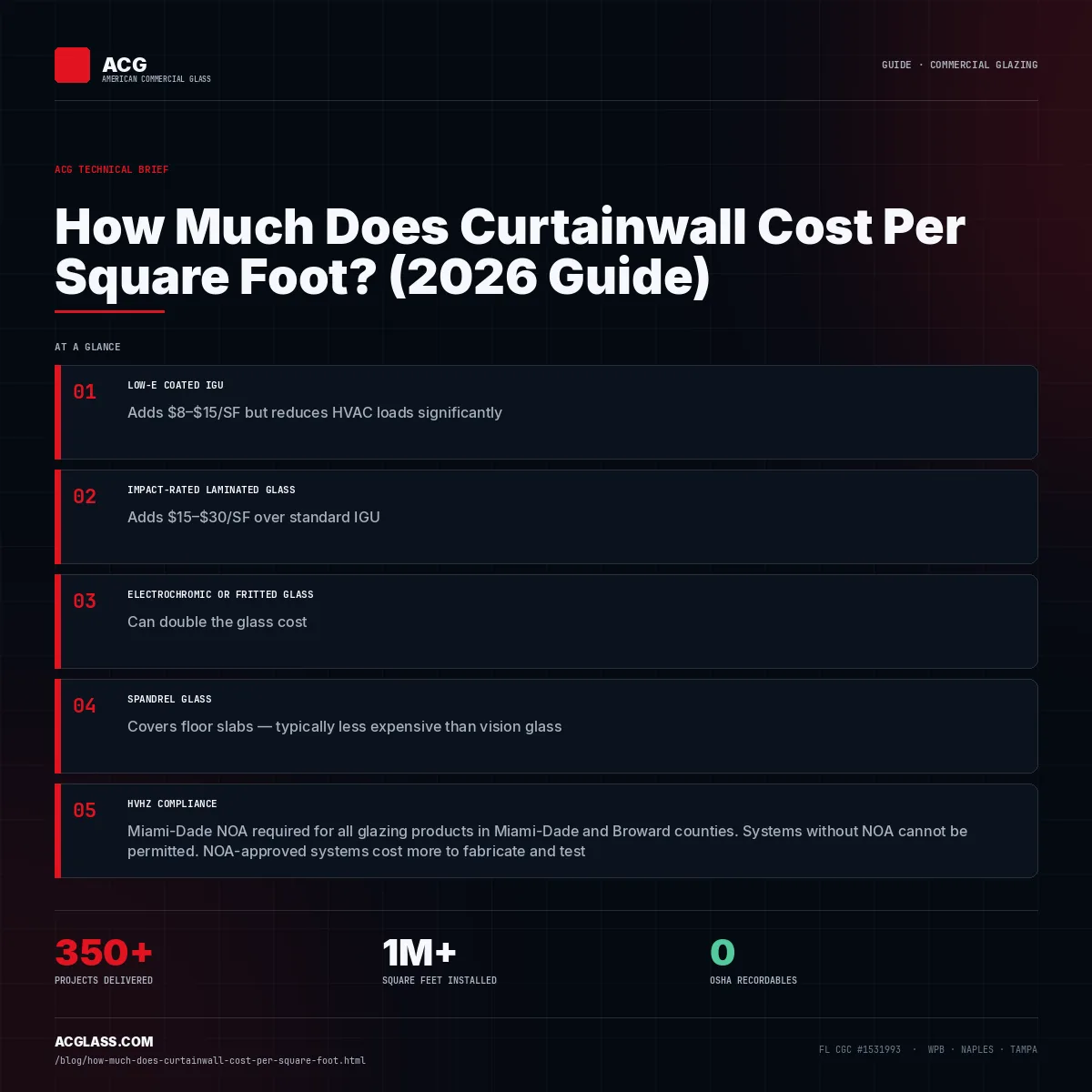
- Standard IGU (insulating glass unit): Baseline cost
- Electrochromic or fritted glass: Can double the glass cost
- Spandrel glass: Covers floor slabs - typically less expensive than vision glass
4. Custom Profiles and Finishes
Standard curtainwall comes in mill finish aluminum or two-coat painted finishes (Kynar 500).
5. Thermal Performance Requirements
Standard aluminum curtainwall is a thermal bridge. Florida energy code (ASHRAE 90.1) requires thermal performance criteria that most projects in South Florida now meet with thermally broken systems.
Florida-Specific Cost Factors
Florida projects face several cost drivers that don't apply in other states:
- HVHZ compliance: Miami-Dade NOA required for all glazing products in Miami-Dade and Broward counties. Systems without NOA cannot be permitted. NOA-approved systems cost more to fabricate and test.
- Impact glass everywhere: Even outside HVHZ, Florida's wind zone map means most coastal commercial buildings need impact-rated glass. Impact laminated glass is standard on most Florida curtainwall projects.
- Salt air exposure: Coastal projects need premium sealants, aluminum with better anodizing, and stainless fasteners to resist corrosion.
- Thermal movement: Florida's heat drives significant thermal expansion and contraction. Sealant systems and joint details must accommodate this movement - especially on west and south facades.
For a comparison with storefront systems (a common alternative for lower floors), see our article on storefront vs curtainwall - when to use which.
How to Get an Accurate Curtainwall Budget Number
The most accurate budget comes from sending plans to a qualified curtainwall contractor early. A good contractor can give you a detailed estimate - not just a per-SF number - that accounts for your specific conditions.
When budgeting early (before design development), use these rules of thumb:
Use our scope engine to start the budgeting conversation. Or reach out directly for a detailed estimate on your project.