
General contractors in Tampa Bay are running a competitive subcontractor selection process in a market that has changed materially since Hurricane Ian in 2022 and Hurricane Milton in October 2024. The glazing package - Division 08 on most specs - is not a commodity buy. The wrong commercial glazier on a Westshore office build or a Water Street Tampa mixed-use project costs you schedule, RFIs, and re-inspection fees that far exceed any savings on the initial number. This guide covers every meaningful evaluation criterion, from Florida licensing mechanics to Procore discipline to product partnerships, written for GCs and owners who need to get the glazing sub selection right the first time.
Why Commercial Glazing in Tampa Bay Is Different From South Florida
Tampa Bay - Hillsborough, Pinellas, Pasco, Polk, and Hernando counties - operates under a distinct set of wind code requirements that differ in important ways from South Florida. Miami-Dade and Broward are in the High Velocity Hurricane Zone (HVHZ), which imposes its own Miami-Dade Notice of Acceptance (NOA) product approval pathway on top of the Florida Building Code. Tampa Bay is not in the HVHZ - but that does not mean wind requirements are relaxed.
Tampa Bay projects must comply with the Florida Building Code 8th Edition, which aligns with ASCE 7-22 wind loading provisions. Design wind speeds in Hillsborough County run 130-140 mph at the coast, and projects within 1,500 feet of open water must be classified under Exposure Category D - the most demanding exposure category - rather than the Exposure Category C that applies further inland. The aftermath of Hurricane Ian (2022) and Hurricane Milton (2024) has sharpened jurisdictional enforcement attention on envelope compliance across the entire Gulf Coast region. Inspectors in Tampa, St. Pete, Clearwater, and Pinellas Park are not processing glazing work on a rubber-stamp basis anymore.
A commercial glazier who primarily operates in HVHZ markets and "covers" Tampa Bay as overflow work brings the wrong product approval pathway instincts. A residential-focused contractor who occasionally picks up commercial work brings no Division 08 instincts at all. A commercial storefront installer in Tampa requires a sub whose default operating mode is Florida Building Code 8th Edition commercial - not an adaptation of some other workflow.
The Tampa Bay market is also in the middle of an extended construction cycle. Downtown Tampa, the Water Street Tampa district, Westshore, Channelside, Ybor City, and St. Pete's downtown and Beach Drive corridors are all active. Suburban growth in Wesley Chapel, Plant City, and the Gateway area in Pinellas is generating significant light commercial and retail volume alongside the high-profile urban projects. The GCs active here - Skanska, Ajax Building Corp, Williams Company, Beck Group, Brasfield & Gorrie, DPR, Ripa, Choate, Creative Contractors - are operating sophisticated project management environments and expect their subs to match.
Licensing: The Table Stakes (and the Trick)
Florida has two distinct license categories relevant to commercial glazing contractors. Understanding the difference matters when you are reviewing a sub's qualification package.
A Florida Certified Glazing Contractor (CG) license - issued by the Florida DBPR - authorizes the holder to contract for glazing work and pull glazing permits. It is a specialty contractor license. Most glazing subcontractors hold a CG license, and for most commercial glazing scopes, it is sufficient to operate legally in Florida.
A Florida Certified General Contractor (CGC) license is a broader credential that authorizes the holder to perform, contract, and supervise construction projects across a wider scope. A CGC-licensed glazing company has passed the full general contractor examination, met the financial stability requirements, and holds the bonding that comes with a general contractor classification. It signals a more institutionalized operation.
The practical implication: a CGC-holding glazier can take on broader project delivery responsibility, interface with permitting authorities on a wider scope of questions, and handle project administration at a level that matches what GCs expect from capable subs. ACG holds CGC #1531993. Verify any license number at the Florida DBPR licensee search before contracting.
The trick to watch for: some contractors list a license number on their letterhead that belongs to an individual qualifier, not the company. If the qualifier leaves, the license is in jeopardy. Confirm the license is held in the company's name, or that the qualifying agent is a current, active employee with documented continuity.
Local Presence Matters More Than You Think
When a glazing sub is driving two hours round-trip from outside the Tampa Bay market to reach your site, the project economics shift in ways that do not show up in the initial number. Crew mobilization becomes a daily friction cost. Punch-list and callback response times extend. Attendance at weekly OAC meetings becomes sporadic or remote-only. Pre-construction coordination with the city building department, inspectors, and the glazing system manufacturer's representative takes longer because the sub has no established local relationships.
Out-of-market contractors frequently price Tampa Bay work to cover their mobilization costs and time - which means their number is not actually lower-priced on a true lifecycle basis. When a project requires an emergency field response - a broken light during installation, a failed inspection, a last-minute RFI requiring an on-site walk - an out-of-market sub adds a day or more of delay that a Tampa-based crew resolves the same afternoon.
ACG maintains a Tampa office alongside its West Palm Beach headquarters and Naples office. Three-office coverage means projects in Hillsborough, Pinellas, Pasco, and Polk counties are handled by Tampa-based crew and project management - not a satellite team driving in from the coast. For GCs running multiple concurrent Tampa Bay projects, that depth of local presence is a material operational advantage.
Product Partnerships: What to Ask About
The commercial glazing product landscape is not flat. There are meaningful quality and specification differences between system manufacturers, and the quality of a sub's relationship with a manufacturer affects product availability, lead time reliability, and technical support on complex openings.
For commercial storefront - the aluminum-framed glass systems that make up the majority of Tampa Bay commercial glazing volume - ESWindows is the relevant benchmark. ESWindows produces the ES-8000 series and related commercial storefront systems that are specced on a significant share of Florida commercial projects. Their products carry Florida Product Approval (FPA) documentation and are engineered for FBC 8th Edition compliance across Tampa Bay exposure categories.
ACG is a top ESWindows installer in Florida. That relationship means consistent product availability, direct manufacturer technical support on complex openings, and the ability to provide accurate submittals with current FPA data - not general product approval references from a manufacturer the sub rarely works with. For GCs whose specs call out ESWindows systems, having a sub with a direct manufacturer relationship shortens the submittal cycle and reduces the risk of product substitution requests mid-project. See our manufacturer partnerships page for the full picture of product relationships.
Beyond storefronts, ask any commercial glazier sub about their relationships with commercial window wall and curtainwall system manufacturers if your project involves those systems. The question is not whether they can source the product - anyone can submit an order. The question is whether they have the installation experience and manufacturer support to execute correctly under your project schedule.
Commercial vs Residential: How to Tell the Difference
Florida's construction market includes a large number of contractors who operate primarily in the residential sector and occasionally pursue commercial projects when residential volume softens. For a GC, awarding commercial glazing work to a residential-focused shop creates compounding problems.
Residential glaziers work from approved contractor lists, install products by reference to a window tag, and interface primarily with homeowners and building officials on single-family permit sets. Commercial glaziers work from Division 08 specifications, submit shop drawings for engineer of record review, track RFIs and submittals in a construction management platform, coordinate with curtainwall and door hardware suppliers, and close out with a documentation package that supports final inspection and warranty records.
The fastest diagnostic: ask for a list of the sub's last 20 projects with project type and GC contact. A commercial-only shop will list office buildings, retail centers, hotels, schools, and institutional projects - with GC references from companies like those named above. A residential shop doing commercial on the side will have a mixed list, often with a handful of small commercial projects and many single-family or multifamily residential entries. ACG’s project history is exclusively commercial - zero residential work - and the entire operation is built around Division 08 commercial delivery. See our full capabilities for the scope of commercial systems we install.
Past Performance: Commercial-Only References
References matter most when they are from comparable project types, comparable GCs, and recent enough to reflect the sub's current team and operations. For Tampa Bay commercial glazing projects, the reference standard should be: commercial projects in Tampa Bay or comparable Florida markets, completed within the last 24-36 months, with a GC project manager or superintendent willing to speak to schedule performance, documentation quality, and field execution.
Specific questions to ask references:
- Did the sub meet the glazing milestone dates on the schedule, or were they a contributing factor to schedule delay?
- How did they handle RFIs and submittals - were responses timely and technically complete?
- Did they manage field issues (broken glass, installation defects, weather-related delays) proactively or reactively?
- Would you use them again on a comparable project?
- Who were the key personnel on the project, and are those same people still with the company?
Personnel continuity matters. A sub who delivers a strong reference list on the strength of a project manager who has since left is a different animal from a sub where that PM is still active and would be assigned to your project.
Systems and Documentation
Commercial glazing projects generate significant documentation: shop drawings, product data submittals, Florida Product Approval references, substitution requests, field test reports, installation certifications, warranty documentation, and close-out packages. GCs and owners need this documentation to close permits, support insurance underwriting, and defend warranty claims.
A sub without organized documentation systems is a liability. The failure modes: submittal packages that come back from the EOR repeatedly for revision, missing FPA documentation that holds up inspection, close-out packages that are incomplete at substantial completion and require weeks of follow-up to assemble.
For Tampa Bay projects involving commercial impact windows, the documentation requirements include Florida Product Approval numbers tied to the specific product, installation configuration, and opening size - not generic manufacturer approvals. A glazier who understands this requirement and submits correctly the first time saves the project weeks of back-and-forth with the building department. Our approach to hurricane-rated glazing documentation is detailed further in our hurricane preparation and commercial impact glass guide.
Schedule Performance and Procore Discipline
Glazing is typically on the critical path of a commercial project's envelope closure schedule. Delayed glazing means delayed MEP rough-in, delayed drywall, delayed interior finishes. A glazing sub who misses their installation window by two weeks can push substantial completion by four to six weeks when the cascade effects work through the schedule.
The best predictor of schedule performance is not the sub's verbal assurance in a pre-bid meeting. It is their track record on comparable projects, their current backlog relative to their crew capacity, and their visibility into your specific project schedule from day one of pre-construction. A sub who does not engage on schedule development until NTP is a schedule risk.
Most mid-to-large Tampa Bay GCs - including the names listed above - manage project documentation in Procore. Active, disciplined use of Procore by a glazing sub means: RFI responses submitted and tracked within the platform, submittal logs current and complete, daily logs consistent, and punch list items documented and closed on schedule. ACG is active in Procore across multiple current projects with the general contractor, Proctor, and Curran Young, among others. That active presence means GC project teams are not chasing documentation from a sub who operates outside the platform.
BuildingConnected and BasisBoard are the dominant bid management platforms in the Tampa Bay commercial market. A sub who is active on both platforms - maintaining current company information, responding to bid invitations promptly, and submitting complete bid packages - signals an organized, commercially-focused operation. Subs who are difficult to find on bid platforms or who require manual outreach to engage on new opportunities are typically lower-volume operations.
Bonding, Insurance, and Bid Capacity
For any glazing project above a modest size threshold, GCs need to see evidence that the sub can back their work financially. The relevant documents:
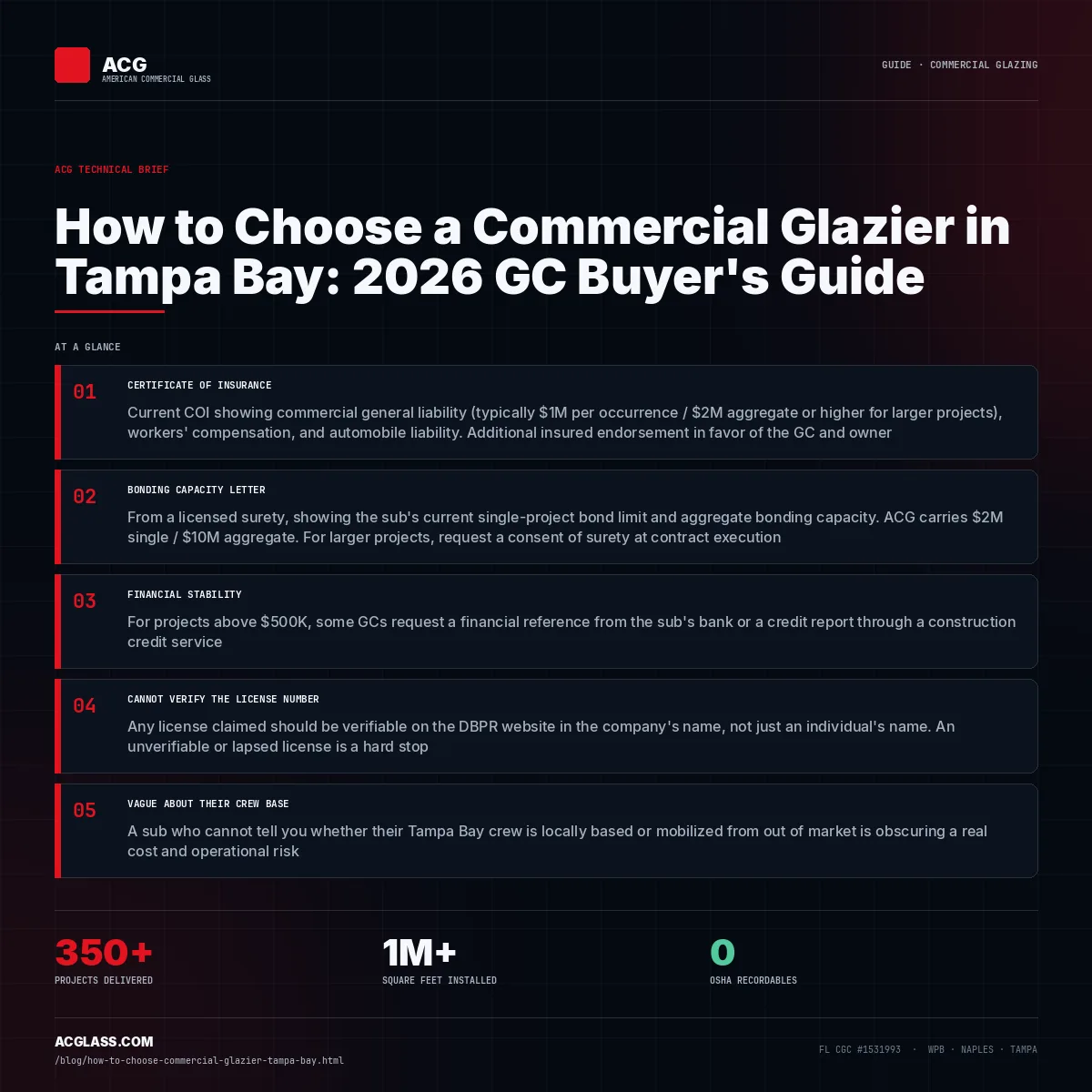
- Certificate of Insurance: Current COI showing commercial general liability (typically $1M per occurrence / $2M aggregate or higher for larger projects), workers' compensation, and automobile liability. Additional insured endorsement in favor of the GC and owner.
- Bonding capacity letter: From a licensed surety, showing the sub's current single-project bond limit and aggregate bonding capacity. ACG provides bond capacity letters during prequalification. For larger projects, request a consent of surety at contract execution.
A sub who cannot produce a current bonding capacity letter is either too small for the project scope, has a claims history that has restricted their surety access, or is not organized enough to maintain current surety relationships. Any of those is a disqualifying signal for a project above the small-project threshold.
The relationship between bonding capacity and bid capacity is also worth noting. Confirm that the sub's stated bonding capacity actually covers the project scope before you invest in a full pre-qualification review.
The Full Checklist: Choosing a Tampa Bay Commercial Glazier
| Requirement | Why It Matters | ACG's Answer |
|---|---|---|
| Florida CGC License | Full general contractor license, not just specialty | CGC #1531993 |
| Commercial-only focus | Residential shops don't understand Division 08 | Exclusively commercial, zero residential |
| Tampa office | Local presence beats driving in | Tampa + West Palm Beach + Naples |
| ESWindows partnership | Flagship commercial storefront product | Top ESWindows installer in Florida |
| Bonding capacity | GCs need to see it | Capacity letter available at prequalification |
| Procore active | Modern GC workflow requirement | the general contractor, Proctor, Curran Young all live |
| BuildingConnected / BasisBoard | Bid intake systems | Both active |
| Owner accountability | Owner-level decision-maker reachable | Connor Walsh (President), Rielly Walsh (CEO) |
Red Flags to Watch For
After reviewing dozens of glazing sub qualification packages in the Tampa Bay market, these are the patterns that consistently signal elevated project risk:
- Cannot verify the license number: Any license claimed should be verifiable on the DBPR website in the company's name, not just an individual's name. An unverifiable or lapsed license is a hard stop.
- References are all residential or more than three years old: The sub's commercial project history should be current and verifiable. Outdated references often indicate the company has changed significantly - in personnel, volume, or focus - since the referenced project.
- Vague about their crew base: A sub who cannot tell you whether their Tampa Bay crew is locally based or mobilized from out of market is obscuring a real cost and operational risk.
- No Procore presence or resistance to using it: If the GC's project is being managed in Procore and the sub resists platform participation, every documentation exchange for the duration of the project will be manual, delayed, and incomplete.
- Bonding capacity does not match project scope: As discussed above. Confirm the surety letter is current and the limit covers the full contract value.
- Cannot name their primary storefront manufacturer relationship: A commercial glazier who is not specific about which manufacturer they primarily work with on storefront systems has no meaningful manufacturer partnership - just whoever can ship fastest at any given moment.
- Mixes up FBC and HVHZ requirements: Tampa Bay is not in the HVHZ. A sub who talks about Miami-Dade NOA requirements for a Hillsborough County project does not understand the applicable code path and will generate incorrect submittals.
Related reading: our article on what makes a reliable commercial glass company in Florida covers the operational and financial signals in more depth.
Questions Every Tampa Bay GC Should Ask
The following questions, asked consistently across competing glazing subs, will surface meaningful differentiation in a pre-qualification or bid leveling process:
- What is your Florida CGC or CG license number, and in whose name is it held? (Verify on DBPR.)
- How many of your last 20 completed projects were commercial - not residential, not mixed-use residential - and what were the GC names?
- Do you have a Tampa-area office, or will your crew be mobilizing from outside the market?
- What is your current bonding capacity - single project and aggregate - and can you provide a current surety letter?
- Are you active in Procore? Who on your team handles RFI and submittal management in the platform?
- What is your primary commercial storefront manufacturer relationship, and what is your current lead time from that manufacturer for a typical storefront package?
- What is your current backlog relative to your crew capacity? Are you in a position to commit to our schedule milestones?
- Who will be the project manager and superintendent on this job, and what is their direct contact information?
- Describe how you handle Florida Product Approval documentation for a storefront submittal package.
- Can you provide three GC references from Tampa Bay commercial projects completed in the last 24 months, with direct PM or superintendent contacts?
A fully qualified Tampa Bay commercial glazier should answer every one of these questions specifically and without hesitation. Vague answers, deflection, or requests to follow up after the meeting on basic qualification questions are informative data points in themselves.
For a deeper look at how commercial glazing investment translates to property value, see our analysis of how commercial glass upgrades increase Florida property value. For information on ACG's full Florida commercial impact window and door product range, see our impact windows and doors page.
ACG: Tampa Bay's Commercial Glazing Sub of Record
American Commercial Glass is a CGC-licensed Florida commercial glazing subcontractor (CGC #1531993) with five years of continuous commercial delivery across Florida. We operate from our West Palm Beach headquarters with Tampa-based crews and project management serving Hillsborough, Pinellas, Pasco, and Polk counties.
Our Tampa Bay work covers the full commercial glazing scope: ESWindows commercial storefront, commercial impact windows for Tampa projects, window wall, curtainwall, fire-rated glazing systems, and entry systems. We are active in Procore, BuildingConnected, and BasisBoard. We provide performance and payment bonds on projects that require them. Connor Walsh (President) and Rielly Walsh (CEO) are directly reachable on every project - there is no layer of sales intermediaries between our ownership and your project team.
Send plans and we return a detailed scope with system recommendations and current 2026 pricing inside 48 hours. No chasing, no ghosting.