
Glare complaints are the most common post-occupancy complaint on any Florida commercial building with large glazed areas. Office tenants report screen glare mid-morning and mid-afternoon. Retail tenants report customer squinting at the sales floor perimeter. Restaurant tenants report uncomfortable seating in the sun belt along west-facing glass. Hospitality tenants report pool-facing rooms that are unusable in late afternoon. Every one of these is solvable with the right glass spec - and the right spec doesn't mean a dark, reflective building that feels like a bunker at night. This article breaks down the three types of glare, the four glass-level solutions, and the failure modes that happen when glare control goes too far in either direction.

Three Types of Commercial Glare
1. Direct Glare
Direct sun hitting the glass and transmitting into the space. On west- and south-facing exposures in Florida, this is the dominant type. Direct glare peaks when the sun angle is low - morning on east exposures, afternoon on west exposures, and winter midday on south exposures. Retail and office occupants at the perimeter experience this as squinting, screen washout, and uncomfortable warmth on skin even when HVAC is keeping air temperature in range.
2. Reflected Glare
Glass facades reflecting sun off nearby buildings or water features. In dense urban markets like downtown Miami, downtown Tampa, and Brickell, this is a significant issue - the tower next door becomes a giant mirror at certain sun angles and the street-level retail or office floors behind it experience intense secondary glare. Reflected glare is often more intense per square foot than direct glare because the reflecting glass is already filtering out some of the atmospheric diffusion.
3. Contrast Glare
The difference between the bright exterior and the dim interior that makes the glass line feel like a slab of white light. This is what hits office workers looking at a screen in front of a window - the screen is 150 cd/m² and the window field behind it is 3,000-5,000 cd/m². The eye can't adapt to both and visual fatigue builds fast. Contrast glare is solvable by either darkening the exterior view (reducing VT) or brightening the interior (adding ambient light) - most commercial solutions do a bit of both.
Four Glass-Level Solutions for Glare
Option 1: Low-VT (Reduced Visible Transmittance) Glass
The most direct approach. Standard clear laminated IGU runs around 70-75% VT. Reducing VT to 35-50% cuts transmitted light proportionally and knocks down glare correspondingly. Common spec: 9/16 inch laminated with a solar control low-E coating like Guardian SN 68 (VT 68%), SNX 62/27 (VT 62%), or a tinted laminated like Gray or Bronze at VT 30-45%. Low-E can help because the coating also cuts IR, which reduces the surface temperature of the glass itself and reduces contrast glare.
The tradeoff is daylight. Florida commercial projects often pursue daylight harvesting strategies for energy code compliance - the Florida Building Code, Energy Conservation, 8th Edition, awards prescriptive credit for high VT at fenestration - and dropping VT below 45% starts to work against those credits. Going below 30% VT typically produces the "bunker" effect where the building reads as dark from outside at night because interior lights don't compete with the glass density.
Option 2: Exterior Sunshades
Architectural shading devices - horizontal fins on south exposures, vertical fins on east/west exposures, or deep overhangs - block direct sun from hitting the glass in the first place. Effective on new construction where the architect can design the shading into the facade. On existing buildings, retrofit exterior shades are feasible but often prohibitively expensive relative to glass replacement.
Shading doesn't reduce VT on the glass, so daylight during diffuse-sky conditions is preserved. Combined with a moderate low-E coating on the glass, shading can deliver excellent glare control without dark glass.
Option 3: Frit or Ceramic Patterns
Ceramic frit patterns - dot arrays, horizontal striations, or custom graphics fired into the glass surface - break up transmitted light and reduce glare without dropping VT uniformly. Common applications: curtainwall spandrel zones, upper floor offices where bird-strike risk is a concern, and high-design retail. Frit density controls how much light is blocked: a 30% coverage dot pattern cuts VT by around 30% but appears visually as a subtle texture rather than a dark film.
Option 4: Low-Iron Glass for Clarity Without Color Shift
Low-iron glass (Starphire, Optiwhite, Guardian UltraClear) removes the green cast that standard float glass has when viewed at oblique angles. On its own it doesn't reduce glare - in fact, higher VT means slightly more transmitted light - but it matters for perceived glare. When combined with a solar control low-E and moderate tint, low-iron preserves the ability to see accurate colors through the glass while still cutting IR and UV. Premium retail and museum-adjacent work uses low-iron for exactly this reason.
Applied Films: The Retrofit Option
On existing buildings where replacing the glass is not feasible, applied third-party films from 3M, Llumar, Solar Gard, and Huper Optik can retrofit glare control at a fraction of glass replacement cost. Typical film specs drop VT by 20-60%, reduce solar heat gain meaningfully, and come with 5-10 year warranties. See the companion article on how tinting affects commercial glass performance for the film-specific tradeoffs and thermal stress risks.
Glare Control Comparison Table
| Solution | VT Reduction | SHGC Impact | Cost Adder | Best Use |
|---|---|---|---|---|
| Standard low-E IGU | Moderate (to ~65% VT) | Significant (0.30-0.40) | Base | Every commercial project baseline |
| Tinted laminated | Strong (to 30-50% VT) | Significant | By scope | West/south exposures, office |
| Ceramic frit pattern | Moderate (pattern dependent) | Moderate | By scope | Curtainwall, spandrel, design-driven |
| Exterior sunshades | None (on glass itself) | Strong (direct sun blocked) | By scope | New construction, architect-designed |
| Low-iron base glass | Slight increase | Neutral | By scope | Premium clarity with other controls |
| Applied film (retrofit) | Variable (20-60%) | Moderate to strong | By scope | Existing buildings, no glass replacement |
Three Common Glare Failure Modes
Failure Mode 1: Going Too Dark
A 20% VT mirror-tinted building solves glare at the occupant but looks dark and uninviting from outside. At night, interior lights struggle to compete with the glass density, and the facade reads as a void. Retail tenants especially hate this because passing foot traffic can't see into the shop. The fix is to cap VT reduction at around 40-50% and use frit or sunshades for the rest of the glare control budget.
Failure Mode 2: Mirror Effect at Night
Highly reflective glass - exterior reflectance above 25% - acts as a mirror from inside at night when interior lights are on. Office occupants see their own reflection instead of the city view they paid for. The fix is to specify a glass with lower exterior reflectance (below 15%) and rely on low-E coating placement to manage solar heat rather than reflectivity.
Failure Mode 3: Solving Glare, Creating Solar Heat
Tinted non-low-E glass absorbs solar energy and re-radiates it as heat into the interior. Glare drops but SHGC increases. The fix is to pair any tint with a low-E coating on surface 2 of the IGU - the standard commercial spec - which reflects IR before it gets absorbed.
Exposure-Specific Recommendations for Florida
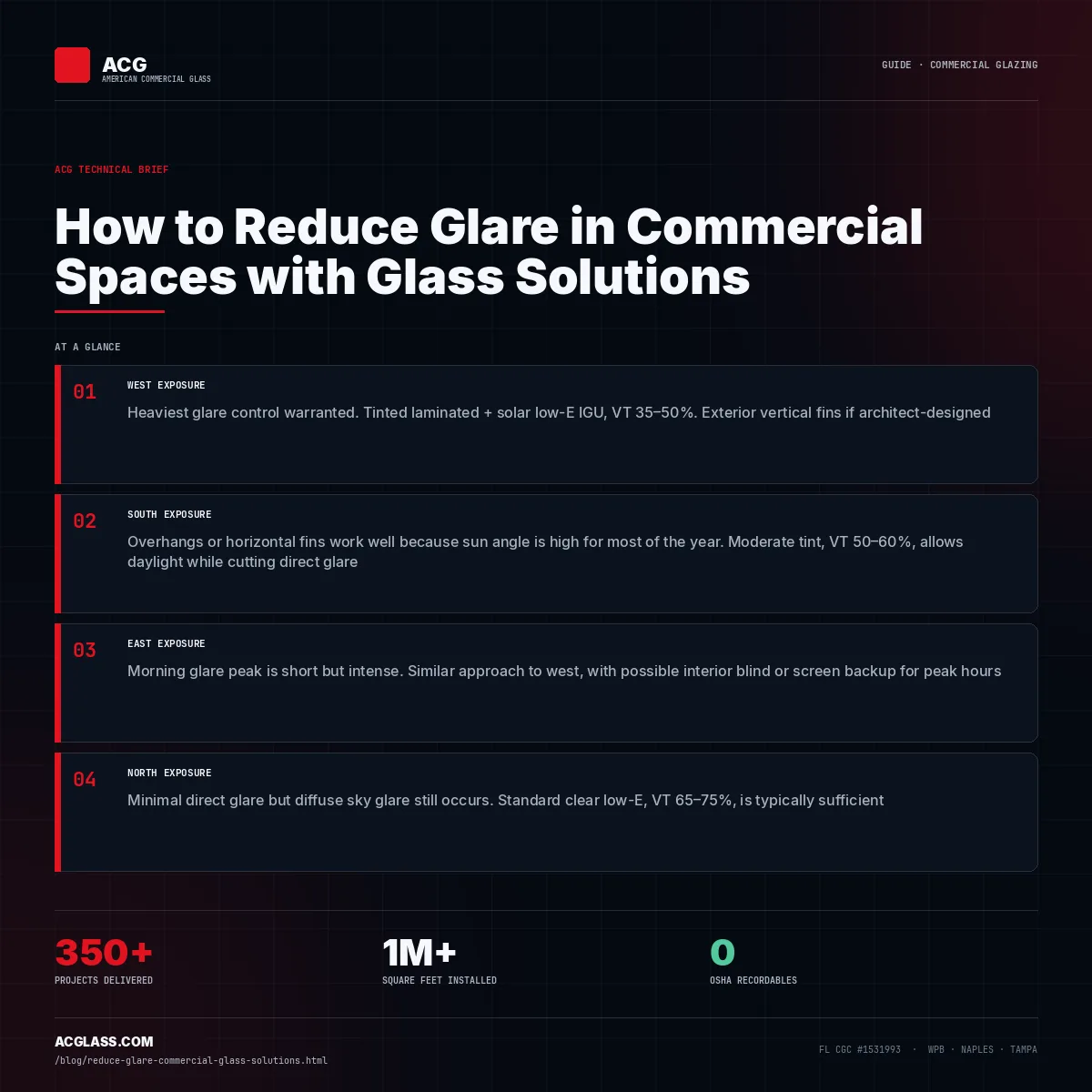
- West exposure: Heaviest glare control warranted. Tinted laminated + solar low-E IGU, VT 35-50%. Exterior vertical fins if architect-designed.
- South exposure: Overhangs or horizontal fins work well because sun angle is high for most of the year. Moderate tint, VT 50-60%, allows daylight while cutting direct glare.
- East exposure: Morning glare peak is short but intense. Similar approach to west, with possible interior blind or screen backup for peak hours.
- North exposure: Minimal direct glare but diffuse sky glare still occurs. Standard clear low-E, VT 65-75%, is typically sufficient.
How This Plays Out on Real Projects
Dale Mabry Retail Tampa used a moderate-tint laminated impact with solar control low-E on the west-facing storefront to control afternoon glare without darkening the sales floor interior. KLUS Lighting Showroom, where the interior is a lighting display, required glass clarity in front of illuminated product - low-iron base with moderate low-E handled both glare and clarity. Illumina Fort Myers combined tinted storefront with exterior architectural features to manage intense Gulf Coast afternoon exposure.
Getting a Spec for Your Project
Glare control starts with a conversation about exposure, tenant use, and design intent. ACG's takeoff process includes glass spec recommendations with VT, SHGC, U-value, and reflectance numbers called out. Send plans through bid.html or contact.html for a line-item proposal. GCs in Tampa, West Palm Beach, and across Florida can have pricing and spec detail inside 48 hours. New construction projects flow through the new construction glazing workflow with full submittal coordination. ACG is CGC-licensed (CGC1531993) and installs ESWindows and other commercial manufacturers. Call (772) 486-7711 to discuss a specific exposure.