
Impact windows are windows engineered and tested to resist hurricane-force debris and wind pressure without breaching the building envelope. In Florida, they are the product of specific physics - laminated glass bonded to a reinforced frame - and specific code language under FBC 2023, ASTM E1886/E1996, and, inside the High-Velocity Hurricane Zone, TAS 201/202/203. This guide defines what impact windows actually are, how they work, what separates a passing product from a failing one, and how commercial systems differ from the residential products most homeowners are familiar with.

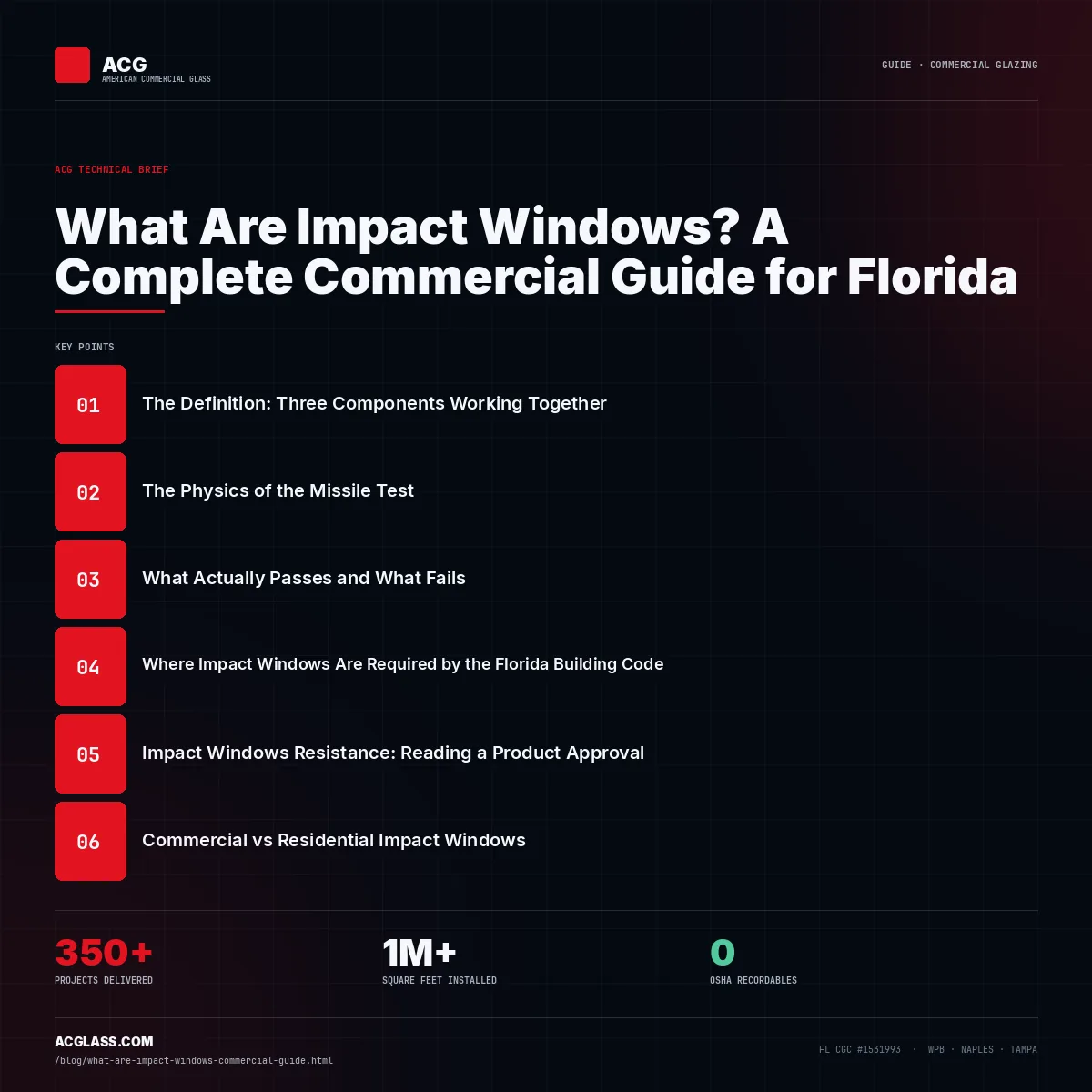
The Definition: Three Components Working Together
An impact window is not a type of glass. It is an assembly - glass, interlayer, frame, and anchor - engineered as a system and tested as a system. A windshield-style laminated lite dropped into an ordinary aluminum frame does not make an impact window. The Florida Product Approval or Miami-Dade Notice of Acceptance is issued on the complete assembly at tested configurations. Change any component, and the approval no longer applies.
The three components that always have to be present:
- Laminated glass - two (or more) glass lites bonded by a polymer interlayer, usually PVB (polyvinyl butyral) or SGP (SentryGlas, ionoplast). The interlayer is the key. When the glass breaks, the interlayer holds the fractured shards in place and keeps the opening covered.
- Reinforced frame - aluminum frames with heavier extrusions, reinforced corners, and, in many commercial products, internal steel or additional aluminum reinforcement at larger spans. The frame transfers wind load from the glass to the building structure.
- Structural glazing bond or mechanical capture - the glass is held in the frame either by structural silicone bond (wet glaze) or by a mechanical capture system with a dry gasket. Both systems are tested as part of the assembly; you cannot substitute one for the other without voiding the approval.
The Physics of the Missile Test
Impact windows earn their approval by passing a physical test that simulates wind-borne debris in a hurricane. The test has two phases.
Phase 1: The Missile
A 2x4 lumber section is fired at the window at a specified velocity. For Large Missile Level D impact - the standard for openings within 30 feet of grade in HVHZ counties - the missile is a 9-lb 2x4 traveling at 50 feet per second. For Small Missile testing, used for openings above 30 feet, ten steel ball bearings are fired in rapid succession. The glass is allowed to crack, but the missile cannot pass through, and the opening cannot be breached.
Phase 2: Cyclic Pressure
After the missile impact, the window - now cracked - is subjected to 9,000 cycles of positive and negative pressure simulating hurricane wind loading. The pressure cycles range across the full design-pressure envelope. If the cracked glass comes loose, the frame deflects out of specification, or the opening loses seal, the product fails.
The combination of missile strike and sustained cyclic pressure is what makes the test meaningful. It simulates what a real hurricane does to a building: a piece of flying debris cracks a window, and then hours of sustained pressure attempt to finish the job by pushing the compromised glass into the building. A passing impact window holds the envelope closed for both events.
What Actually Passes and What Fails
In real testing, the difference between a passing product and a failing one almost always comes down to details in the assembly - not the glass thickness alone.
| Failure Mode | Root Cause |
|---|---|
| Interlayer tear-through after missile | Interlayer too thin or wrong material for span |
| Glass pulled out of frame under cyclic pressure | Inadequate structural silicone bite or mechanical capture depth |
| Frame deflection beyond allowable | Insufficient frame reinforcement for tested DP |
| Anchor pullout from substrate | Incorrect anchor pattern or substrate not matching tested condition |
| Seal failure at glazing pocket | Wrong gasket durometer or improper setting blocks |
This is why installed configuration matters. A product tested with 1/2-inch structural silicone bite passes. The same product installed with 1/4-inch bite fails - even though it is the same window. Impact resistance is a property of the complete, correctly installed assembly.
Where Impact Windows Are Required by the Florida Building Code
FBC 2023 governs opening protection throughout Florida. The requirement to use impact-rated openings (or equivalent protection like tested shutters) depends on location and height:
HVHZ (Miami-Dade and Broward)
All exterior openings must be impact-rated or protected. Products must carry a Miami-Dade NOA tested to TAS 201 (large missile impact), TAS 202 (uniform static air pressure), and TAS 203 (cyclic wind pressure). The HVHZ protocols are stricter than the ASTM equivalents and are the highest hurricane opening standard in the United States.
Wind-Borne Debris Region (Rest of Coastal Florida)
Most of Florida outside HVHZ is in the wind-borne debris region, where design wind speeds exceed 140 mph and opening protection is required. Products must be tested to ASTM E1886 and E1996 and carry a Florida Product Approval. The glazing must be impact-rated or the opening must be covered by tested shutters during a named storm. For commercial occupied buildings, impact glass is almost always the practical choice - shutters are labor-intensive to deploy and leave the building closed during an event.
Outside the Wind-Borne Debris Region
Limited portions of interior Florida fall outside the wind-borne debris region and do not require opening protection. Commercial buildings in these zones can use non-impact glazing, but for longer holds and insurability, impact-rated systems are still frequently specified. For a full breakdown of where code applies, see our Florida commercial glazing hurricane code guide.
Impact Windows Resistance: Reading a Product Approval
When architects specify impact windows, and when GCs submit them for permit, the product approval document is the controlling reference. Understanding the fields on that document is how you confirm that "impact windows resistance" actually covers your project.
Key fields to read on a Florida Product Approval or Miami-Dade NOA:
- Tested design pressures - positive (inward) and negative (outward) DP values in psf. Your project's calculated design pressures cannot exceed these.
- Missile level - Large Missile (Level D) for openings at grade level in wind-borne debris regions, Small Missile for openings at height.
- Maximum tested size - width and height of the most extensive unit tested. Your specified sizes cannot exceed these without additional engineering.
- Glass makeup - specific laminated glass buildup that was tested. Substitutions require engineering review.
- Installation conditions - substrate type, anchor pattern, and anchor embedment depth that were tested.
- Impact and cyclic test references - TAS 201/202/203 for HVHZ, ASTM E1886/E1996 for non-HVHZ.
Commercial vs Residential Impact Windows
Most online guides to impact windows are written for homeowners. Commercial impact glazing is a different product category, specified differently, priced differently, and installed differently.
| Attribute | Residential | Commercial |
|---|---|---|
| Typical lite size | Up to ~60 sq ft | Up to ~120 sq ft per lite, larger with engineering |
| Frame systems | Single-hung, casement, fixed, sliding | Fixed storefront, window wall, curtainwall, entrance systems |
| Design pressure range | DP50 typical | DP50 to DP100+ depending on height and exposure |
| Glass makeup | 1/4" lam, PVB interlayer common | 1/2" to 1" laminated IGU, PVB or SGP interlayer |
| Spec path | Selected from builder options | Division 08 specification with engineered calcs |
| Install method | Single window replacement | Pre-glazed or field-glazed storefront, coordinated with GC schedule |
| Example product | PGT WinGuard, ESWindows residential | ESWindows ES-8000 storefront, ES-9000 window wall |
Commercial projects also carry different installation expectations. Pre-glazed storefront - where the ESWindows frames ship from the factory with glass already installed - is a significant scheduling advantage on commercial work, because it eliminates the field-glazing sequence and compresses the install window. That is why ACG uses ESWindows on most commercial storefront and window wall scopes. For more on the product side, see our impact glass vs laminated glass comparison.
Common Misconceptions About Impact Windows
Even experienced owners and GCs carry a few misconceptions that cost time on commercial projects.
"The glass won't crack"
It will. Impact glass is designed to crack and hold together, not to remain pristine after a missile hit. Cracked impact glass that stayed in its frame and kept the envelope sealed passed the test. It still needs replacement after a storm event, but it did its job.
"All laminated glass is impact glass"
No. Laminated glass is a glass category; impact glass is a tested assembly. Safety laminated glass used for interior guard rails or skylights is laminated, but it is not tested to missile impact standards and carries no Florida Product Approval for exterior use in a wind-borne debris region.
"Impact windows and hurricane shutters do the same job"
Functionally similar, but very different operationally. Shutters protect the glass; impact windows are the glass. Shutters need deployment before a storm and removal after. Impact windows are always deployed. For commercial occupied buildings - retail, office, hospitality - impact windows keep the building operational through storm season. See our impact glass vs shutters guide for the full commercial comparison.
"Impact windows make the building dark"
Modern laminated makeups with low-iron glass and tuned low-E coatings produce visible-light transmission and clarity comparable to non-impact commercial glazing. The days of tinted-blue, darkened impact glass are 15 years behind us.
When to Specify Impact Windows on a Commercial Project
For Florida commercial new construction, the answer is almost always: impact-rated from day one, even if code allows shutters or another path. For existing buildings, the trigger to replace is usually one of: insurance non-renewal on non-impact glazing, a major repositioning, or visible deterioration in the existing system. For context on when replacement pencils, see our commercial impact glass cost guide.
ACG and Commercial Impact Windows in Florida
ACG is a CGC-licensed Florida commercial glazing subcontractor (CGC1531993) headquartered in West Palm Beach. Commercial Division 08 scope, statewide. Our primary impact-rated product partner is ESWindows, whose ES-8000 pre-glazed storefront and ES-9000 window wall systems carry Florida Product Approvals and Miami-Dade NOAs across the full commercial design-pressure range. Recent commercial impact projects include Wave Food Hall (Cocoa Beach), KLUS Lighting (Vero Beach), Baron Shoppes Tradition, and Villa L'Onz (Riviera Beach). Send drawings and we return a Division 08 scope with system recommendations and 2026 pricing inside 48 hours. Call (772) 486-7711 or email connor@acglass.com.
Ready to get started?
ACG is a CGC-licensed Florida commercial glazing subcontractor (CGC1531993) headquartered in West Palm Beach. Commercial Division 08 scope, statewide. Send plans and we return a detailed scope with system recommendations and 2026 pricing inside 48 hours.